
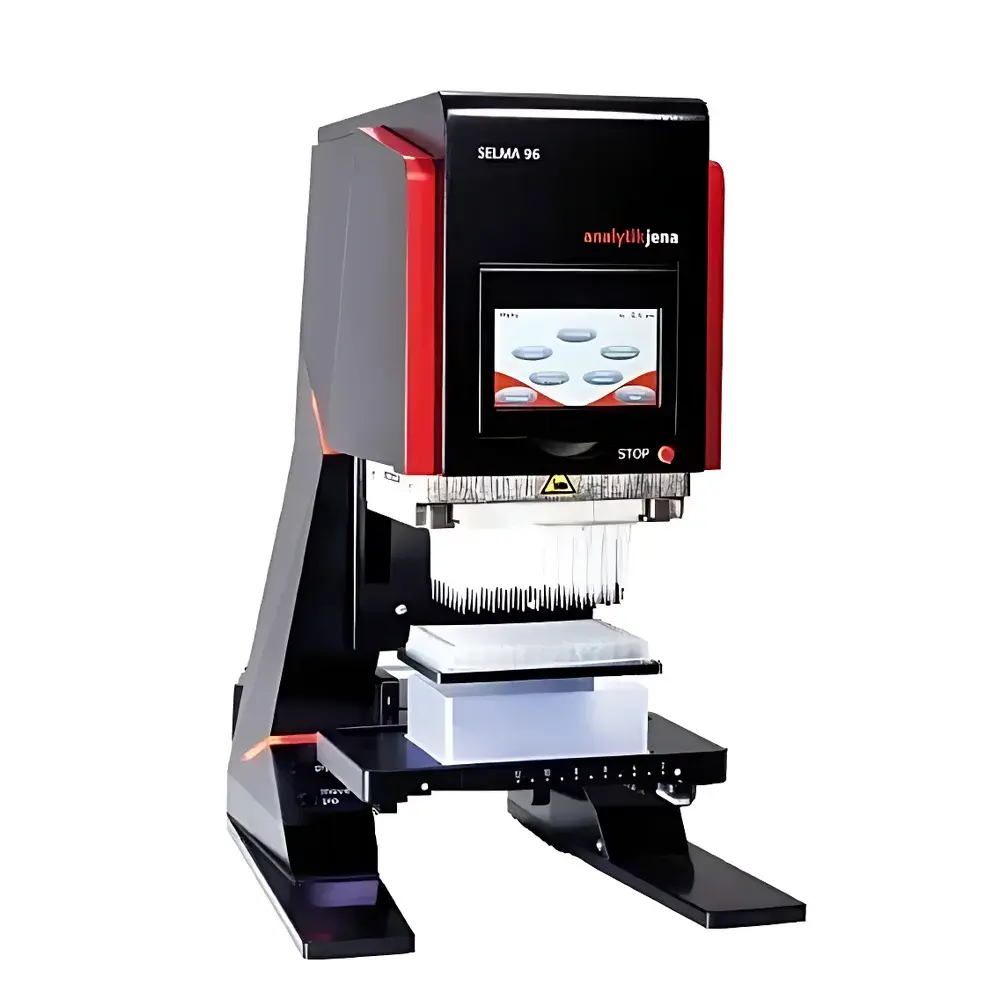
Analytik Jena SELMA® Portable Liquid Handling Workstation
| Brand | Analytik Jena |
|---|---|
| Origin | Germany |
| Manufacturer | Analytik Jena AG |
| Country of Origin | Germany |
| Model | SELMA® |
| Type | Benchtop 96/384-Channel Automated Liquid Handler |
| Dimensions (W×H×D) | 307 × 480–520 × 325 mm |
| Weight | 15–20 kg |
| Display | 3.5-inch color touchscreen (Chinese UI supported) |
| Pipetting Accuracy | ≤1% CV (full range), ≤2–3% CV (low-volume ranges, e.g., 0.5–5 µL) |
| Minimum Dispense Volume | 0.5 µL |
| Maximum Dispense Volume | 1000 µL (96-channel), 60 µL (384-channel) |
| Tip Types | Four for 96-channel (25/60/250/1000 µL) |
| Plate Compatibility | Standard 96-well and 384-well microplates, including PCR plates, assay plates, and deep-well blocks |
| Key Functions | Single-/multi-column dispensing, full-plate transfer, serial dilution, plate reformatting (96↔384), bead-based nucleic acid extraction, wall-touch dispensing, tip washing, mixing, and multi-step aspiration/dispensing with air-gap separation |
Overview
The Analytik Jena SELMA® Portable Liquid Handling Workstation is an engineered solution for precision, reproducible, and contamination-controlled liquid transfer in regulated and non-regulated laboratory environments. Designed around core principles of positive-displacement pipetting and calibrated air-gap aspiration, SELMA® delivers traceable volumetric performance across low-to-mid volume ranges (0.5–1000 µL) without requiring external calibration services or robotic integration. Its compact footprint and modular architecture make it uniquely suited for biosafety level 2 (BSL-2) and BSL-3 workflows—particularly within laminar flow hoods and biological safety cabinets where space, sterility, and operator proximity are critical constraints. Introduced by Analytik Jena AG in 2010 and continuously refined through field deployment in academic, clinical, and industrial labs, SELMA® bridges the gap between manual multichannel pipettes and high-throughput automated platforms—offering GLP-compliant repeatability without infrastructure dependency.
Key Features
- Modular dual-channel configuration: Supports both 96-channel and 384-channel pipetting heads interchangeably on a single base unit, enabling flexible experimental scaling without hardware duplication.
- TipTray™ technology: Enables rapid, sealed-tip loading/unloading with mechanical alignment assurance—reducing aerosol generation and cross-contamination risk during tip exchange.
- Full-range volumetric accuracy: Certified performance across all four 96-channel tips (25/60/250/1000 µL) and two 384-channel tips (25/60 µL), with coefficient of variation (CV) ≤1% at nominal volumes and ≤3% down to 0.5 µL—validated per ISO 8655-6 and ASTM E2758 standards.
- Intuitive 3.5-inch color touchscreen interface: Fully localized Chinese GUI with context-sensitive prompts; supports creation, storage, and recall of >50 user-defined protocols—including gradient dilutions, plate reformatting (96 ↔ 384), magnetic bead handling, and wall-contact dispensing routines.
- Minimalist operational workflow: Only three manual interventions required per run—plate placement, tip tray insertion, and tip ejection—eliminating repetitive wrist motion and inter-operator variability inherent in manual pipetting.
- Robust mechanical architecture: Aluminum-alloy frame with vibration-dampened Z-axis drive ensures positional stability during aspiration from low-volume wells or viscous solutions (e.g., glycerol-containing lysates or serum matrices).
Sample Compatibility & Compliance
SELMA® is validated for use with standard ANSI/SBS-compliant microplates (96- and 384-well), PCR strips, deep-well blocks, and custom assay plates. Its low dead-volume aspiration path and programmable air-gap control support accurate handling of challenging samples—including genomic DNA extracts, cell culture supernatants, whole blood derivatives, and organic solvent mixtures used in LC sample preparation. The system meets essential requirements for Good Laboratory Practice (GLP) and current Good Manufacturing Practice (cGMP) environments: audit-trail-capable protocol logging (with timestamped user ID and parameter sets), electronic signature readiness, and compatibility with FDA 21 CFR Part 11–compliant data management systems when integrated via RS-232 or USB export. It is routinely deployed in applications requiring compliance with ISO/IEC 17025, CLSI EP10-A3, and USP endotoxin testing workflows.
Software & Data Management
SELMA® operates natively on embedded firmware with no PC dependency. All protocols—including multi-step sequences with conditional logic (e.g., “if volume >50 µL, perform double dispense”)—are authored directly on-device. Protocol files include metadata fields for experiment ID, operator name, date/time stamp, and version number. Export options include CSV-formatted execution logs and PDF protocol summaries—both supporting long-term archival and regulatory review. While standalone operation is standard, optional USB host mode permits direct transfer of protocols and logs to LIMS or ELN systems. No proprietary software license or annual maintenance fee is required for basic functionality, ensuring uninterrupted access to validated methods over the instrument’s service life.
Applications
- High-fidelity qPCR and RT-PCR setup—including master mix distribution, template dilution, and no-template control (NTC) replication—with minimized well-to-well carryover.
- ELISA and immunoassay plate coating, blocking, and detection antibody dispensing under sterile cabinet conditions.
- Magnetic bead-based nucleic acid isolation (e.g., plasmid prep, cfDNA enrichment) with programmable wash cycles and elution optimization.
- Toxicity screening in 384-well formats using primary hepatocytes or iPSC-derived cardiomyocytes—leveraging precise sub-microliter dosing for IC50 determination.
- Antibiotic resistance profiling via broth microdilution (CLSI M07-A10), including serial dilution across 12 concentrations in duplicate.
- Pesticide residue analysis sample prep: QuEChERS extract partitioning and LC-MS injection vial filling with volume consistency critical for quantitative accuracy.
- Protein crystallization screening using nanoliter-scale reagent dispensing into sitting-drop plates—enabled by wall-touch mode and low-volume precision.
FAQ
Does SELMA® require external calibration or annual certification?
No. SELMA® is factory-calibrated per ISO 8655-6 and includes built-in self-diagnostic routines. Users may perform optional verification using gravimetric or photometric methods per internal SOPs—but no third-party certification is mandated for routine operation.
Can SELMA® be operated inside a Class II biological safety cabinet?
Yes. At 307 mm wide and ≤520 mm tall, SELMA® fits standard BSC workspaces. Its fanless thermal design and absence of external exhaust ports eliminate airflow disruption, maintaining cabinet integrity during operation.
Is method transfer possible between SELMA® units?
Yes. Protocols are stored in device-independent binary format and can be copied between units via USB flash drive—ensuring identical volumetric behavior across multiple instruments in multi-site labs.
What maintenance is required beyond tip replacement?
Only quarterly cleaning of the tip ejector mechanism and Z-axis guide rails with isopropyl alcohol; no lubrication or alignment tools are needed. The sealed stepper motor assembly requires no scheduled servicing.
Does SELMA® support integration with third-party lab automation systems?
Not natively via API or middleware—but RS-232 output allows basic status signaling (e.g., “run complete”, “error code”) to PLCs or central controllers for semi-automated scheduling in hybrid workflows.



