
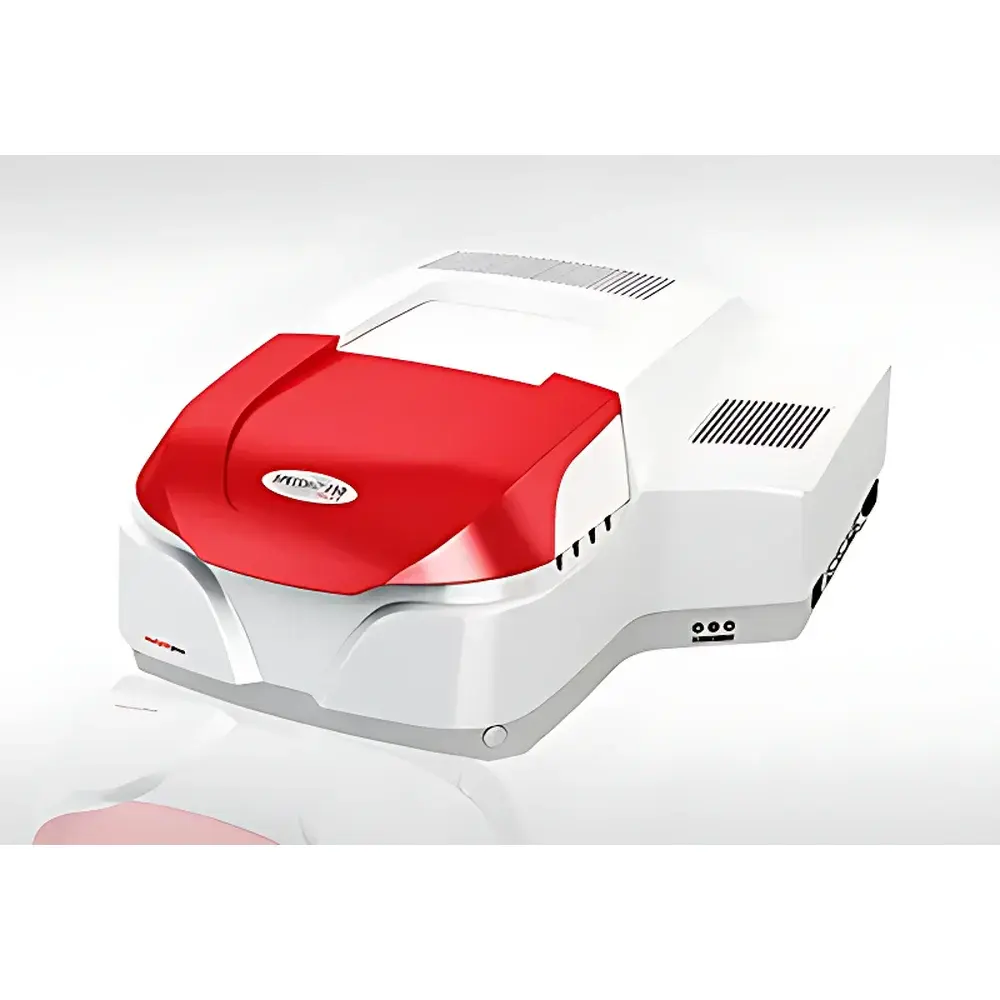
Analytik Jena SPECORD 210 PLUS UV-Vis Spectrophotometer
| Brand | Analytik Jena |
|---|---|
| Origin | Germany |
| Manufacturer | Analytik Jena AG |
| Type | Imported Instrument |
| Model | SPECORD 210 PLUS |
| Optical Design | Double-Beam |
| Detector | Peltier-Cooled CCD Array |
| Wavelength Range | 185–1100 nm |
| Spectral Bandwidth | 0.2, 0.5, 1, 2, and 4 nm (5-step adjustable) |
| Wavelength Accuracy | < ±0.1 nm (entire range) |
| Stray Light | < 0.005% at 340 nm (NaNO₂) |
| Photometric Range | –5 to +5 A |
| Baseline Stability | ≤ 0.0001 A (RMS) |
| Long-Term Drift | ≤ 0.0005 A/h |
| Scan Speed | Up to 12,000 nm/min |
| Wavelength Reproducibility | < ±0.01 nm |
Overview
The Analytik Jena SPECORD 210 PLUS UV-Vis Spectrophotometer is a high-performance, double-beam scanning spectrophotometer engineered for precision quantitative and qualitative analysis across research, quality control, and regulated pharmaceutical environments. Built upon the optical heritage of Carl Zeiss—whose legacy in precision optics underpins all Analytik Jena UV-Vis systems—the instrument integrates a Peltier-cooled CCD array detector with real-time dual-beam optics to deliver exceptional photometric stability, spectral fidelity, and operational robustness. Its 185–1100 nm wavelength coverage spans deep UV through near-infrared, enabling broad-spectrum applications from nucleic acid quantification and protein characterization to pharmaceutical assay development and materials transmittance profiling. The system employs a deuterium lamp for UV and a tungsten-halogen lamp for visible/NIR regions, with fully automated lamp switching governed by software logic to optimize source lifetime and spectral continuity.
Key Features
- Zeiss-engineered optical train—including holographic concave grating, high-reflectivity mirrors, and precision-aligned beam paths—ensures maximum photon throughput and long-term alignment stability.
- Double-beam architecture with real-time reference compensation eliminates baseline drift caused by source intensity fluctuation or detector thermal drift.
- Peltier-cooled CCD detector provides low-noise, high-dynamic-range signal acquisition across the full spectral range without mechanical scanning of the monochromator.
- Five-step adjustable spectral bandwidth (0.2, 0.5, 1, 2, and 4 nm) supports method flexibility—from high-resolution peak discrimination to rapid screening under pharmacopeial compliance (e.g., USP <857>, EP 2.2.25).
- Integrated holmium oxide glass filter enables automated, traceable wavelength calibration with < ±0.1 nm accuracy across the entire 185–1100 nm range.
- Scan speed up to 12,000 nm/min facilitates kinetic monitoring of fast chemical reactions, enzymatic assays, and dissolution profile acquisition in real time.
- Large sample compartment accommodates standard cuvettes (1–100 mm pathlength), solid-sample holders, fiber-optic probes, temperature-controlled cells, and direct integration with dissolution testing apparatuses per USP <711>.
Sample Compatibility & Compliance
The SPECORD 210 PLUS supports liquid, solid, and gaseous samples via interchangeable accessories—including integrating spheres for diffuse reflectance, gas cells with sealed windows, and variable-pathlength flow cells. Its optical design meets ISO/IEC 17025 requirements for measurement uncertainty estimation and is routinely validated against NIST-traceable standards (e.g., SRM 930e, SRM 2034). In regulated environments, the instrument complies with key pharmacopeial specifications: USP <857> (Spectrophotometry and Light-Scattering), EP 2.2.25 (UV-Visible Absorption Spectrophotometry), and JP 6.03 (Ultraviolet and Visible Absorption Spectrophotometry). When operated with compliant software (e.g., SPECORD Software Suite v3.x), audit trails, electronic signatures, and user access controls support adherence to FDA 21 CFR Part 11 and EU Annex 11 requirements for data integrity.
Software & Data Management
The SPECORD Software Suite provides an integrated platform for instrument control, method development, data acquisition, and report generation. It includes pre-validated analytical methods aligned with industry standards—for water quality (APHA 3111B), pharmaceuticals (USP <857>), food analysis (AOAC 973.42), and life sciences (Bradford, Lowry, DNA/RNA A260/A280). The SCS (Self-Check System) performs automated diagnostics on lamp status, detector response, grating positioning, and optical alignment prior to each measurement sequence. All connected accessories—including thermoelectric cells, autosamplers, and dissolution interfaces—are auto-detected and configured. Raw absorbance, transmittance, and derivative spectra are stored in vendor-neutral formats (CSV, ASCII, JCAMP-DX), while PDF and Excel reports can be templated to meet internal SOPs or regulatory submission requirements. Full audit trail logging records user actions, parameter changes, and calibration events with timestamps and operator IDs.
Applications
- Pharmaceutical QC/QA: Active pharmaceutical ingredient (API) assay, excipient identification, dissolution testing, and stability-indicating methods per ICH Q2(R2).
- Clinical & Biomedical Research: Quantification of proteins (BCA, Bradford), nucleic acids (A260/A280 ratio), enzyme kinetics (NADH/NADPH monitoring), and hemoglobin derivatives.
- Environmental Analysis: Nitrate/nitrite detection in drinking water (EPA Method 353.2), COD determination, and heavy metal complexation studies.
- Materials Science: Thin-film thickness calculation via interference fringes, bandgap estimation of semiconductors, and polymer degradation monitoring.
- Food & Beverage: Colorimetric analysis (CIELAB), antioxidant capacity (FRAP/DPPH), and authenticity verification (e.g., honey adulteration via UV fingerprinting).
FAQ
Does the SPECORD 210 PLUS support GLP/GMP-compliant operation?
Yes—when paired with the validated SPECORD Software Suite and configured with role-based user accounts, electronic signatures, and full audit trail functionality, it satisfies core requirements of GLP (OECD Principles) and GMP (FDA 21 CFR Part 11, EU Annex 11).
Can the instrument perform simultaneous multi-wavelength kinetic measurements?
Yes—the CCD array detector acquires full spectra continuously during kinetic runs, enabling time-resolved spectral mapping at user-defined intervals without sequential wavelength stepping.
Is the holmium oxide calibration traceable to national standards?
Yes—the built-in holmium oxide filter is certified to NIST SRM 2034 specifications and enables in-situ wavelength verification without external reference materials.
What maintenance is required for long-term optical performance?
No routine optical alignment is needed due to Zeiss-monolithic optical bench design; annual lamp replacement and biannual detector dark-current verification are recommended per manufacturer guidelines.
How does the double-beam architecture improve measurement reproducibility?
By splitting the light beam into sample and reference paths simultaneously—and measuring both signals concurrently—the system inherently corrects for source intensity drift, detector sensitivity variation, and environmental fluctuations in real time.





