
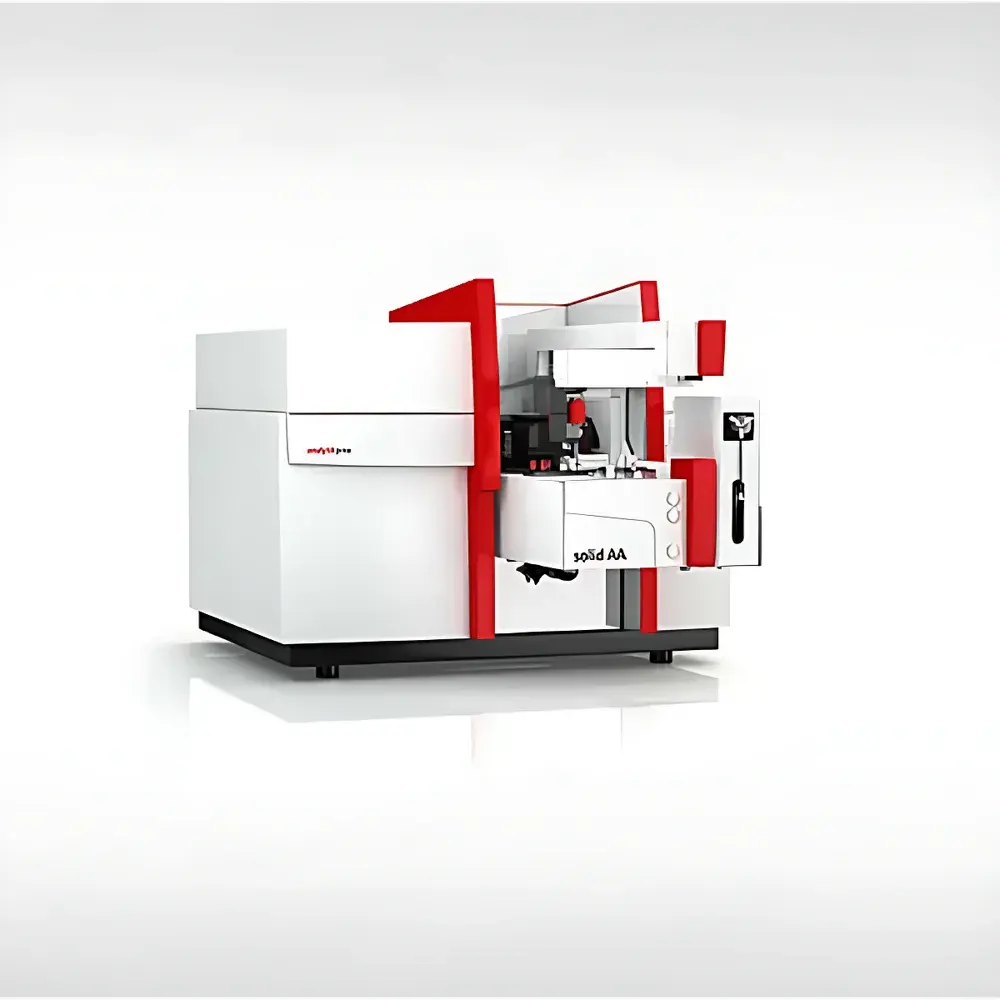
Analytik Jena ZEEnit 650P Zeeman Graphite Furnace Atomic Absorption Spectrometer
| Brand | Analytik Jena |
|---|---|
| Origin | Germany |
| Model | ZEEnit 650P |
| Instrument Type | Graphite Furnace AAS |
| Background Correction | Dual-mode Zeeman (2-field / 3-field / dynamic field) + D₂ lamp |
| Furnace Design | Transversely Heated Graphite Atomizer (THGA) |
| Automation Level | Fully Automated with Integrated Autosampler, 8-Lamp Turret, RFID-enabled Lamp Recognition |
| Sample Introduction | Liquid & Solid (Direct Solid Sampling compatible) |
| Compliance Framework | Designed for GLP/GMP environments |
Overview
The Analytik Jena ZEEnit 650P is a high-performance, transversely heated graphite furnace atomic absorption spectrometer (GF-AAS) engineered for ultra-trace elemental analysis in complex matrices. It operates on the fundamental principle of atomic absorption spectroscopy—where ground-state free atoms in the graphite furnace absorb characteristic radiation emitted by element-specific hollow cathode lamps. The instrument integrates Zeeman-effect background correction as its primary correction method, leveraging magnetic field modulation to distinguish atomic absorption from broad-band spectral interferences (e.g., molecular absorption, light scattering). Unlike conventional deuterium or continuum-source correction, Zeeman correction provides superior accuracy at low absorbance levels (<0.005 AU) and eliminates baseline drift during transient signals—critical for quantifying elements such as Cd, Pb, As, Cr, and Se in environmental, clinical, food, and pharmaceutical samples. The ZEEnit 650P employs a variable-strength magnetic field system capable of operating in 2-field, 3-field, and dynamic field modes, enabling optimization of sensitivity, linear dynamic range (up to 3–4 orders of magnitude), and interference suppression across diverse analyte-matrix combinations.
Key Features
- Transversely Heated Graphite Atomizer (THGA) with integrated L’vov platform and temperature-controlled gas flow—ensuring uniform thermal distribution, reduced memory effects, and improved reproducibility (RSD < 2% at sub-pg levels).
- Dual-background correction architecture: Primary Zeeman correction with tunable magnetic field strength (0–1.2 T), supplemented by optional D₂ lamp correction for verification or specific matrix conditions.
- 8-position automated lamp turret with RFID recognition—enabling seamless switching between coded hollow cathode lamps (HCLs) and high-intensity superlamps, with automatic wavelength and current optimization.
- Intelligent autosampler with programmable dilution, standard addition, and spike recovery protocols—supporting up to 120 sample positions and direct solid micro-sample introduction via optional solid sampling accessories.
- Integrated safety architecture: Real-time furnace temperature monitoring, argon flow validation, overpressure/overheat shutdown, and interlocked optical compartment access—all compliant with IEC 61010-1 safety standards.
- Compact monochromator design with holographic grating (1800 grooves/mm) and thermally stabilized Czerny-Turner optics—delivering spectral resolution < 0.2 nm at 200 nm and stray light < 0.001% at 220 nm.
Sample Compatibility & Compliance
The ZEEnit 650P accommodates liquid samples (aqueous, acidic digests, organic extracts) and solid micro-samples (≤ 10 mg), including soils, tissues, polymers, and alloys—without mandatory acid digestion when used with the Direct Solid Sampling (DSS) module. Its Zeeman correction enables reliable quantification in high-salt, high-viscosity, or suspended particulate matrices where conventional AAS fails. The system conforms to key international analytical standards, including ASTM D3695 (trace metals in water), ISO 11171 (elemental impurities in fuels), USP / (elemental impurities in pharmaceuticals), and EN 14802 (heavy metals in sludge). Software functionality supports full audit trail generation, electronic signatures, and role-based user permissions aligned with FDA 21 CFR Part 11 and EU Annex 11 requirements for regulated laboratories.
Software & Data Management
Operation is managed via the jAAS software suite—a Windows-based platform supporting method development, sequence programming, real-time signal visualization, and multi-point calibration (linear, quadratic, weighted least-squares). All instrument parameters—including ramp/hold temperatures, gas flow profiles, lamp currents, and magnetic field settings—are stored with metadata (operator ID, timestamp, version) in encrypted project files. Data export complies with ASTM E1382 and ASTM E1461 formats for LIMS integration. Batch reporting includes uncertainty estimation per ISO/IEC 17025 guidelines, and raw signal traces are retained for reprocessing without data loss. Remote diagnostics and firmware updates are supported via secure HTTPS protocol.
Applications
The ZEEnit 650P is routinely deployed in accredited environmental labs for EPA Method 200.9 compliance (Cd, Pb, Ni, Cu in drinking water); in clinical toxicology for blood Pb and urinary Cd screening per CLIA and CAP guidelines; in food safety testing for As speciation support (after hydride generation coupling); and in battery material R&D for Li, Co, Ni, and Mn quantification in cathode slurries. Its solid-sampling capability accelerates quality control in metallurgy and catalyst manufacturing, reducing turnaround time from hours to minutes while eliminating digestion-related contamination risks.
FAQ
What distinguishes Zeeman background correction from deuterium correction?
Zeeman correction uses magnetic field-induced splitting of atomic absorption lines to separate analyte signal from broadband background—providing higher specificity and lower detection limits than continuum-source methods.
Can the ZEEnit 650P analyze mercury without cold vapor generation?
No—Hg analysis requires coupling with a dedicated cold vapor AAS module or hydride generation system; the ZEEnit 650P’s graphite furnace is optimized for non-volatile and semi-volatile elements.
Is method transfer possible from older ZEEnit models?
Yes—jAAS software maintains backward compatibility with method files from ZEEnit 600/700 series, including furnace programs, calibration curves, and background correction settings.
Does the system support regulatory audit readiness out-of-the-box?
Yes—audit trail logging, user authentication, electronic signature capture, and data integrity safeguards are enabled by default and configurable per laboratory SOPs.
What maintenance intervals are recommended for the graphite furnace?
Graphite tubes require replacement every 200–500 firings depending on matrix load; platform cleaning is advised after every 50 analyses; annual performance verification per ISO/IEC 17025 is recommended.
Related Products




