
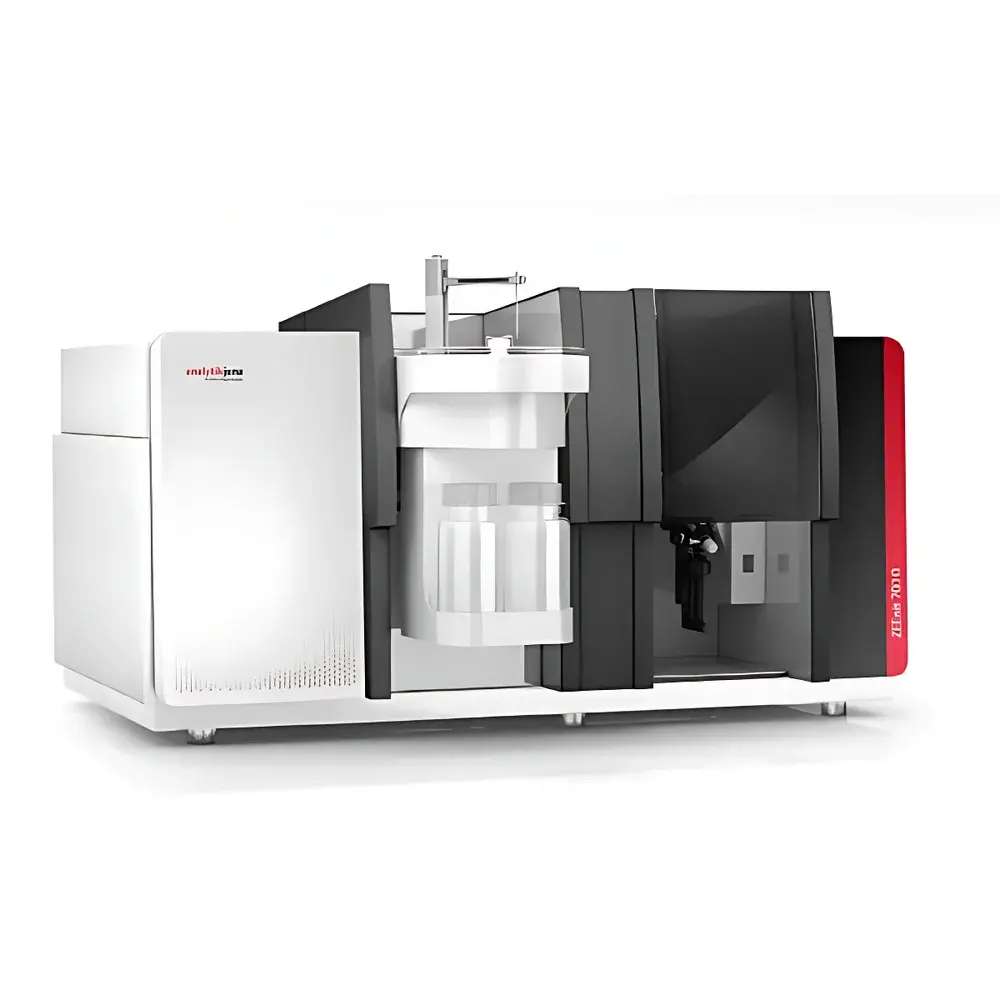
Analytik Jena ZEEnit 700Q Flame and Graphite Furnace Atomic Absorption Spectrometer
| Brand | Analytik Jena |
|---|---|
| Origin | Germany |
| Model | ZEEnit 700Q |
| Instrument Type | Flame and Graphite Furnace AAS |
| Background Correction | Zeeman-effect with tunable magnetic field (2-field / 3-field / dynamic mode) + D₂ lamp |
| Automation Level | Fully automated flame and GF-AAS operation |
| Sample Introduction | Auto-sampler with intelligent dilution, 8-position encoded lamp turret with RFID support |
| Solid Sampling Option | Optional direct solid analysis module |
Overview
The Analytik Jena ZEEnit 700Q is a dual-mode atomic absorption spectrometer engineered for high-precision elemental quantification across trace to major concentration levels in complex, matrix-rich samples. It integrates flame AAS (FAAS) and electrothermal graphite furnace AAS (GFAAS) within a single optical platform, leveraging transversely heated graphite tube (THGA) technology and advanced Zeeman-effect background correction. Unlike conventional deuterium or continuum-source correction methods, the ZEEnit 700Q employs a programmable permanent magnet system capable of precise magnetic field modulation—operating in 2-field, 3-field, or dynamic Zeeman modes—to maximize analytical sensitivity while extending linear dynamic range up to four orders of magnitude. This architecture ensures robust discrimination of structured molecular absorption and scattering interferences, particularly critical for environmental digests, biological tissues, geological leachates, and industrial process streams where spectral overlap and non-specific absorption are prevalent.
Key Features
- Transversely Heated Graphite Atomizer (THGA) with integrated temperature control and real-time power feedback for reproducible atomization kinetics and minimized memory effects.
- Tunable Zeeman background correction system: selectable 2-field (static), 3-field (symmetric), or dynamic field modulation—optimized per element and matrix to balance sensitivity, precision, and interference rejection.
- Dual-background correction redundancy: simultaneous Zeeman and D₂ lamp correction enables method validation and cross-verification under regulatory audit conditions.
- Full automation suite: 8-position motorized lamp turret with RFID recognition for coded hollow cathode lamps (HCLs) and ultra-high-intensity superlamps; intelligent auto-dilutor with programmable dilution factors (1:2 to 1:100); and integrated flame gas control with safety interlocks.
- Modular solid sampling compatibility: optional direct solid analysis (DSA) attachment allows microgram-scale solid sample introduction without acid digestion—reducing contamination risk, labor, and reagent consumption while preserving volatile elements.
- Compact monochromator design with holographic grating (1800 grooves/mm) and thermally stabilized optics, delivering <0.15 nm spectral bandwidth and long-term wavelength stability (<±0.002 nm over 8 h).
Sample Compatibility & Compliance
The ZEEnit 700Q accommodates aqueous solutions, organic solvents (with appropriate nebulizer and burner head configuration), suspended particulates (via ultrasonic homogenization), and certified reference materials (CRMs) across ISO/IEC 17025-accredited laboratories. Its Zeeman correction performance meets ASTM D4294 (petroleum), EPA Method 200.9 (drinking water), and ISO 11885 (wastewater) requirements for multi-element trace metal determination. The instrument’s firmware and software architecture support full GLP/GMP compliance—including electronic signatures, audit trails, user access levels, and 21 CFR Part 11–compliant data integrity controls when deployed with optional security packages.
Software & Data Management
Control and data acquisition are managed via the instrument-native ASpect software, a Windows-based application compliant with IEC 62443-3-3 cybersecurity standards. ASpect provides method wizards for flame and furnace optimization (including pyrolysis/atomization temperature ramping), automatic calibration curve fitting (linear, quadratic, and weighted least-squares), and QC monitoring (spike recovery, duplicate analysis, drift correction). Raw absorbance/time profiles, peak area/height integration, and background-subtracted signals are stored in vendor-neutral ASCII format. Export modules support LIMS integration via ASTM E1384-compliant XML schema and direct connectivity to enterprise chromatography data systems (CDS) via OPC UA protocol.
Applications
The ZEEnit 700Q is routinely deployed in environmental testing labs for Pb, Cd, As, and Hg in soil extracts and municipal effluents; in clinical chemistry for Cu, Zn, and Se in serum and whole blood; in food safety for Ni and Cr migration from packaging; and in metallurgical QA/QC for residual Al, Mg, and Ti in high-purity alloys. Its dual-mode capability eliminates instrument switching between routine FAAS screening (e.g., Ca, Mg, Na in beverages at ppm levels) and confirmatory GFAAS quantification (e.g., sub-ppt Cd in semiconductor-grade chemicals), thereby reducing operational downtime and cross-contamination risk.
FAQ
What is the difference between Zeeman and D₂ background correction in the ZEEnit 700Q?
Zeeman correction uses magnetic field-induced splitting of atomic absorption lines to distinguish atomic from broadband background absorption, offering superior specificity for structured interferences. D₂ correction measures total absorption at adjacent wavelengths and subtracts it—effective for smooth background but less reliable for sharp molecular bands.
Can the ZEEnit 700Q analyze solid samples without digestion?
Yes—when equipped with the optional Direct Solid Analysis (DSA) module, it enables laser-assisted or graphite probe-based introduction of mg-scale solids (e.g., polymers, catalysts, plant tissue), eliminating wet digestion while maintaining detection limits comparable to solution-based GFAAS.
Is the instrument compatible with regulatory data integrity requirements?
Yes—the ASpect software supports role-based user authentication, immutable audit trails, electronic signatures, and 21 CFR Part 11–compliant electronic records when configured with validated security settings and time-stamped digital certificates.
How does the tunable magnetic field improve analytical performance?
Adjusting field strength optimizes the Zeeman splitting magnitude per element, allowing users to maximize signal-to-noise ratio for low-abundance analytes (e.g., Tl in seawater) while minimizing self-absorption effects for high-concentration elements (e.g., Fe in steel digests).
Related Products





