
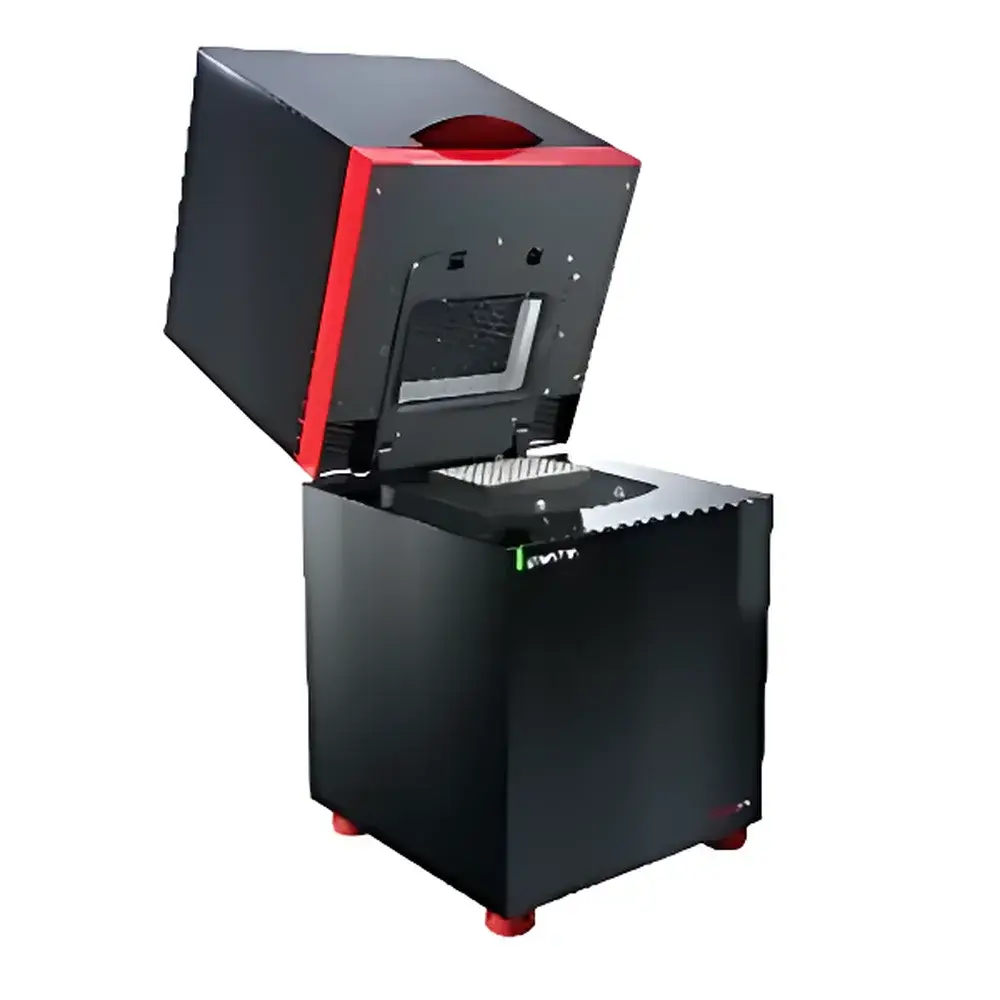
analytikjena qTOWER384G Real-Time Fluorescence Quantitative PCR System
| Brand | analytikjena |
|---|---|
| Origin | Shanghai, China |
| Manufacturer Type | Authorized Distributor |
| Product Category | Domestic (China-manufactured) |
| Model | qTOWER384G |
| Instrument Type | Real-Time Fluorescence Quantitative PCR System |
| Sample Throughput | 384-well format |
| Maximum Heating Rate | 4 °C/s |
| Temperature Accuracy | ±0.1 °C |
| Well-to-Well Temperature Uniformity | ±0.15 °C |
| Optical Configuration | 6-channel excitation/emission system (field-upgradable from 1–6 channels) |
| Filter Sets | 12 interchangeable excitation/emission filter combinations, including FRET-optimized and protein melting-specific configurations |
| Light Source | RGBW solid-state LEDs (blue, green, red, white) with uniform spectral intensity, zero thermal emission, >50,000 h lifetime |
| Detector | High-sensitivity channel-type photomultiplier tube (PMT) |
| Detection Method | 16-channel fiber-optic scanning (16 wells simultaneously), ROX-free operation with optional passive reference correction |
| Sensitivity | Single-copy DNA detection |
| Dynamic Range | 10 logs (10¹–10¹¹ copies) |
| Recommended Reaction Volume | 2–30 µL |
| Thermal Gradient | 24-column linear temperature gradient (enables precise annealing optimization) |
| Thermal Block | Peltier-based, corrosion-resistant, high-thermal-conductivity alloy |
| Heat Lid | 110 °C maximum, auto-adjusting pressure (up to 30 kg/plate), height compensation |
| Software | qPCRsoft — quantitative analysis, dual standard curve, ΔΔCt with amplification efficiency modeling, melting curve analysis, SNP/allelic discrimination, endpoint genotyping, efficiency calculation, MIQE-compliant reporting, LIMS integration (via USB), GLP/GMP-ready audit trail (optional configuration), unlimited installations, lifetime free updates |
| Acoustic Noise Level | ≤45 dB(A) |
| Compliance | Designed and validated per ISO 13485 principles |
Overview
The analytikjena qTOWER384G is a purpose-built real-time fluorescence quantitative PCR system engineered for high-throughput, high-fidelity nucleic acid quantification in regulated and research-intensive environments. Unlike retrofitted conventional PCR platforms, the qTOWER384G features an integrated optical-thermal architecture optimized exclusively for quantitative applications. Its core measurement principle relies on synchronous detection of fluorescent signal accumulation during exponential amplification—using SYBR Green, hydrolysis probes (TaqMan), molecular beacons, or FRET-based chemistries—coupled with precise kinetic thermal control across all 384 reaction positions. The system employs a six-channel optical engine with field-upgradable configuration, enabling laboratories to scale detection capability without hardware replacement. This design ensures long-term adaptability to evolving assay multiplexing requirements while maintaining metrological traceability across instrument generations.
Key Features
- Six-channel modular optical system: Configurable from 1 to 6 detection channels in situ; no service intervention required for future upgrades.
- Twelve interchangeable excitation/emission filter sets: Includes dedicated configurations for FRET-based assays (e.g., probe mismatch detection) and protein thermal shift analysis (Tm profiling), extending utility beyond nucleic acid applications.
- RGBW solid-state LED illumination: Four independent, thermally stable light sources deliver uniform photon flux across 450–720 nm, eliminating lamp degradation, heat-induced well distortion, and recalibration cycles.
- Channel-type photomultiplier tube (PMT) detection: Provides low-noise, high-gain signal acquisition with superior signal-to-background ratio versus CCD or CMOS alternatives—critical for low-abundance target detection.
- 16-channel fiber-optic scanning: Simultaneous acquisition from 16 wells per cycle reduces total run time without compromising data integrity; eliminates need for ROX normalization under standard conditions.
- 24-column linear thermal gradient: Enables empirical determination of optimal annealing temperature across a single run—essential for primer validation, assay development, and robustness testing per ICH Q5B and ISO/IEC 17025 guidelines.
- Peltier-based thermal module: Constructed from aerospace-grade corrosion-resistant alloy with enhanced thermal conductivity; maintains ±0.15 °C well-to-well uniformity and ±0.1 °C absolute accuracy over full 4–99 °C range.
- Intelligent heat lid: Self-calibrating pressure mechanism applies consistent 30 kg force per plate; programmable up to 110 °C to prevent evaporation in low-volume reactions (2–30 µL).
Sample Compatibility & Compliance
The qTOWER384G accepts standard ANSI/SBS-compliant 384-well PCR plates—including skirted, semi-skirted, and low-profile formats—as well as compatible optical seals. Its thermal and optical calibration protocols are traceable to NIST-traceable reference standards. While manufactured in Shanghai under analytikjena’s global quality management system (ISO 13485 certified), the instrument meets essential performance criteria aligned with CLSI EP17-A2 for limit of detection verification and ISO 20387 for biobanking applications. When operated with qPCRsoft’s audit trail module enabled and integrated into validated network infrastructure, the system supports compliance with FDA 21 CFR Part 11 (electronic records/signatures), EU Annex 11, and GLP/GMP documentation requirements—including user access control, change history logging, and electronic signature workflows.
Software & Data Management
qPCRsoft is a CE-marked, standalone Windows application offering full experimental control, real-time monitoring, and post-run analysis. It implements MIQE (Minimum Information for Publication of Quantitative Real-Time PCR Experiments) reporting templates—automatically generating structured PDF reports with metadata, amplification plots, melt curves, Ct tables, efficiency calculations, and statistical confidence intervals. The software natively exports CFX, RDML, and CSV formats for third-party statistical packages (e.g., R/Bioconductor, GraphPad Prism). LIMS connectivity is achieved via standardized USB HID protocol; custom API integration is supported through documented COM interface. All licenses are perpetual and transferable; updates—including new analysis algorithms and regulatory feature packs—are delivered at no additional cost for the instrument’s operational lifetime.
Applications
The qTOWER384G serves core functions across clinical diagnostics (viral load monitoring, MRD assessment), pharmaceutical QC (plasmid titer verification, residual host cell DNA quantification), academic research (gene expression profiling, CRISPR editing efficiency, miRNA quantification), and food/environmental testing (pathogen detection, GMO screening). Its 10-log dynamic range and single-copy sensitivity support absolute quantification of rare transcripts or circulating tumor DNA. The inclusion of protein-melting filter sets permits parallel thermal stability assays for antibody-antigen interactions or ligand-binding studies—making it a dual-purpose platform for nucleic acid and biophysical characterization workflows.
FAQ
Is the qTOWER384G manufactured in Germany or China?
The qTOWER384G is produced in analytikjena’s Shanghai manufacturing facility under strict adherence to the company’s global quality management system (ISO 13485), with final calibration and firmware validation performed per German engineering specifications.
Can the instrument perform digital PCR or endpoint PCR?
No—it is exclusively designed for real-time fluorescence-based quantitative PCR. It does not support droplet generation, chip-based partitioning, or non-fluorescent endpoint detection modes.
Does the software meet FDA 21 CFR Part 11 requirements out-of-the-box?
qPCRsoft includes configurable audit trail, electronic signature, and role-based access modules. Full Part 11 compliance requires implementation of institutional IT policies (e.g., password complexity, session timeout, backup protocols) and procedural validation per organizational SOPs.
What maintenance is required beyond routine cleaning?
The RGBW LED light source and PMT detector are rated for >50,000 hours with no scheduled replacement. Annual optical alignment verification and thermal calibration using NIST-traceable references are recommended for GLP/GMP environments.
Is remote monitoring or cloud data export supported?
Local network sharing and scheduled automated report export to network drives are supported. Cloud upload requires customer-deployed secure gateway infrastructure; analytikjena does not operate or host cloud services for raw qPCR data.



