
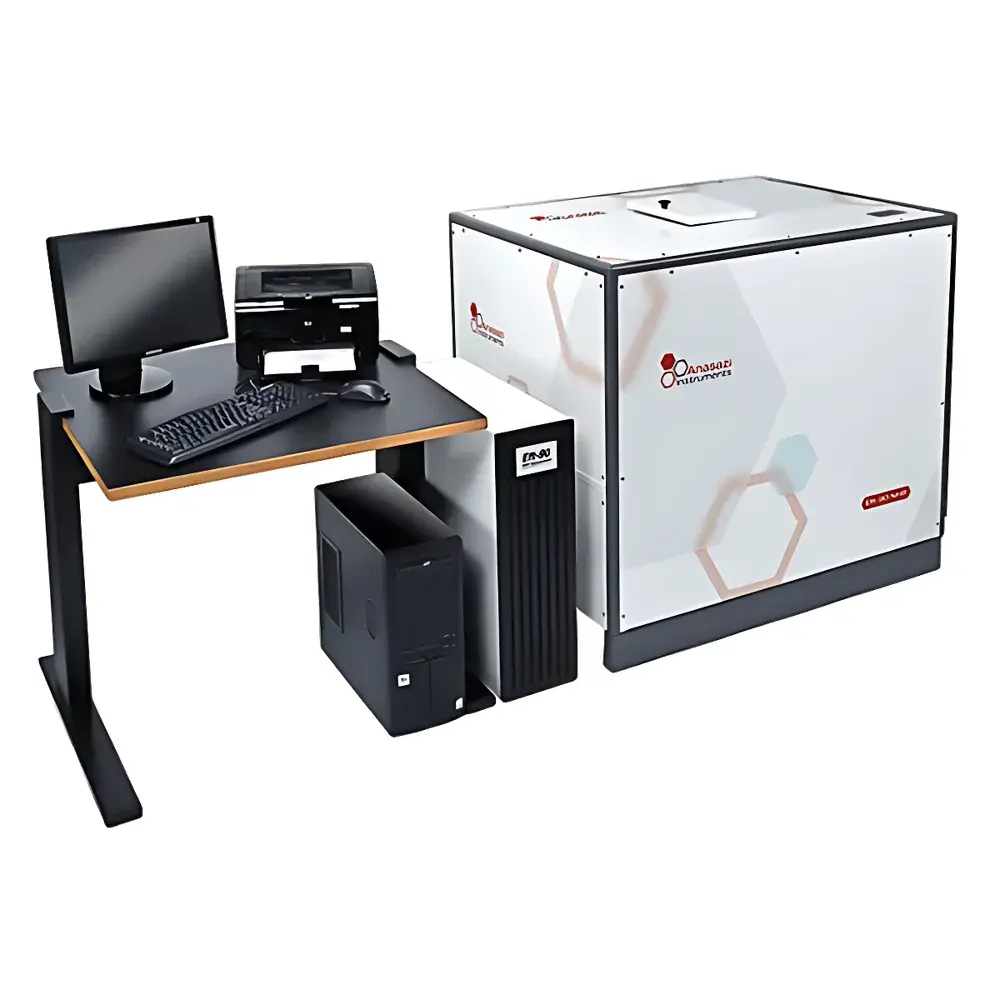
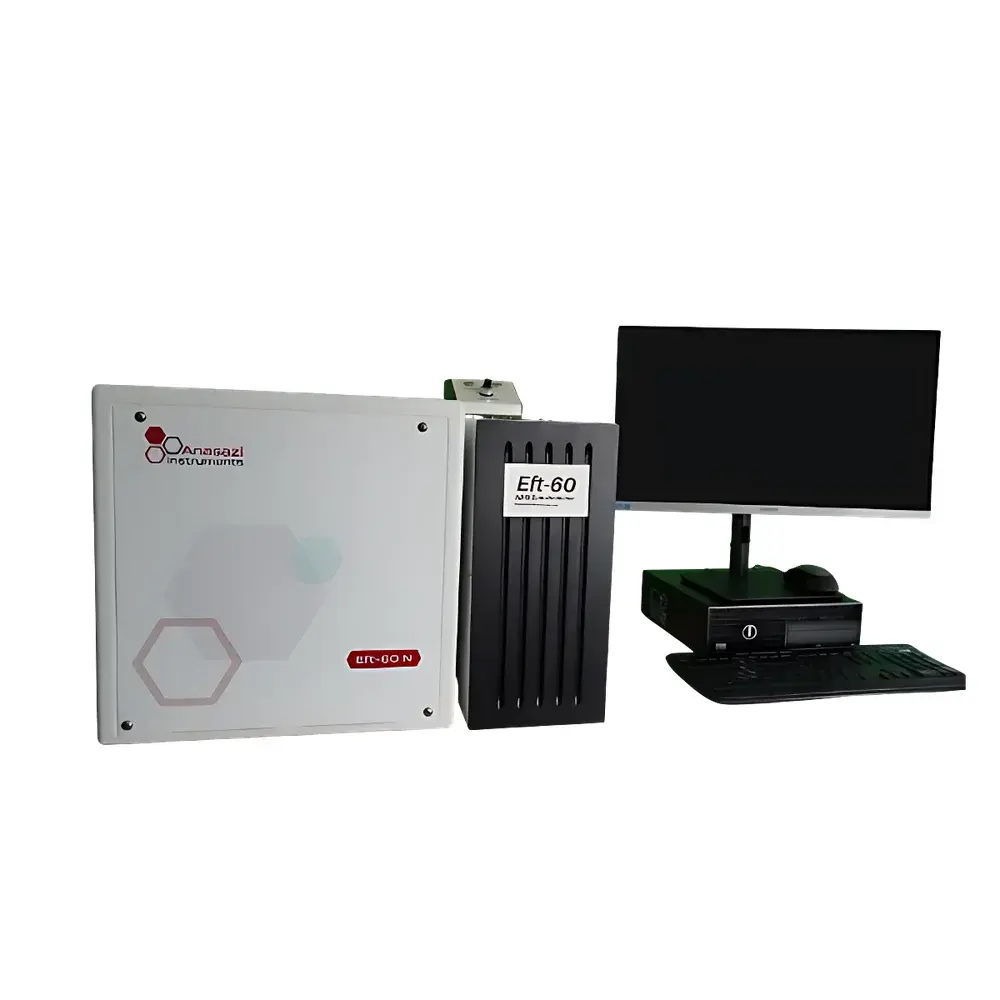
Anasazi EFT-60/EFT-90 Benchtop Permanent-Magnet Nuclear Magnetic Resonance Spectrometer
| Brand | Anasazi |
|---|---|
| Origin | USA |
| Model | EFT-60, EFT-90 |
| Operating Frequency | 60 MHz / 90 MHz |
| Sample Type | Liquid |
| Measurement Principle | Pulsed Fourier Transform NMR |
| Magnet Type | AlNiCo Permanent Magnet |
| ¹H Resolution | < 0.5 Hz |
| Sensitivity | < 0.001 mmol/L (for ¹H, standard sample) |
| Supported Nuclei | ¹H, ¹³C, ¹⁹F, ³¹P, ²³Na, ⁵⁹Co, ²⁹Si, and other quadrupolar/low-γ nuclei |
| Software Platform | EFT-NMR Console v4.x |
| Compliance | ASTM E2857, ISO/IEC 17025 (method validation support), GLP-ready audit trail logging |
Overview
The Anasazi EFT-60 and EFT-90 are compact, permanent-magnet benchtop nuclear magnetic resonance (NMR) spectrometers engineered for routine structural elucidation, reaction monitoring, and quantitative analysis in academic laboratories, teaching facilities, and industrial R&D environments. Unlike conventional superconducting NMR systems requiring cryogenic liquid helium and nitrogen, the EFT series utilizes a high-stability AlNiCo permanent magnet—eliminating dependency on cryogens while maintaining field homogeneity sufficient for high-fidelity ¹H and multinuclear spectroscopy. The instruments operate on pulsed Fourier transform (PFT) methodology, delivering time-domain free induction decay (FID) acquisition followed by digital signal processing to generate frequency-domain spectra with sub-Hertz linewidths. With nominal operating frequencies of 60 MHz and 90 MHz (corresponding to ~1.41 T and ~2.11 T static fields, respectively), these systems bridge the performance gap between low-field educational tools and high-field research platforms—enabling robust ¹H, COSY, HETCOR, DEPT, T₁/T₂ relaxation, and kinetics experiments without infrastructure overhead.
Key Features
- Zero-cryogen operation: No liquid helium or liquid nitrogen required—reducing annual operational costs by approximately USD $10,000 per instrument and eliminating supply-chain dependencies.
- Thermally stabilized permanent magnet: AlNiCo alloy core with integrated active temperature regulation ensures field drift < 0.1 Hz/hour over ambient fluctuations (15–30 °C), enabling reproducible long-term acquisitions.
- Broadband multinuclear capability: Dual-channel RF architecture supports simultaneous or sequential excitation/detection across ¹H, ¹³C, ¹⁹F, ³¹P, ²³Na, ⁵⁹Co, ²⁹Si, and other NMR-active nuclei via software-selectable probe tuning.
- Integrated vibration damping and passive thermal shielding: Robust mechanical design permits stable operation on standard laboratory benches—even in shared spaces with HVAC cycling or foot traffic.
- Real-time spectral visualization and parameter adjustment: Operator-guided pulse sequence editing, automatic shimming feedback, and live FID preview reduce training time; undergraduate students routinely acquire and process ¹H, COSY, and HETCOR data independently.
- Modular hardware configuration: Standard ¹H-only system expandable to dual-channel ¹H/¹³C, ¹H/¹⁹F, or custom multi-nucleus setups—scalable to evolving research needs without full-system replacement.
Sample Compatibility & Compliance
The EFT-60/EFT-90 accepts standard 5 mm outer-diameter NMR tubes (Wilmad 528-PP or equivalent) and accommodates aqueous, organic, and mixed-solvent samples. Viscosity tolerance extends up to ~10 cP; deuterated solvents (e.g., CDCl₃, DMSO-d₆) are recommended for lock-free ¹H referencing and solvent suppression. All pulse sequences—including inversion-recovery (T₁), CPMG (T₂), BAPR peak registration, segmented averaging, and solvent-presaturation—are implemented in accordance with IUPAC NMR nomenclature guidelines. Data integrity meets GLP and GMP documentation requirements: raw FIDs and processed spectra retain embedded metadata (timestamp, operator ID, pulse sequence name, acquisition parameters); audit trails log all processing steps per FDA 21 CFR Part 11 principles when paired with validated network storage configurations. Method validation protocols align with ASTM E2857 (Standard Guide for Validation of NMR Quantitative Methods) and ISO/IEC 17025 clause 7.2.2 for analytical method verification.
Software & Data Management
EFT-NMR Console v4.x provides an integrated environment for instrument control, sequence programming, real-time processing, and reporting. The GUI supports drag-and-drop pulse sequence assembly, customizable macro scripting (Python API), and batch processing of multi-sample datasets. Spectral processing includes zero-filling, exponential line-broadening, phase correction, baseline flattening, and peak integration with uncertainty estimation. Export formats include JCAMP-DX (.jdx), NMR-Data-Exchange XML, CSV, PNG, and PDF—ensuring compatibility with third-party cheminformatics platforms (e.g., MestReNova, ACD/Labs, ChemDraw). Raw data files are stored in vendor-neutral HDF5 format with embedded calibration coefficients and hardware configuration snapshots—facilitating long-term archival and reprocessing under updated algorithms.
Applications
These spectrometers serve as primary analytical tools in synthetic organic chemistry, natural product isolation, pharmaceutical formulation QC, polymer characterization, and undergraduate pedagogy. Documented use cases include: structural confirmation of novel heterocycles (J. Med. Chem. 2013, 56, 889); stereochemical assignment of terpenoids via ¹H–¹³C HETCOR (J. Nat. Prod. 2014, 77, 2321); quantification of residual solvents in APIs (ACS Appl. Mater. Interfaces 2011, 3, 4262); kinetic profiling of ester hydrolysis using real-time ¹H monitoring; and ²⁹Si NMR of organosilicon catalysts (Chem. Phys. Lipids 2009, 158, 10). Over 700 installations across 25+ countries—including Columbia University, Purdue, University of Texas, Tsinghua University, and Sun Yat-sen University—demonstrate robustness in diverse environmental and operational contexts.
FAQ
Does the EFT require cryogens or external cooling?
No. The AlNiCo permanent magnet operates at ambient temperature with internal thermoelectric stabilization—no liquid helium, liquid nitrogen, or chiller units are needed.
Can I run 2D experiments like COSY or HETCOR on the EFT-60?
Yes. Both EFT-60 and EFT-90 support 2D NMR including COSY, TOCSY, HETCOR, and DEPT—all implemented via phase-cycled PFT acquisition with user-adjustable t₁ increments and coherence selection gradients.
What is the typical ¹H lineshape and resolution achievable?
Under standard conditions (CDCl₃, 25 °C, 16 scans), ¹H linewidths ≤ 0.45 Hz (full width at half maximum) are routinely observed for tetramethylsilane (TMS) reference, meeting ASTM E2857 resolution criteria for quantitative applications.
How is data security and regulatory compliance addressed?
The software supports role-based access control, electronic signatures, and immutable audit logs. When deployed on validated IT infrastructure, it satisfies FDA 21 CFR Part 11 and EU Annex 11 requirements for electronic records and signatures.
Is technical support and method development assistance available globally?
Yes. Anasazi maintains direct engineering support channels in North America, Europe, and Asia-Pacific, with application specialists providing remote pulse sequence optimization, spectral interpretation training, and method transfer services.




