
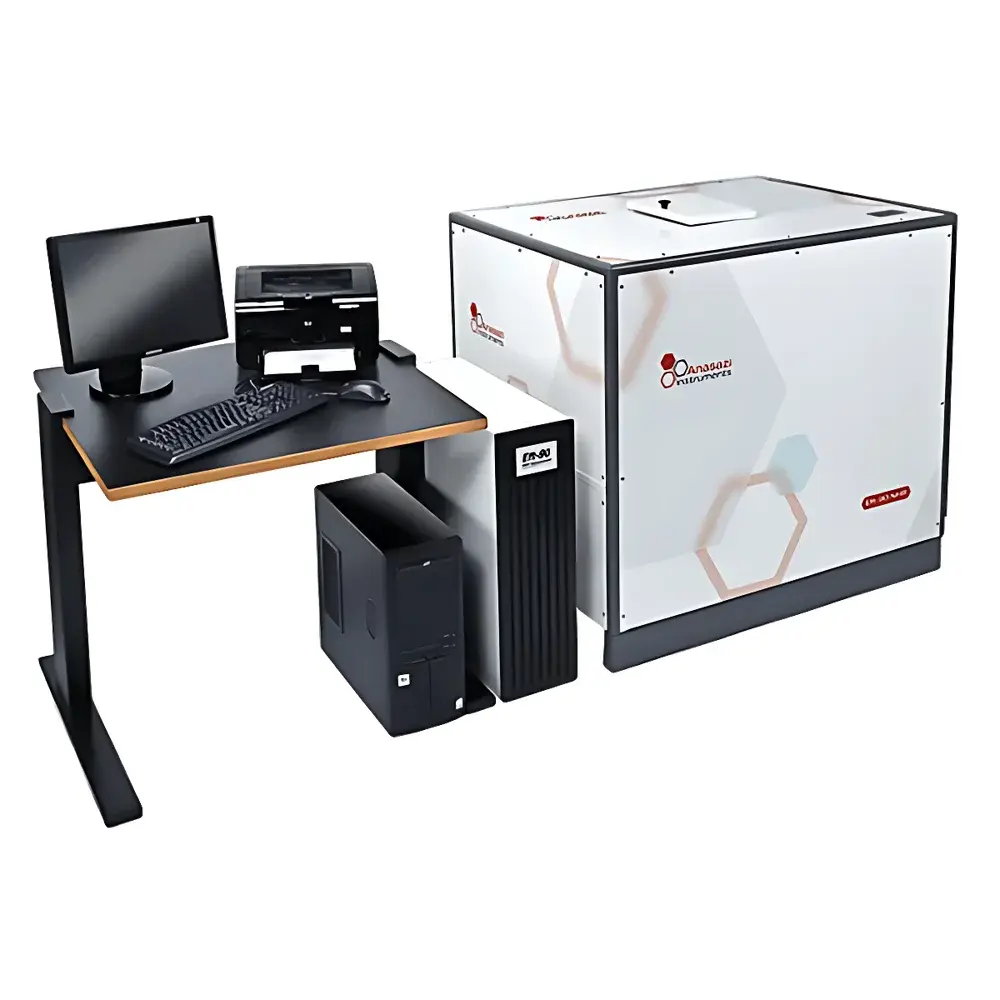
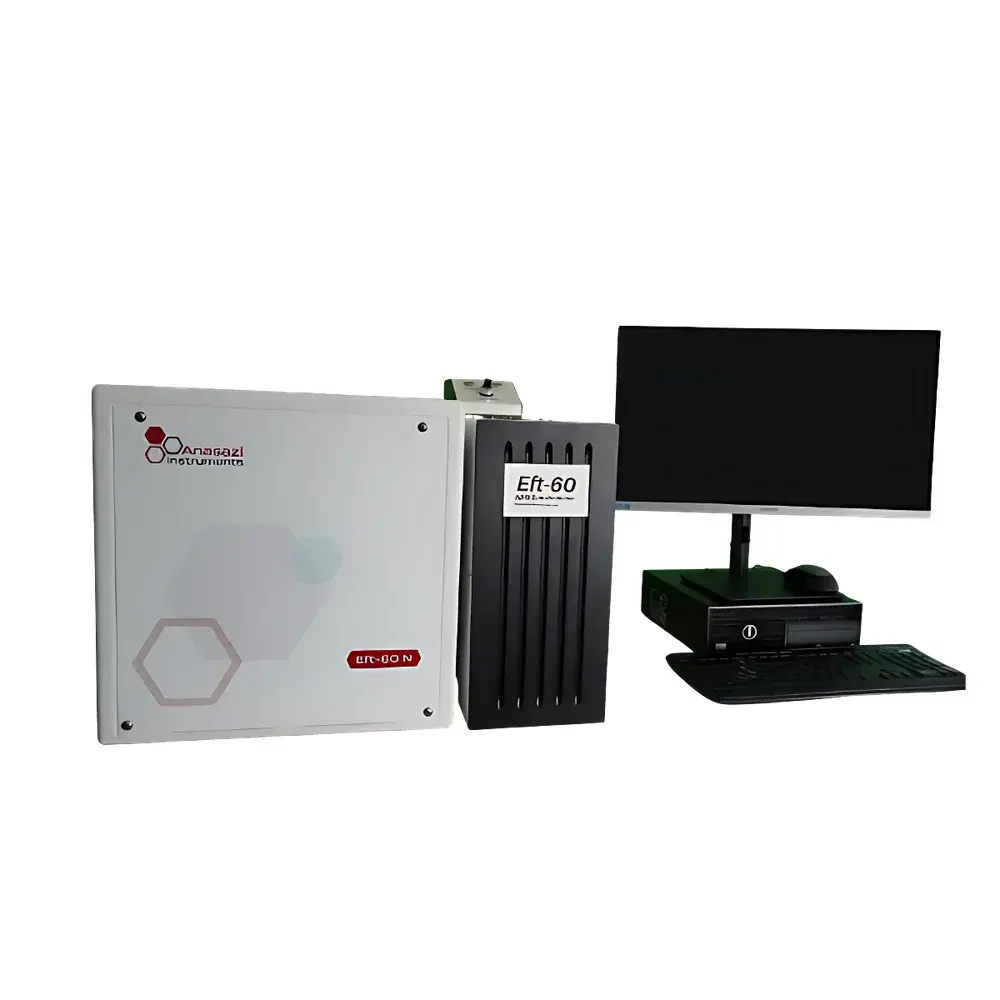
Anasazi EFT-60/EFT-90 Benchtop Permanent-Magnet Nuclear Magnetic Resonance Spectrometer
| Brand | Anasazi |
|---|---|
| Origin | USA |
| Model | EFT-60, EFT-90 |
| Operating Frequency | 60 MHz / 90 MHz |
| Sample Type | Liquid |
| Measurement Principle | Pulsed Fourier Transform NMR |
| Magnet Type | AlNiCo Permanent Magnet |
| Resolution (1H) | <0.5 Hz |
| Sensitivity | <0.001 mmol/L |
| Nuclei Supported | ¹H, ¹³C, ¹⁹F, ³¹P, ²³Na, ⁵⁹Co, ²⁹Si, and other quadrupolar/nuclear spin-½ nuclei |
| Compliance | ASTM E2874, ISO/IEC 17025-compatible operation, GLP-ready data audit trail |
Overview
The Anasazi EFT-60 and EFT-90 are compact, permanent-magnet benchtop nuclear magnetic resonance (NMR) spectrometers engineered for routine structural elucidation and quantitative analysis in academic, industrial, and teaching laboratories. Unlike conventional superconducting NMR systems requiring cryogenic liquid helium and nitrogen, the EFT series utilizes a high-stability AlNiCo permanent magnet, eliminating ongoing cryogen procurement, associated infrastructure, and operational downtime. Both models operate at fixed Larmor frequencies—60 MHz and 90 MHz respectively—optimized for ¹H detection with full multi-nuclear capability. The instruments employ pulsed Fourier transform (PFT) methodology, enabling standard 1D and 2D experiments—including COSY, HETCOR, DEPT, inversion-recovery T₁, CPMG-based T₂, and solvent suppression—without external field shimming or active room-temperature stabilization beyond integrated thermal regulation. Their design prioritizes reproducibility, long-term field homogeneity (<0.5 Hz linewidth for ¹H in DMSO-d₆), and robustness against mechanical vibration and ambient temperature fluctuations—critical attributes for shared instrumentation environments.
Key Features
- Zero-cryogen operation: Eliminates dependency on liquid helium and liquid nitrogen, reducing annual operating costs by approximately USD $10,000 per unit while removing safety, logistics, and regulatory burdens associated with cryogenic handling.
- High-field stability: AlNiCo magnet architecture delivers passive thermal compensation, maintaining field drift below 0.1 ppm/h over 24 hours without active field-frequency lock or deuterium feedback.
- Multi-nuclear versatility: Dual-channel RF electronics support simultaneous or sequential excitation/detection of ¹H, ¹³C, ¹⁹F, ³¹P, ²³Na, ⁵⁹Co, ²⁹Si, and other spin-½ or low-gamma nuclei—enabling heteronuclear correlation, relaxation studies, and reaction monitoring.
- Teaching- and research-optimized workflow: Intuitive software interface enables students and non-specialist users to acquire, process, and interpret spectra within minutes; real-time spectral preview, automated phase correction, and baseline flattening reduce dependence on expert spectroscopists.
- Modular configuration: Standard system includes ¹H NMR, COSY, solvent suppression, and T₁/T₂ measurement modules; optional upgrades include dual-channel ¹H/¹³C, ¹H/¹⁹F, or broad-band multi-nuclear probe kits with variable-temperature capability (–10 °C to +60 °C).
Sample Compatibility & Compliance
The EFT-60/EFT-90 accepts standard 5 mm outer-diameter NMR tubes and accommodates aqueous, organic, and mixed-solvent samples—including D₂O, CDCl₃, DMSO-d₆, and acetone-d₆—with built-in solvent peak suppression algorithms. All acquired data adhere to FAIR principles (Findable, Accessible, Interoperable, Reusable) via vendor-neutral JCAMP-DX export and Bruker-compatible processing formats. Instrument operation supports GLP-compliant workflows through timestamped audit logs, user-access controls, and electronic signature-capable experiment metadata capture. While not certified for GMP manufacturing release testing, the platform meets ASTM E2874 guidelines for benchtop NMR validation and is routinely deployed in method development, impurity profiling, and structure verification under ISO/IEC 17025-accredited quality systems.
Software & Data Management
Control and processing are managed through Anasazi’s proprietary EFT Software Suite, which runs natively on Windows-based host PCs. The suite integrates pulse sequence programming (via editable text-based templates), real-time FFT processing, peak integration with customizable baselines, and 2D contour plot generation. All raw FID data are stored in binary format with embedded acquisition parameters (pulse width, relaxation delay, number of scans, receiver gain), ensuring full traceability. Export options include PNG/SVG graphics, CSV-formatted peak tables, and JCAMP-DX files compatible with third-party tools such as MestReNova, TopSpin, and ACD/Labs. Data security features include role-based access levels, encrypted local storage, and optional network backup integration compliant with institutional IT policies.
Applications
These spectrometers serve diverse applications across synthetic chemistry, natural products isolation, pharmaceutical QC, polymer characterization, and undergraduate pedagogy. Published use cases include structural confirmation of novel alkaloids (e.g., uliginosin derivatives), quantification of enantiomeric excess in asymmetric catalysis, kinetic monitoring of ester hydrolysis, and assignment of regioisomeric substitution patterns in heterocyclic scaffolds. In teaching labs, the EFT platform enables hands-on instruction in spin-spin coupling, chemical shift anisotropy, NOE effects, and multidimensional correlation logic—without scheduling conflicts or instrument downtime common with high-field facilities. Industrial users leverage the system for rapid batch verification of intermediate purity, residual solvent analysis, and stability-indicating assay development.
FAQ
Does the EFT require any cryogens or external cooling systems?
No. The AlNiCo permanent magnet operates at ambient temperature and requires no liquid helium, liquid nitrogen, or chiller units.
Can I run 2D experiments such as COSY or HETCOR on the EFT-60/EFT-90?
Yes. Both models support standard 2D sequences including COSY, TOCSY, HETCOR, HSQC (via inverse detection), and DEPT—all implemented with hardware-timed gradient pulses and phase cycling.
What is the typical signal-to-noise ratio for a 1 mM ethylbenzene sample in CDCl₃?
At 60 MHz, single-scan ¹H SNR exceeds 120:1 for 1 mM ethylbenzene in 0.6 mL volume; at 90 MHz, SNR improves by ~1.5× under identical conditions.
Is the system compatible with regulated environments subject to FDA 21 CFR Part 11?
While the EFT does not include out-of-the-box Part 11 compliance features (e.g., biometric login or electronic signature validation), its audit log framework and metadata-rich data files support implementation of Part 11 controls via institutional IT infrastructure and validated SOPs.
How often does the magnet require recalibration or shimming?
None. The permanent magnet is factory-shimmed and thermally stabilized; no routine shimming or field calibration is required during normal operation.





