
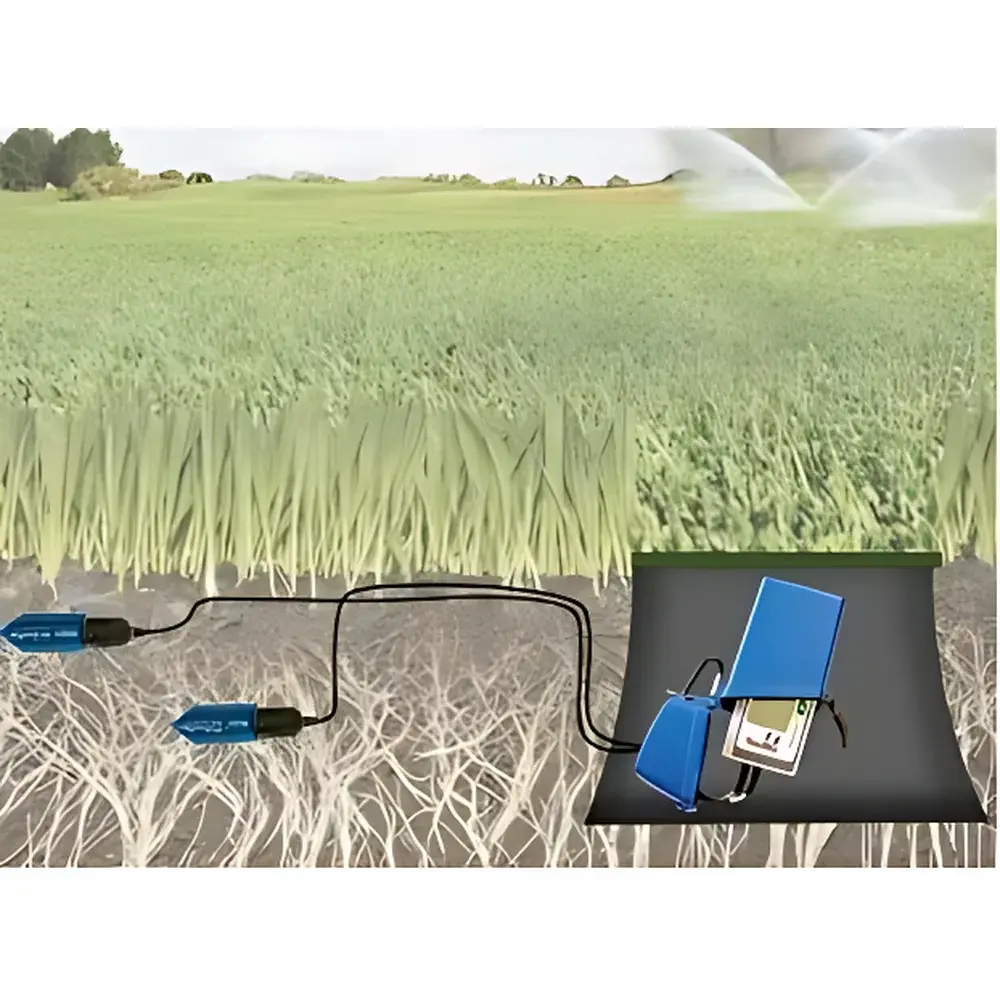
Anasys SMEC300 Soil Moisture, Electrical Conductivity, and Temperature Sensor
| Brand | Anasys |
|---|---|
| Origin | USA |
| Model | SMEC300 |
| Measurement Principles | Capacitive Volumetric Water Content (VWC), Four-Point Graphite Electrode EC, Precision Thermistor |
| Output | Analog Voltage (Time-Division Multiplexed) |
| VWC Range | 0–Saturation |
| VWC Resolution | 0.1% |
| VWC Accuracy | ±3% |
| EC Range | 0–10 mS/cm |
| EC Resolution | 0.01 mS/cm |
| EC Accuracy | ±2% |
| Temperature Range | −18 to +50 °C |
| Temp Resolution | 0.1 °C |
| Temp Accuracy | ±0.8 °C |
| Sensing Volume | 6 cm × 2 cm |
| Cable Options | 1.8 m, 6 m, extendable to 15 m |
| Power | 3 V DC @ 6–10 mA |
Overview
The Anasys SMEC300 is a tri-parameter soil sensor engineered for simultaneous, in-situ measurement of volumetric water content (VWC), bulk electrical conductivity (EC), and soil temperature. It employs a robust, field-deployable architecture integrating three independent sensing modalities within a single compact probe: a high-stability capacitive dielectric sensor for VWC determination, a four-point graphite electrode array for contactless bulk EC measurement (minimizing polarization effects and electrode corrosion), and a calibrated NTC thermistor embedded at the sensor’s thermal centroid. Unlike optical or TDR-based alternatives, the SMEC300 utilizes time-division multiplexed analog voltage output—enabling seamless integration with legacy data loggers, handheld readout units (e.g., Anasys FieldPro series), or third-party environmental monitoring systems without requiring digital communication protocols. Its low-profile, planar geometry (6 cm × 2 cm cross-section) ensures minimal soil disturbance during insertion and consistent spatial sampling across heterogeneous profiles—critical for long-term agronomic studies, irrigation scheduling, and vadose zone hydrology.
Key Features
- Capacitive VWC sensing with temperature-compensated dielectric calibration, delivering stable performance across clay-to-sand textural gradients
- Four-point graphite EC electrodes eliminate electrolytic polarization and enable reliable salinity assessment in high-ionic-strength soils (up to 10 mS/cm)
- Integrated one-button EC calibration routine—no external standards required for field recalibration
- Thermistor-based temperature measurement traceable to NIST-certified reference curves, with automatic thermal drift compensation applied to both VWC and EC outputs
- Low-power operation (3 V DC, 6–10 mA peak) optimized for solar-powered remote stations and battery-operated networks
- Modular cable options (1.8 m standard; 6 m and 15 m extended variants) with IP68-rated polyurethane jacketing for burial and moisture resistance
Sample Compatibility & Compliance
The SMEC300 is validated for direct insertion into mineral soils, organic substrates (e.g., peat, compost), and engineered growing media—including hydroponic aggregates and green roof substrates. It complies with ASTM D5198 (Standard Practice for Determination of Soil Moisture Content) for VWC reporting and aligns with ISO 11274 (Soil Quality — Determination of Water Retention Characteristics) for saturation-range characterization. While not certified for regulatory compliance under FDA 21 CFR Part 11, its analog output architecture supports audit-ready data acquisition when paired with GLP/GMP-compliant logging systems featuring timestamped metadata, hardware-level calibration logs, and secure firmware signing. All materials meet RoHS Directive 2011/65/EU requirements for hazardous substance restriction.
Software & Data Management
The SMEC300 operates as a plug-and-play analog transducer—requiring no embedded firmware or driver installation. Raw voltage outputs are mapped to physical units via documented linear or polynomial transfer functions provided in the manufacturer’s Technical Reference Manual (Rev. 4.2). When interfaced with Anasys WatchDog™ data loggers or compatible Campbell Scientific CR-series units, users gain access to automated calibration validation routines, real-time unit conversion (e.g., mS/cm → dS/m), and configurable sampling intervals (1 min to 24 h). Exported datasets include embedded sensor ID, timestamp (UTC), battery voltage, and diagnostic flags—facilitating traceability in multi-sensor networks. For research-grade analysis, MATLAB® and Python (via PySerial/NumPy) libraries are available for batch processing and uncertainty propagation modeling per GUM (JCGM 100:2008).
Applications
- Precision irrigation management in vineyards, orchards, and row-crop systems—leveraging real-time VWC-EC-temperature co-variation to optimize leaching fractions and prevent salinization
- Vadose zone flux modeling in hydrogeologic monitoring wells and lysimeter arrays
- Soil health assessment in long-term ecological research (LTER) sites, tracking seasonal dynamics of water retention and solute mobility
- Green infrastructure performance evaluation—including bioswales, rain gardens, and permeable pavements—where coupled moisture-salinity-temperature response informs maintenance thresholds
- Controlled-environment agriculture (CEA) substrate monitoring, particularly in closed-loop hydroponics where EC drift signals nutrient imbalance before visible plant stress occurs
FAQ
Does the SMEC300 require periodic factory recalibration?
No—its capacitive and graphite-electrode design exhibits negligible long-term drift. Field recalibration is optional and performed via the one-button EC routine; VWC and temperature calibrations are factory-set and documented in the Certificate of Conformance.
Can multiple SMEC300 sensors share a single analog input channel?
Yes—using time-division multiplexing (TDM) mode, up to eight SMEC300 units can be daisy-chained on one analog port when driven by a compatible logger with programmable excitation sequencing.
Is the probe suitable for frozen soil conditions?
The sensor is rated for operation down to −18 °C, but accurate VWC measurement ceases below 0 °C due to dielectric property shifts in ice-phase water; EC and temperature remain valid in partially frozen matrices.
What is the recommended minimum soil contact pressure during installation?
No compaction force is required—the planar profile enables insertion with hand pressure only; excessive force may deform the graphite electrodes and invalidate EC linearity.
How does the SMEC300 handle soil-to-sensor air gap artifacts?
Its 6 cm × 2 cm sensing volume and dual-side electrode configuration minimize edge effects; however, users should perform a 24-hour equilibration period post-installation to ensure full hydraulic contact before baseline data collection.
Related Products







