
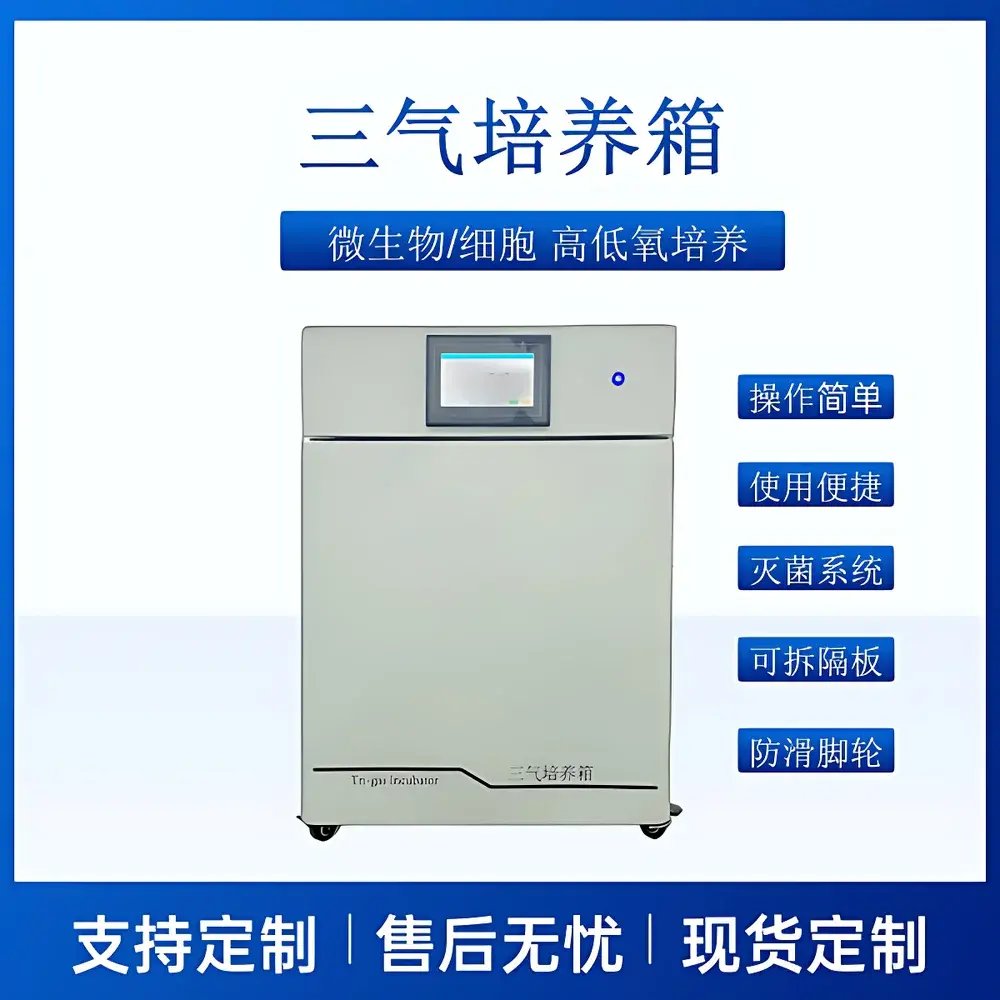
ANAYN CYSQ-80-III Tri-Gas Incubator for Hypoxic Cell Culture
| Brand | ANAYN |
|---|---|
| Origin | Zhejiang, China |
| Instrument Type | Air-Jacketed Tri-Gas Incubator |
| O₂ Concentration Range | 1–95% (v/v) |
| CO₂ Concentration Range | 0–20% (v/v) |
| Temperature Control Range | +3°C to +60°C |
| Temperature Uniformity | ±0.3°C (@37°C) |
| Temperature Stability | ±0.2°C (@37°C) |
| Humidity Level | ≥90% RH (passive water-jacket evaporation, uncontrolled) |
| Chamber Volume | 80 L |
| External Dimensions (W×D×H) | 640 × 650 × 1040 mm |
| Internal Dimensions (W×D×H) | 400 × 400 × 500 mm |
| Display | 5.0-inch capacitive touchscreen |
| CO₂ Sensor | NDIR infrared sensor |
| O₂ Sensor | Imported electrochemical sensor |
| Temperature Sensor | PT100 platinum resistance sensors (5-wall + door independent control) |
| Sterilization | UV lamp (programmable on/off) |
| Power Consumption | 400 W |
| Gas Inlets | Dedicated high-purity N₂, O₂, and CO₂ ports with solenoid valve control |
Overview
The ANAYN CYSQ-80-III is an air-jacketed tri-gas incubator engineered for precise simulation of physiologically relevant hypoxic, normoxic, and hyperoxic environments in mammalian cell culture, stem cell expansion, tumor biology studies, and microbiological applications requiring controlled O₂, CO₂, and temperature parameters. Unlike standard CO₂ incubators, this system integrates independent, real-time regulation of three gases—O₂, CO₂, and N₂—enabling dynamic oxygen modulation from 1% to 95% (v/v), critical for modeling ischemic conditions, embryonic development, or high-altitude physiology. The chamber employs a dual-sensor architecture: a non-dispersive infrared (NDIR) CO₂ sensor ensures long-term stability and minimal drift, while a calibrated electrochemical O₂ sensor delivers linear response and reproducible accuracy across the full operational range. Temperature control is achieved via a six-zone sensing network—five wall-mounted PT100 probes plus a dedicated door sensor—feeding into a PID algorithm that actively compensates for thermal gradients and door-opening events.
Key Features
- Air-jacketed thermal design with independent heating circuits for chamber walls and door, minimizing external ambient influence and improving recovery time after door opening.
- Microprocessor-controlled gas mixing logic: automatically selects optimal gas blending strategy—N₂/CO₂ dilution for hypoxia (O₂ 23%)—to maintain target CO₂ concentration within ±0.1% while adjusting O₂ independently.
- Passive humidity maintenance via stainless-steel (AISI 304) water pan; achieves ≥90% RH through natural evaporation—designed for low-contamination workflows where active humidification may introduce condensation or microbial risk.
- UV sterilization module with programmable timer and interlock: deactivates during incubation and activates only during scheduled cycles, preventing UV exposure to samples and extending lamp life.
- Intelligent airflow management: low-turbulence fan-assisted circulation mimics natural convection, reducing thermal stratification and accelerating gas equilibration (<15 min for full O₂/CO₂ recovery post-door-open).
- Comprehensive safety architecture: dual independent overtemperature cutoffs (electronic and mechanical relay), automatic gas valve shutoff upon sensor fault or door open event, and audible/visual alarm for deviation beyond user-defined thresholds.
Sample Compatibility & Compliance
The CYSQ-80-III supports standard tissue culture formats including T-flasks (up to T225), multiwell plates (6–96-well), Petri dishes, and roller bottles. Its 80 L working volume accommodates up to four adjustable stainless-steel shelves (standard configuration: one shelf included). All interior surfaces are electropolished AISI 304 stainless steel with seamless radiused corners, facilitating cleaning validation and reducing biofilm retention. While not certified to ISO 13485 or FDA 21 CFR Part 11 out-of-the-box, the system’s logging-capable touchscreen interface records timestamped values for temperature, CO₂, and O₂ at user-selectable intervals (1–60 min), supporting GLP-compliant documentation when paired with external audit-trail software. It complies with IEC 61010-1 for laboratory equipment safety and meets CE marking requirements for electromagnetic compatibility (EMC) and low-voltage directives.
Software & Data Management
The 5.0-inch capacitive touchscreen provides intuitive access to all operational parameters—including setpoints, real-time readings, historical trend graphs (72-hr buffer), and alarm logs. Data export is supported via USB port (CSV format) for integration into LIMS or statistical analysis platforms (e.g., GraphPad Prism, MATLAB). No proprietary cloud service or vendor lock-in is required; raw data files are human-readable and compatible with common spreadsheet applications. Optional RS-485 Modbus RTU interface enables integration into centralized building management systems (BMS) or automated lab infrastructure. Firmware updates are performed locally via USB without internet dependency, preserving data integrity and cybersecurity posture in regulated environments.
Applications
- Hypoxia research: modeling tumor microenvironments, ischemia-reperfusion injury, and HIF-1α signaling pathways under sustained or cyclic low-O₂ conditions (1–5% O₂).
- Stem cell differentiation: controlling O₂ tension to direct mesenchymal or pluripotent stem cell fate decisions without exogenous cytokine bias.
- Microaerophilic pathogen culture: cultivating Campylobacter jejuni, Helicobacter pylori, or Prevotella species requiring sub-atmospheric O₂ and elevated CO₂.
- 3D organoid and spheroid culture: maintaining stable gas gradients essential for necrotic core formation and metabolic zonation.
- Bioprocess development: screening optimal O₂/CO₂ combinations for monoclonal antibody production in CHO or HEK293 suspension cultures.
FAQ
Does the CYSQ-80-III support active humidity control?
No. Humidity is maintained passively via a stainless-steel water reservoir; RH is not measured or regulated. This design prioritizes contamination control and simplifies maintenance in applications where precise RH is secondary to gas and temperature fidelity.
What calibration standards are recommended for O₂ and CO₂ sensors?
ANAYN recommends annual verification using NIST-traceable gas mixtures: 5.0% CO₂ in air and 1.0% O₂ in N₂ for low-end validation; 15.0% CO₂ and 90.0% O₂ for high-end checks. Sensor recalibration requires factory service or authorized technician.
Can the incubator operate continuously at 4°C?
No. Minimum operating temperature is +3°C above ambient. For cold storage applications, a dedicated refrigerated incubator or environmental chamber is required.
Is the UV sterilization cycle validated for microbial reduction?
UV dose delivery follows IEC 62471 photobiological safety guidelines. While effective against surface contaminants (e.g., >3-log reduction of E. coli in 30 min), it is not validated per ISO 14644 or USP for aseptic processing; supplemental chemical disinfection remains necessary for GMP cell therapy workflows.
How does the system handle door-opening events?
Upon door detection, the controller immediately halts fan circulation, closes all gas inlet solenoids, and initiates rapid re-equilibration protocol upon closure—restoring nominal O₂ and CO₂ levels within 12–18 minutes depending on setpoint and ambient conditions.




