
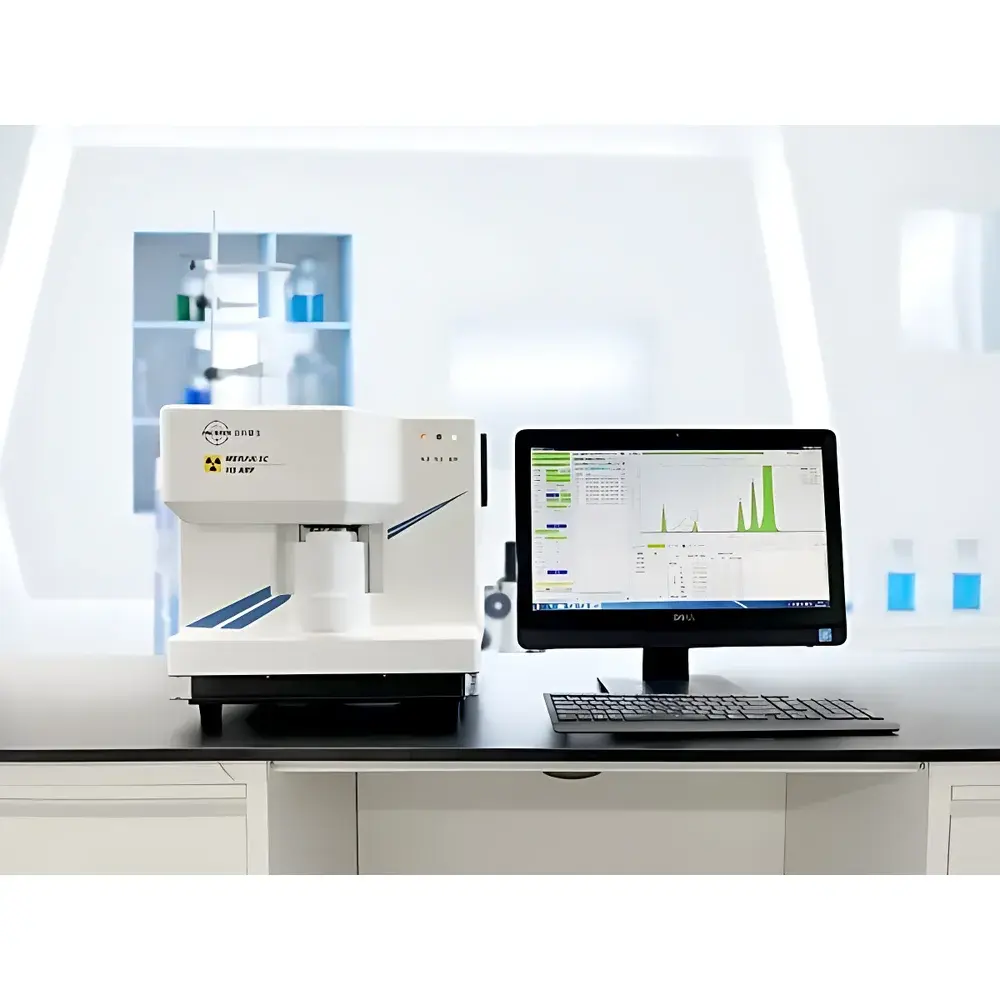
Anchor Wisdom MERAK-SC Single Wavelength X-Ray Fluorescence Spectrometer (HS-XRF)
| Brand | Anchor Wisdom |
|---|---|
| Origin | Beijing, China |
| Model | MERAK-SC |
| Excitation | Monochromatic Focused X-ray (Johansson-type DCC crystal) |
| Detection | Ultra-thin Graphene-window Silicon Drift Detector (SDD) |
| Elemental Range | F–Cl (light elements), K–Zn (transition metals) |
| LOD (F) | 0.15 wt% (300 s, aqueous matrix) |
| LOD (Al–Cl) | 0.0002–0.005 wt% (300 s) |
| Sample Types | Liquids, powders, solids |
| Geometry | Top-illumination |
| Sample Rotation | Motorized, software-controlled |
| Temperature Control | 24 ± 0.3 °C |
| Analysis Time | 30–300 s per sample |
| Stability | < ±3% intensity drift over 24 h |
| Quantification Engine | Fast FP 2.0 fundamental parameters software |
| Compliance | Designed for ISO 8258 (control charts), ASTM E1621 (ED-XRF for cement), USP <233> (elemental impurities), and GLP/GMP-aligned data integrity workflows |
Overview
The Anchor Wisdom MERAK-SC is a high-performance single-wavelength X-ray fluorescence (SW-XRF) spectrometer engineered to overcome the fundamental limitations of conventional energy-dispersive XRF (ED-XRF) in light element analysis. Unlike polychromatic ED-XRF systems—whose broad Bremsstrahlung background severely suppresses detection sensitivity for elements with atomic numbers below sodium—the MERAK-SC employs monochromatic focused excitation via a Johansson-type doubly curved crystal (DCC). This optical configuration delivers intense, narrow-band X-ray photons (e.g., Cu Kα at 8.04 keV or Mo Kα at 17.48 keV, configurable per application) directly onto a micro-focused sample spot (≤100 µm diameter), minimizing scattered continuum background and maximizing signal-to-noise ratio for fluorine (F), oxygen (O), sodium (Na), magnesium (Mg), aluminum (Al), silicon (Si), phosphorus (P), sulfur (S), and chlorine (Cl). Coupled with an ultra-thin graphene-window silicon drift detector (SDD), the system achieves exceptional quantum efficiency down to 60 eV—enabling reliable quantification of F at 0.15 wt% LOD (300 s, water-based matrix) without cryogenic cooling or vacuum purging. The instrument operates on a top-illumination geometry, eliminating risk of optical path contamination from dust or liquid spillage—a critical design advantage for routine QC labs handling heterogeneous or volatile samples.
Key Features
- Monochromatic excitation using a full-focusing Johansson-type DCC crystal, delivering >10× higher peak-to-background ratio vs. standard ED-XRF for light elements
- Graphene-window SDD with 100,000 cps maximum count rate, optimized for simultaneous major/minor/trace element detection
- Motorized sample rotation stage, programmable via software to homogenize signal response from non-uniform solids or viscous liquids
- Precision thermal management system maintaining chamber temperature at 24 ± 0.3 °C—critical for long-term spectral stability and detector gain consistency
- Top-illumination optical architecture with sealed beam path, protecting optics and detector from particulate or solvent exposure
- Configurable secondary target option for enhanced excitation of mid-Z elements (K–Cu), extending quantitative capability across geological, metallurgical, and fuel matrices
Sample Compatibility & Compliance
The MERAK-SC accepts liquid samples in dedicated low-background quartz or polypropylene cups (10–50 mL volume), pressed powders, fused beads, and flat solid specimens up to 50 mm in diameter. Its robust mechanical design meets IEC 61000-6-3 (EMC) and IEC 61010-1 (safety) standards. For regulated environments, the instrument supports audit-trail-enabled operation under FDA 21 CFR Part 11-compliant software configurations (via optional Fast FP 2.0 Enterprise module), including electronic signatures, user role-based access control, and immutable raw-data archiving. Method validation aligns with ISO/IEC 17025 requirements, and elemental quantification protocols reference ASTM E1621 (cement), ASTM D7348 (coal), ISO 12913 (soil), and USP (pharmaceutical elemental impurities).
Software & Data Management
Fast FP 2.0 serves as the integrated quantification platform—offering a graphical, workflow-driven interface for method development, calibration, and reporting. It implements a physics-based fundamental parameters algorithm that accounts for matrix absorption, enhancement, and secondary fluorescence without requiring extensive empirical calibrations. Users define sample type (e.g., “coal ash”, “waste leachate”, “lithium cathode slurry”), select excitation mode (primary monochromatic beam or secondary target), and specify measurement time; the software auto-optimizes acquisition parameters and applies mass attenuation corrections derived from first principles. All spectra, processing logs, and calibration histories are stored in SQLite-based local databases with timestamped metadata, supporting traceability per GLP and GMP documentation requirements.
Applications
- Cement manufacturing: Rapid quantification of CaO, SiO₂, Al₂O₃, Fe₂O₃, SO₃, Cl⁻, and free lime in raw meal, clinker, and finished cement
- Coal and biomass analysis: Determination of S, Cl, Na, K, Ca, Mg for calorific value prediction, slagging/fouling index calculation, and environmental compliance reporting
- Hazardous waste screening: Simultaneous detection of total S, Cl, F in incinerator fly ash and landfill leachates per EPA Method 6010D
- Metallurgical feedstocks: High-precision assay of Mg, Al, Si, P, S, Cl, K, Ca in bauxite, magnesite, graphite, and ferroalloy raw materials
- Lithium-ion battery materials: Quantitative analysis of Ni, Co, Mn, Al, Fe, Cu, Zn, and residual F in NMC cathodes and electrolyte additives
- Petroleum coke and catalysts: Monitoring of V, Ni, Na, Ca, S, Cl to assess fouling potential and refining efficiency
- Environmental soil testing: Oxide-level profiling (SiO₂, Al₂O₃, Fe₂O₃, CaO, MgO) alongside regulatory analytes (P, S, Cl) without digestion
FAQ
Does the MERAK-SC require vacuum or helium purge for light element analysis?
No. The combination of monochromatic excitation and graphene-window SDD enables ambient-air analysis of F, O, Na, and Mg without vacuum pumping or gas purging.
Can it analyze solid samples without pelletization or fusion?
Yes—homogeneous solids (e.g., polished metals, glass standards) and granular powders can be measured directly. For heterogeneous samples, the motorized rotation stage improves representativeness.
How does its performance compare to wavelength-dispersive XRF (WD-XRF)?
For F–Cl quantification in routine industrial matrices, the MERAK-SC achieves comparable LODs and accuracy to benchtop WD-XRF—but with significantly lower cost of ownership, footprint, and operational complexity.
Is Fast FP 2.0 validated for regulated pharmaceutical use?
The core Fast FP 2.0 engine complies with USP computational requirements. Full 21 CFR Part 11 compliance requires the optional Enterprise license and documented IQ/OQ/PQ protocols.
What maintenance is required beyond routine calibration checks?
Annual verification of DCC crystal alignment and SDD energy calibration is recommended. No consumables (e.g., X-ray tube filaments, cryocoolers) require replacement under normal operation.
Related Products






