
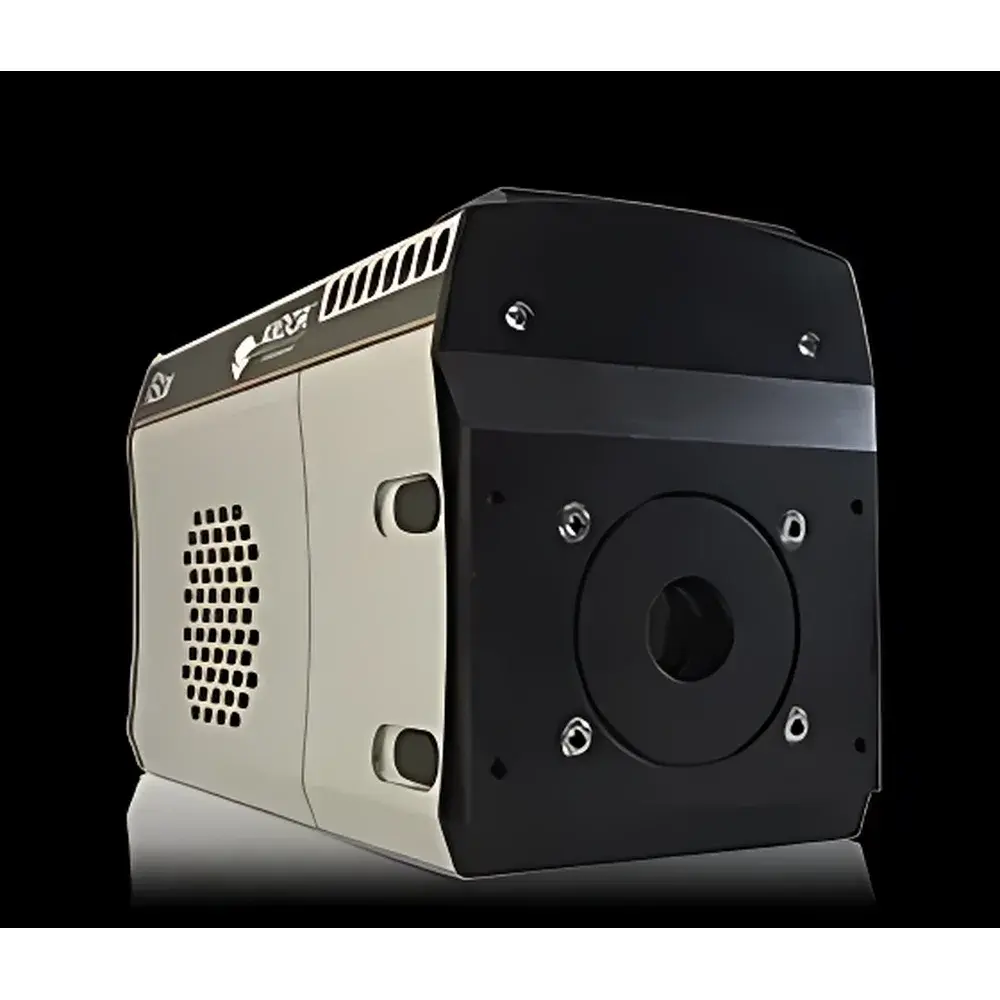
Andor DH334 Scientific-Grade ICCD Camera
| Brand | Andor |
|---|---|
| Origin | United Kingdom |
| Model | DH334 |
| Sensor Format | 1024 × 1024 CCD |
| Pixel Size | 13 × 13 µm (100% fill factor) |
| Effective Imaging Area | 13.3 × 13.3 mm (18 mm intensifier) / 19.5 × 19.5 mm (25 mm intensifier) |
| Optical Gate Width | < 2 ns |
| Read Noise | 4 e⁻ |
| Spectral Range | 120–1100 nm (intensifier-dependent) |
| Peak Quantum Efficiency | 50% (Gen II), 45% (Gen III) |
| Fiber-Optic Taper Magnification | 1:1 or 1.5:1 |
| Frame Rate | 4 fps |
| Cooling | Thermoelectric to –40 °C |
| Trigger Delay Resolution | 10 ps |
| Minimum Trigger-to-Gate Delay | 19 ns |
| Gate Contrast Ratio | ≥1:10⁸ (deep UV compatible) |
| Interface | USB 2.0 |
| Phosphor Options | P43, P46 |
Overview
The Andor DH334 is a scientific-grade intensified charge-coupled device (ICCD) camera engineered for ultra-low-light, time-resolved imaging applications requiring sub-nanosecond optical gating and high signal fidelity. Built upon Andor’s iStar platform architecture, the DH334 integrates a high-performance 1024 × 1024 pixel back-illuminated CCD sensor with either an 18 mm or 25 mm Gen II or Gen III image intensifier—each coupled via fiber-optic taper (1:1 or 1.5:1 magnification). Its core operational principle relies on photocathode-driven electron multiplication within a microchannel plate (MCP), followed by phosphor-based photon conversion and CCD readout. This cascade enables single-photon sensitivity with precise temporal control over detection windows, making it suitable for experiments where both spatial resolution and picosecond-level timing accuracy are critical.
Key Features
- Sub-2 ns true optical gate width—verified by streak camera calibration—enabling time-of-flight discrimination in combustion diagnostics and plasma physics;
- Intelligate™ technology synchronizes MCP voltage switching with photocathode bias at the nanosecond level, maintaining >1:10⁸ contrast ratio even below 200 nm;
- Dual-intensifier compatibility: 18 mm (13.3 × 13.3 mm effective area) and 25 mm (19.5 × 19.5 mm) options support flexible field-of-view and light-collection requirements;
- Thermoelectric cooling to –40 °C reduces dark current to <0.001 e⁻/pix/s, ensuring stable baseline performance during long-exposure gated acquisitions;
- Onboard digital delay generator with 10 ps resolution and <19 ns total system latency allows deterministic synchronization across multi-camera or laser-triggered setups;
- P43 (green-emitting, fast decay) and P46 (blue-emitting, high resolution) phosphor screens provide application-tailored trade-offs between temporal response and spatial fidelity;
- USB 2.0 interface supports full-frame transfer at 4 fps with lossless 16-bit digitization and hardware-level trigger buffering for burst-mode acquisition.
Sample Compatibility & Compliance
The DH334 is routinely deployed in environments governed by ISO/IEC 17025-compliant laboratories and adheres to electromagnetic compatibility standards per EN 61326-1:2013. Its spectral response (120–1100 nm) accommodates vacuum ultraviolet (VUV) spectroscopy when equipped with solar-blind CsTe photocathodes, as well as near-infrared imaging using GaAs variants. The camera meets mechanical and thermal specifications required for integration into vacuum chambers (up to 10⁻⁶ mbar) and laser safety Class 1 enclosures. All firmware and control logic comply with IEC 62304 for medical device software lifecycle management—relevant for preclinical bioluminescence imaging systems operating under GLP frameworks.
Software & Data Management
Controlled via Andor’s SDK-compatible Solis® software (v5.x), the DH334 supports scriptable acquisition sequences, ROI-based binning, and real-time histogram analysis. The software implements audit-trail logging compliant with FDA 21 CFR Part 11 for regulated environments, including electronic signatures, session timestamps, and parameter change history. Raw data export follows FITS and HDF5 formats—both natively supported by Python (Astropy, h5py) and MATLAB workflows. Integration with LabVIEW, EPICS, and Python APIs enables automated experiment orchestration in synchrotron beamlines or combustion test rigs.
Applications
- Combustion Diagnostics: Time-resolved OH* and CH* chemiluminescence imaging with 2 ns gate separation to resolve flame front propagation in turbulent premixed flames;
- Ultrafast Spectroscopy: Gated detection in pump–probe transient absorption setups, leveraging sub-ns jitter-free triggering for femtosecond laser synchronization;
- Bioluminescence & Chemiluminescence Imaging: Quantitative low-background monitoring of luciferase kinetics in live-cell assays under ambient darkroom conditions;
- Plasma & Discharge Physics: Spatially resolved emission mapping of pulsed plasma jets with ns-scale temporal slicing to isolate ion vs. neutral species dynamics;
- LIDAR & Remote Sensing: High-sensitivity return-signal capture in atmospheric backscatter measurements, where background suppression via gated integration improves SNR by >40 dB.
FAQ
What is the minimum achievable optical gate width, and how is it verified?
The DH334 achieves a verified optical gate width of <2 ns, measured using calibrated streak camera cross-correlation. This value reflects the full-width-at-half-maximum (FWHM) of the temporal point spread function at the intensifier output.
Can the DH334 operate in vacuum environments?
Yes—the camera housing is rated for operation in vacuum up to 10⁻⁶ mbar when configured with vacuum-compatible connectors and sealed feedthroughs. Optional conduction-cooled variants eliminate outgassing concerns.
Is Gen III intensifier performance validated across the full VUV range?
Gen III CsI photocathodes deliver measurable QE down to 120 nm; however, absolute quantum efficiency below 140 nm requires characterization with synchrotron radiation sources and is documented in Andor’s application note AN-ICCD-VUV-01.
How does Intelligate™ differ from conventional MCP gating?
Intelligate™ applies synchronized high-voltage transients directly to both MCP input and photocathode, eliminating gate-induced image distortion and preserving linearity across the entire active area—even at deep UV wavelengths.
Does Solis software support automated calibration routines for gain and linearity?
Yes—Solis includes factory-calibrated flat-field correction, MCP gain mapping, and pixel-response non-uniformity (PRNU) compensation modules, all traceable to NIST-standard photodiode references.




