
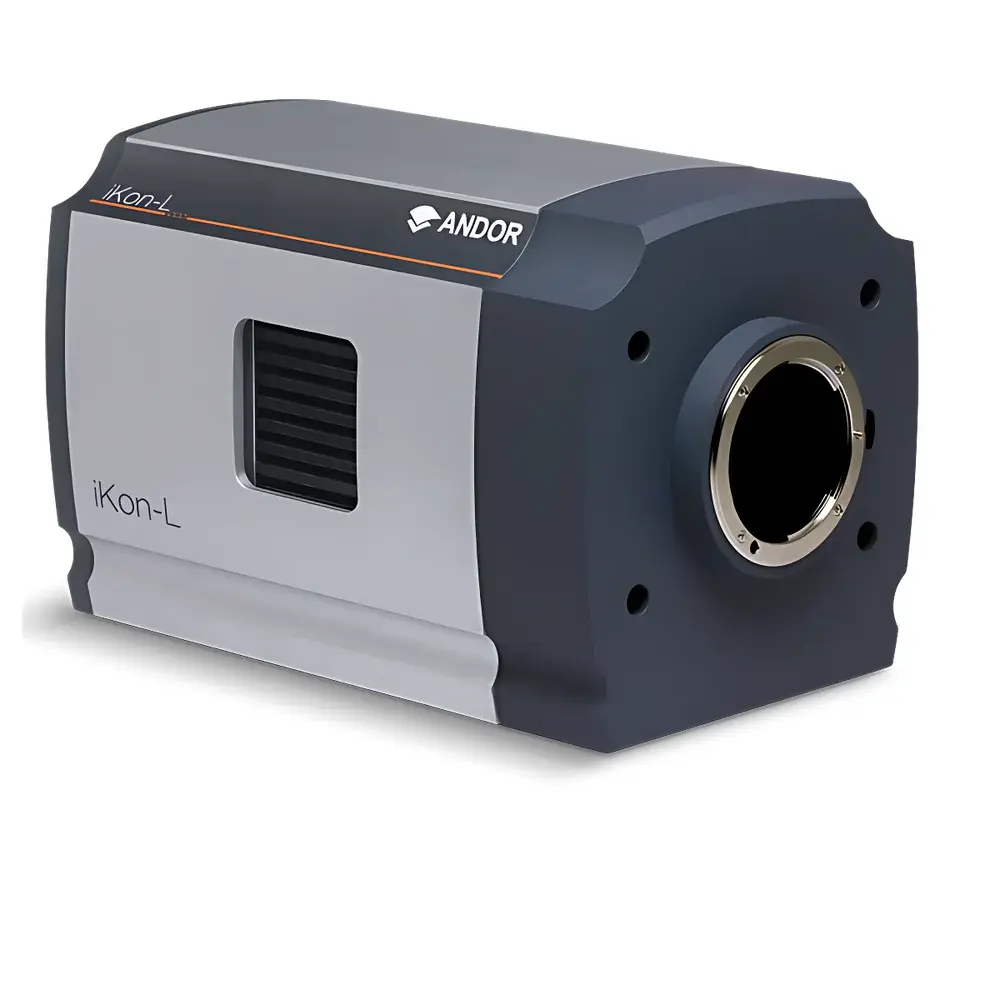
Andor iKon-L 936 Scientific Grade Deep-Cooled CCD Camera
| Brand | Andor |
|---|---|
| Origin | United Kingdom |
| Model | iKon-L 936 |
| Effective Pixels | 2048 × 2048 |
| Pixel Size | 13.5 µm × 13.5 µm |
| Sensor Diagonal | 39 mm |
| Cooling | Thermoelectric Vacuum Cryostat (Down to –100 °C) |
| Mount | F-mount (EF-mount optional) |
| Quantum Efficiency | Optimized for Near-Infrared (NIR) via Deep Depletion Technology |
| Readout Modes | Standard Low-Noise Mode & Fast Kinetics Mode (µs Time Resolution) |
Overview
The Andor iKon-L 936 is a scientific-grade, deep-cooled back-illuminated CCD camera engineered for quantitative low-light imaging applications requiring exceptional signal fidelity, long integration times, and high spatial uniformity. Based on a 2048 × 2048 pixel, 13.5 µm square pixel sensor with a 39 mm diagonal format, the iKon-L 936 delivers 4.2 megapixels of active imaging area optimized for wide-field applications in astronomy, spectroscopy, fluorescence lifetime imaging (FLIM), Raman microscopy, and single-molecule detection. Its core architecture employs a vacuum-sealed, thermoelectrically cooled cryostat capable of stabilizing the sensor at –100 °C—enabling sub-electron read noise and dark current suppression below 0.0001 e⁻/pixel/sec. This thermal management system operates maintenance-free over extended operational lifetimes, eliminating reliance on liquid nitrogen or mechanical compressors. The sensor utilizes deep-depletion silicon technology, providing enhanced quantum efficiency (>90% peak) across visible wavelengths and extended responsivity into the near-infrared (700–1100 nm), critical for applications involving NIR-emitting fluorophores or astronomical H-alpha and Paschen-series line detection.
Key Features
- Back-illuminated, deep-depletion CCD sensor with 2048 × 2048 resolution and 13.5 µm pixels
- Vacuum-integrated thermoelectric cooling to –100 °C for ultra-low dark current and high dynamic range
- F-mount lens interface (EF-mount available as factory option) enabling compatibility with standard astronomical and industrial optics
- Two operational modes: Standard high-sensitivity mode for long-exposure imaging and Fast Kinetics mode supporting temporal resolution down to the microsecond regime
- On-chip binning, multiple readout speeds, and programmable region-of-interest (ROI) acquisition for adaptive experiment design
- Hermetically sealed vacuum package with integrated desiccant—no scheduled maintenance or re-pumping required
Sample Compatibility & Compliance
The iKon-L 936 is designed for integration into regulated and research-grade optical systems where measurement traceability and stability are essential. Its analog-to-digital conversion and clocking architecture comply with IEEE 1284 and EMVA 1288 standards for scientific camera characterization. The camera’s firmware and hardware design support GLP/GMP-aligned workflows through deterministic exposure timing, hardware-triggered acquisition, and non-volatile storage of calibration metadata (e.g., gain, offset, temperature log). While not FDA-cleared as a medical device, its performance characteristics meet requirements outlined in ASTM E1544 (Standard Practice for Calibration of Spectrometers) and ISO 15739 (Imaging Sensors — Noise Measurement), making it suitable for QC/QA laboratories performing spectral or photometric validation under ISO/IEC 17025-accredited conditions.
Software & Data Management
The iKon-L 936 is fully supported by Andor’s SOLIS software suite—a platform validated for Windows 10/11 x64 environments and compliant with FDA 21 CFR Part 11 requirements when deployed with appropriate system configuration (audit trail logging, electronic signatures, and role-based access control). SOLIS provides real-time image preview, non-linear flat-field correction, dark frame subtraction, photon-counting mode analysis, and time-series export in FITS, TIFF, and HDF5 formats. Application programming interfaces (APIs) are provided for MATLAB, Python (via PyAndor), and LabVIEW, enabling seamless integration into custom automation frameworks. All acquired data retain embedded EXIF-like metadata—including sensor temperature, exposure duration, gain setting, and calibration timestamp—ensuring full experimental provenance.
Applications
- Astronomical imaging: Wide-field deep-sky surveys, narrowband nebula imaging, and transit photometry
- Low-light spectroscopy: High-resolution Raman, LIBS, and UV-Vis-NIR absorption/emission measurements
- Life sciences: Time-resolved fluorescence, bioluminescence imaging, and chemiluminescent Western blot detection
- Materials science: Photoluminescence mapping, defect analysis in semiconductors, and cathodoluminescence
- Industrial metrology: Precision surface inspection under low-illumination conditions and laser-induced breakdown monitoring
FAQ
What is the typical read noise at the slowest readout speed?
At 100 kHz readout, the iKon-L 936 achieves ≤2.5 e⁻ RMS read noise (typical), measured with correlated double sampling and optimized amplifier gain.
Can the camera operate continuously at –100 °C without performance degradation?
Yes—the vacuum cryostat and thermoelectric cooler are rated for continuous operation at –100 °C with no scheduled maintenance intervals over 10+ years under normal laboratory conditions.
Is NIR quantum efficiency enhancement a standard feature or an optional upgrade?
Deep-depletion NIR optimization is factory-configured as standard on the iKon-L 936 sensor; no additional hardware or firmware license is required.
Does Fast Kinetics mode require external triggering?
Fast Kinetics acquisition is hardware-synchronized and supports both internal timing generation and external TTL trigger input with jitter <100 ns.
How is calibration data stored and recalled?
Dark frames, flat fields, and gain maps are saved as portable .cal files and automatically applied during acquisition when matching sensor temperature and readout parameters are detected.



