
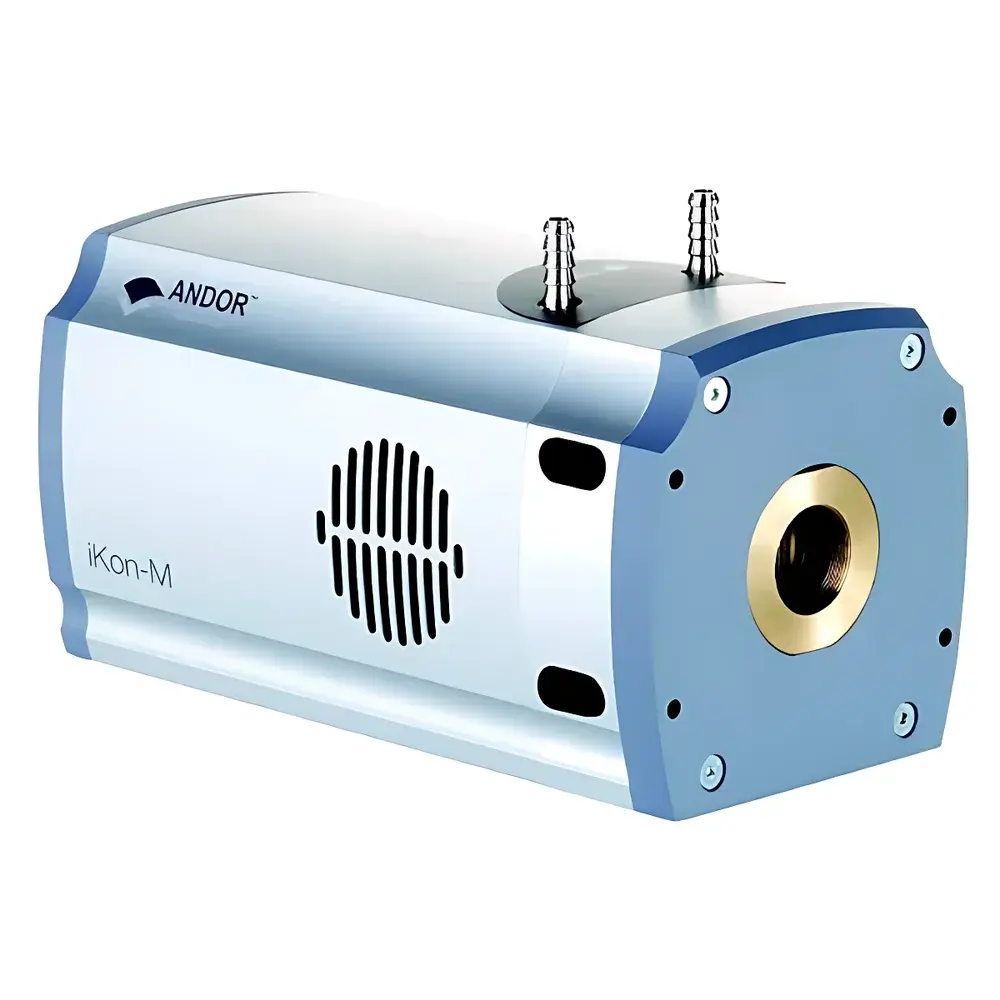
Andor iKon-L 936 Series Scientific-Grade CCD Camera
| Brand | Andor |
|---|---|
| Origin | United Kingdom |
| Model | iKon-L 936 Series |
| Sensor | E2V CCD, 2048 × 2048 pixels |
| Pixel Size | 13.5 µm × 13.5 µm |
| Active Area | 27.6 mm × 27.6 mm |
| Cooling | Thermoelectric (TE), down to −100 °C |
| Readout Noise | as low as 2.9 e⁻ |
| Full-Well Capacity | 100,000 e⁻ |
| Maximum Readout Speed | 5 MHz |
| Frame Rate | 0.95 fps (at full resolution) |
| Dynamic Range | 16-bit |
| Quantum Efficiency | up to 95% |
| Interface | USB 2.0 |
| Mount | Standard F-mount |
| Shutter | Integrated 45 mm mechanical shutter |
| Key Technologies | UltraVac™ vacuum sealing, Fringe Suppression Technology™ (FST™) for etalon artifact reduction (BR-DD variant) |
Overview
The Andor iKon-L 936 Series is a high-performance, scientific-grade CCD camera engineered for demanding low-light imaging applications in astronomy, spectroscopy, fluorescence microscopy, and synchrotron radiation detection. Built around an E2V back-illuminated CCD sensor with 2048 × 2048 pixels and 13.5 µm pixel pitch, the iKon-L 936 delivers a large 27.6 mm × 27.6 mm imaging area—ideal for wide-field applications requiring both spatial coverage and photon-limited sensitivity. Its core architecture leverages Andor’s proprietary UltraVac™ technology, which maintains long-term vacuum integrity without reliance on consumable getters or periodic reprocessing. This ensures stable quantum efficiency (QE) over years of operation and eliminates drift in dark current performance—a critical requirement for quantitative, time-series measurements in regulated environments.
Key Features
- Back-illuminated E2V CCD sensor with peak quantum efficiency exceeding 95% across visible to near-UV wavelengths (configurable for UV-enhanced, deep-depletion, or standard front-illuminated variants)
- Thermoelectric cooling to −100 °C, enabling sub-0.001 e⁻/pixel/sec dark current at operating temperature—essential for long-exposure astrophotography and Raman spectroscopy
- UltraVac™ hermetic vacuum enclosure with in-situ monitoring capability, certified for >10-year operational vacuum lifetime under continuous use
- Two selectable readout modes: high-sensitivity (low-noise, 2.9 e⁻ RMS) and high-speed (5 MHz clocking), supporting flexible trade-offs between SNR and temporal resolution
- Fringe Suppression Technology™ (FST™) integrated into BR-DD sensor variants to mitigate etalon fringing in the 700–1100 nm range—critical for NIR spectroscopic applications requiring spectral fidelity
- 16-bit digitization with >87 dB dynamic range; integrated 45 mm mechanical shutter with <10 ms actuation time and synchronization TTL I/O for precise exposure control
- Standard F-mount interface with optional C-mount and custom optical flange adapters; USB 2.0 interface with driver support for Windows and Linux platforms
Sample Compatibility & Compliance
The iKon-L 936 supports integration into diverse optical configurations—including monochromators, microscopes, telescope focal planes, and vacuum-compatible beamlines. Its mechanical design conforms to ISO 10110 optical mounting standards and includes provisions for thermal anchoring in cryogenic enclosures. The camera complies with CE, FCC, and RoHS directives. Firmware and acquisition software are validated for compliance with GLP/GMP data integrity requirements, including audit-trail logging, user access controls, and electronic signature support per FDA 21 CFR Part 11 when used with Andor’s Solis™ Software Suite. Sensor variants meet ASTM E1548-21 specifications for scientific imaging detector characterization and are routinely deployed in ISO/IEC 17025-accredited laboratories for spectral radiance calibration and photon-counting validation.
Software & Data Management
Controlled via Andor’s Solis™ Software (v5.0+), the iKon-L 936 provides full programmability through native .NET, LabVIEW, MATLAB, and Python APIs (including PyAndor). Solis supports hardware-synchronized multi-camera acquisition, real-time dark frame subtraction, non-uniformity correction (NUC), and pixel defect mapping with persistent bad-pixel table storage. All raw image data are saved in FITS or TIFF format with embedded metadata (exposure time, temperature, gain, binning, timestamp, and sensor configuration)—ensuring FAIR (Findable, Accessible, Interoperable, Reusable) data principles. Optional Solis Advanced Analysis Module enables on-the-fly centroiding, photometry, spectral line fitting, and statistical noise modeling compliant with ISO 15739:2013 for imaging system noise characterization.
Applications
- Astronomical imaging: Deep-sky surveys, adaptive optics wavefront sensing, and exoplanet transit photometry requiring ultra-low dark current and high QE in Hα and [OIII] bands
- Raman and fluorescence spectroscopy: High-resolution spectral mapping where etalon suppression and single-photon sensitivity enable sub-micromolar detection limits
- Time-resolved luminescence: Microsecond-scale gated imaging using external trigger input and programmable exposure sequencing
- Synchrotron and X-ray detection: Indirect imaging via scintillator coupling; optimized for low-energy X-ray (<10 keV) detection with deep-depletion sensor options
- Quantitative microscopy: Confocal and TIRF applications demanding high dynamic range and reproducible photometric linearity across >10⁴ intensity span
FAQ
What sensor technologies are available for the iKon-L 936 platform?
The iKon-L 936 supports multiple E2V CCD variants: standard front-illuminated, back-illuminated (BI), UV-enhanced BI, and deep-depletion BI (BR-DD) with Fringe Suppression Technology™.
Is the camera suitable for vacuum or ultra-high-vacuum (UHV) environments?
While the iKon-L 936 itself is not UHV-rated, its UltraVac™ sealed sensor head may be mounted externally to UHV chambers via differential pumping or optical viewports; custom flange adapters are available upon request.
Does the iKon-L 936 support hardware triggering and external synchronization?
Yes—it features TTL-compatible input/output lines for exposure start/stop, frame strobe, and programmable delay generation, fully compatible with Andor’s Neo sCMOS and other timing controllers.
Can dark current be modeled and subtracted in post-processing?
Solis software includes automated dark frame acquisition at user-defined temperatures and exposure times, with pixel-wise scaling and interpolation across temperature gradients per ISO 15739 Annex B.
What maintenance is required to preserve vacuum integrity over time?
None—the UltraVac™ seal is permanent and requires no periodic servicing, getter replacement, or bake-out procedures; vacuum status is continuously monitored and reported via Solis diagnostic panel.





