
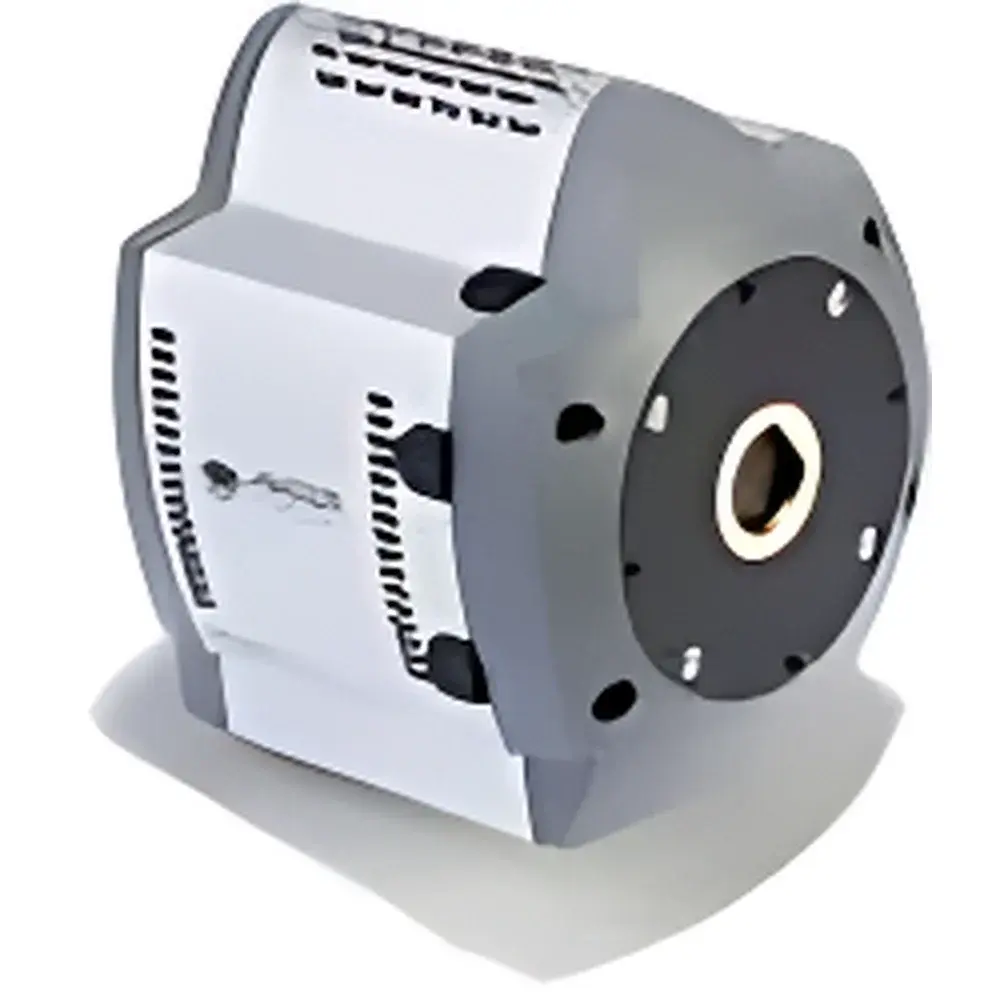
Andor iXon+ DU888 Large-Format Electron-Multiplying CCD Camera
| Brand | Andor |
|---|---|
| Origin | United Kingdom |
| Model | iXon+ DU888 |
| Sensor Format | 1024 × 1024 Frame Transfer EMCCD |
| Active Area | 13.3 × 13.3 mm |
| Pixel Size | 13.3 µm |
| Readout Speed | 30 MHz |
| Full-Frame Frame Rate | 26 fps @ 1024 × 1024 |
| Binned Frame Rate | 93 fps @ 512 × 512 |
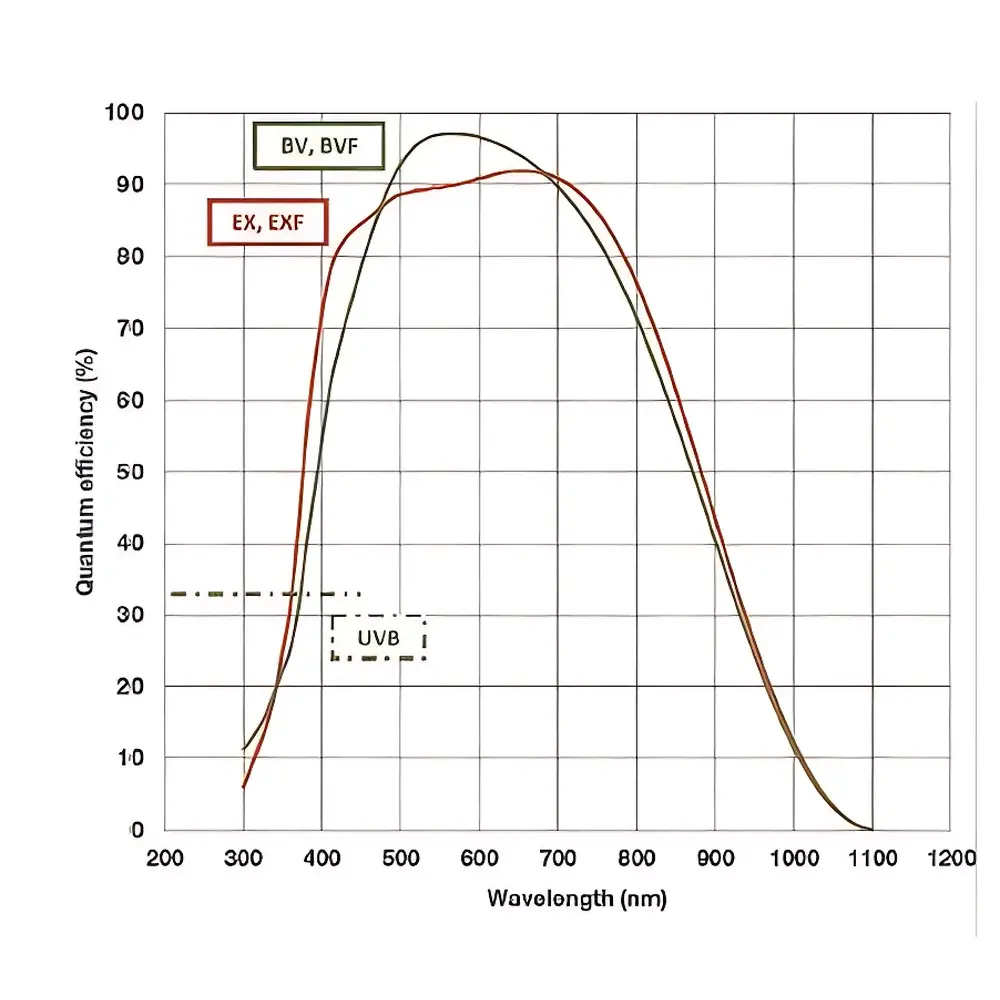
| Quantum Efficiency | Enhanced via EX2 coating (peak >95% in visible, extended NIR response) |
| Cooling | -95 °C thermoelectric with UltraVac™ vacuum seal |
| Dark Current | <0.0001 e⁻/pix/s at -95 °C |
| EM Gain Range | 1–3000× (linear, calibrated) |
| RealGain™ Technology | Real-time, hardware-based linear gain calibration |
| EMCAL™ | On-chip EM gain auto-calibration for long-term stability |
| CIC Suppression | Optimized pixel clocking + False Noise Filter (FNF) algorithm |
| Output Interface | USB 3.0 |
| Data Output Modes | Counts, electrons, photons (quantitative photon counting) |
| Etaloning Suppression | Edge-optimized coating & optical design for reduced NIR fringing |
| Baseline Stability | <0.5 ADU RMS over 1 hr |
| Vacuum Warranty | 7 years (UltraVac™) |
Overview
The Andor iXon+ DU888 is a large-format, frame-transfer electron-multiplying charge-coupled device (EMCCD) camera engineered for quantitative, single-photon-level imaging under ultra-low-light conditions. Based on a 1024 × 1024 back-illuminated sensor with a 13.3 × 13.3 mm active area, the DU888 leverages true electron multiplication in the on-chip gain register to achieve sub-electron read noise performance—effectively eliminating read noise as a limiting factor in photon-limited applications. Its operation relies on stochastic impact ionization within a high-voltage gain register, enabling deterministic amplification of photoelectrons prior to readout. This architecture delivers photon-counting capability without compromising spatial resolution or dynamic range, making it uniquely suited for time-resolved fluorescence microscopy, adaptive optics wavefront sensing, low-flux astronomical photometry, and quantum optics experiments where signal integrity, linearity, and reproducibility are non-negotiable.
Key Features
- 1024 × 1024 frame-transfer EMCCD sensor with 13.3 µm pixels and 13.3 × 13.3 mm imaging area—maximizing field-of-view while preserving Nyquist sampling in high-magnification optical systems.
- 30 MHz parallel readout delivering 26 fps at full resolution and 93 fps at 512 × 512 binning—enabling high-temporal-resolution capture of dynamic biological or physical processes.
- EX2 anti-reflection coating optimized for peak quantum efficiency (>95% at 550 nm) and extended spectral response from 200 nm to 1100 nm, with etaloning suppression in the near-infrared.
- Thermoelectric cooling to -95 °C combined with UltraVac™ hermetic vacuum sealing—ensuring <0.0001 e⁻/pix/s dark current and stable baseline performance over multi-hour acquisitions.
- RealGain™ technology: real-time, hardware-synchronized gain calibration that maps applied voltage to absolute electron multiplication factor—critical for longitudinal quantitative studies.
- EMCAL™ (EM Gain Auto-Calibration): periodic on-chip reference signal acquisition compensates for gain drift due to aging, temperature fluctuation, or voltage hysteresis.
- False Noise Filter (FNF): embedded FPGA-based processing that identifies and removes clock-induced charge (CIC) events in real time without degrading temporal fidelity or spatial resolution.
- Flexible output quantification: raw counts, calibrated electrons, or estimated incident photons—traceable to NIST-traceable calibration sources and compliant with ISO 15739:2013 for image sensor metrology.
Sample Compatibility & Compliance
The iXon+ DU888 integrates seamlessly with inverted and upright research-grade microscopes (e.g., Nikon Ti2, Olympus IXplore, Zeiss Axio Observer), including compatibility with motorized filter wheels, shutters, and stage controllers via TTL and RS-232 protocols. Its mechanical footprint and C-mount interface conform to ISO 10110-7 optical mounting standards. The camera’s firmware and driver stack support Windows/Linux environments and comply with USB Video Class (UVC) 1.5 specifications for plug-and-play integration. For regulated environments, the system supports audit trail logging and user-access controls when used with Andor’s Solis or SDK-based custom software—facilitating alignment with GLP, GMP, and FDA 21 CFR Part 11 requirements for electronic records and signatures.
Software & Data Management
Andor Solis v5.x provides native support for all DU888 functionalities—including RealGain™ visualization, EMCAL™ scheduling, FNF threshold tuning, and multi-modal data export (TIFF, HDF5, FITS). The SDK (C/C++, Python, MATLAB) enables full programmatic control of exposure, gain, ROI, and calibration routines. All quantitative outputs (electron counts, photon estimates) are embedded with metadata compliant with the FITS standard (including BSCALE/BZERO, EXPTIME, GAIN, TEMPERAT, and EMGAIN keywords). Time-stamped acquisition logs, gain calibration history, and vacuum status telemetry are archived automatically—supporting traceability in peer-reviewed publications and regulatory submissions.
Applications
- Single-molecule fluorescence imaging (smFRET, PALM/STORM) requiring high spatiotemporal resolution and photon budget efficiency.
- Calcium and voltage-sensitive dye imaging in live neurons and cardiac tissue at frame rates exceeding physiological dynamics.
- Adaptive optics correction loops in ground-based astronomy, where wavefront sensor latency must remain below 10 ms.
- Low-light Raman spectroscopy and time-gated luminescence lifetime mapping in materials science.
- Quantum key distribution (QKD) receiver validation and entangled photon pair detection.
- High-dynamic-range radioluminescence imaging in preclinical radio-pharmaceutical development.
FAQ
What is the primary advantage of frame-transfer architecture in the DU888 compared to interline EMCCDs?
Frame-transfer design eliminates smearing during rapid exposures by transferring accumulated charge to a masked storage region in <1 µs—preserving image fidelity in fast kinetic experiments where interline fill-factor limitations and vertical smear would otherwise dominate.
How does RealGain™ differ from conventional EM gain reporting?
Unlike nominal voltage-based gain settings, RealGain™ uses synchronized reference pulses and on-chip test structures to deliver a per-frame, absolute electron multiplication factor—enabling cross-session and cross-instrument quantitative comparison.
Is the UltraVac™ vacuum seal serviceable or replaceable after the 7-year warranty period?
No—the UltraVac™ seal is a permanently bonded, helium-leak-tested enclosure; end-of-warranty vacuum degradation necessitates factory reconditioning or sensor replacement per Andor’s service policy.
Can the DU888 operate in photon-counting mode without post-acquisition thresholding?
Yes—its combination of ultra-low read noise (<0.1 e⁻ rms), calibrated EM gain, and FNF allows true photon-event discrimination at the hardware level, with output directly in photon-equivalent units.
Does the camera support hardware-triggered synchronization with pulsed lasers or external event markers?
Yes—via LVDS-compatible trigger input with <10 ns jitter, supporting master-slave timing configurations for pump-probe, LIDAR, or time-correlated single-photon counting (TCSPC) setups.




