
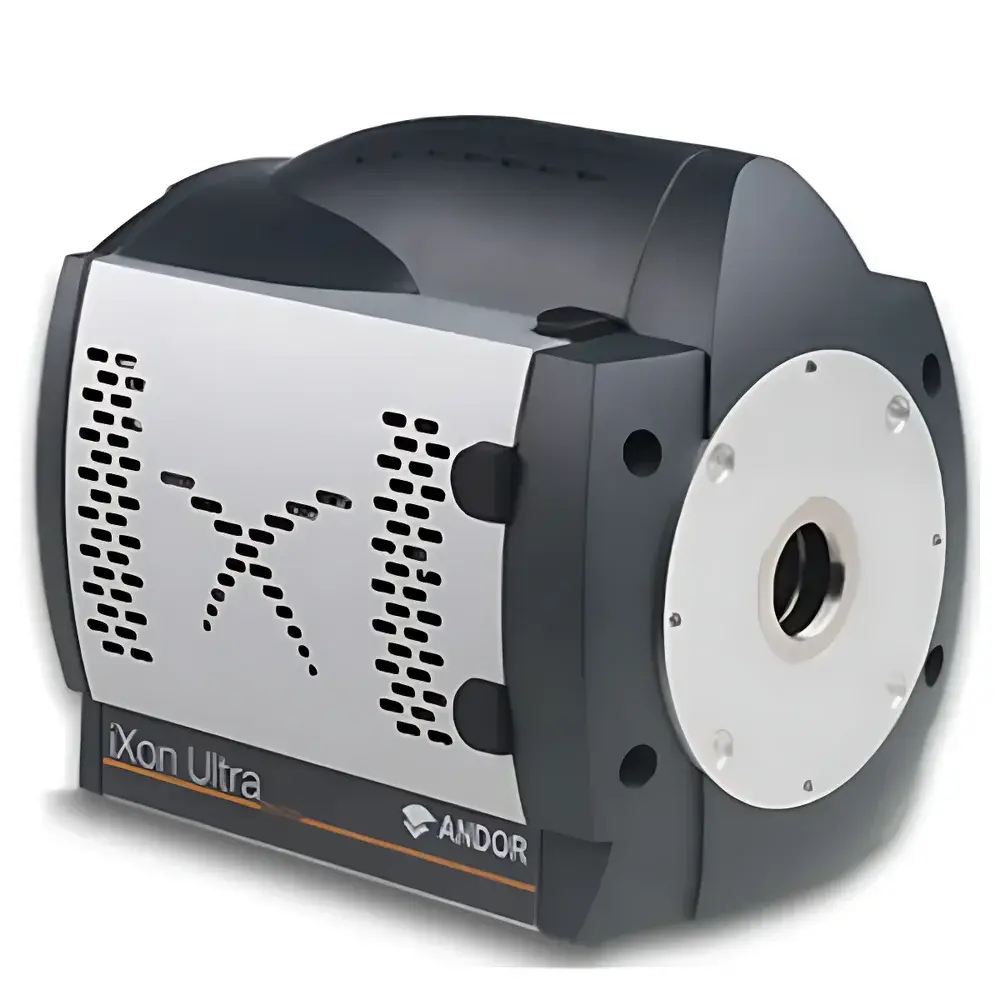
Andor iXon Life 888 EMCCD Camera
| Brand | Andor |
|---|---|
| Origin | Belgium |
| Model | iXon Life 888 |
| Sensor Type | Back-Illuminated EMCCD |
| Resolution | 1024 × 1024 |
| Pixel Size | 13 µm |
| Full-Frame Frame Rate | 26 fps |
| Cooling Temperature | -80 °C |
| Shutter Type | Global Shutter |
| Interface | USB 3.0 |
| QE Peak | >95% |
| Read Noise | Sub-electron (EM-gain enabled) |
| Dark Current | <0.001 e⁻/pix/s at -80 °C |
| EM Gain Range | Up to 3000× |
Overview
The Andor iXon Life 888 is a high-speed, ultra-sensitive electron-multiplying charge-coupled device (EMCCD) camera engineered for quantitative low-light scientific imaging. Leveraging back-illuminated silicon sensor architecture and on-chip electron multiplication gain, the iXon Life 888 achieves single-photon detection capability with photon-counting fidelity under extremely low illumination conditions. Its peak quantum efficiency exceeds 95% in the visible to near-UV range (400–700 nm), enabling optimal signal capture from weakly fluorescent or transient biological specimens. The vacuum-sealed, thermoelectrically cooled housing maintains stable sensor temperature down to -80 °C—suppressing dark current to <0.001 e⁻/pix/s—and ensuring high signal-to-noise ratio (SNR) over extended exposure durations. Designed specifically for integration into fluorescence microscopy platforms—including TIRF, confocal, and super-resolution systems—the iXon Life 888 balances sensitivity, speed, and field-of-view without compromising spatial resolution or temporal fidelity.
Key Features
- Back-illuminated EMCCD sensor with 1024 × 1024 active pixels and 13 µm pixel pitch for optimal light collection and spatial sampling
- Global shutter operation eliminates motion artifacts during rapid acquisition sequences
- USB 3.0 interface enables high-bandwidth data transfer up to 26 full-frame images per second
- Vacuum-based cryogenic cooling system delivers stable thermal management at -80 °C, minimizing thermally induced noise
- On-chip electron multiplication gain (up to 3000×) allows effective read noise suppression below 1 electron RMS
- Integrated mechanical shutter option supports precise exposure control and synchronization with external triggers
- Firmware-controlled gain calibration and linear response across EM and conventional CCD readout modes
Sample Compatibility & Compliance
The iXon Life 888 is routinely deployed in live-cell imaging workflows where phototoxicity and photobleaching must be minimized—such as single-molecule tracking, Ca²⁺ dynamics, and organelle motility studies. Its high QE and sub-electron noise performance enable reliable quantification of sparse fluorophore signals without excessive excitation intensity. The camera complies with CE marking requirements for laboratory instrumentation and meets RoHS Directive 2011/65/EU standards. Firmware architecture supports audit-trail logging and user-access controls aligned with GLP-compliant environments. While not FDA 21 CFR Part 11 certified out-of-the-box, its metadata-rich TIFF output and deterministic timestamping facilitate integration into validated imaging pipelines under GxP frameworks when paired with appropriate LIMS or image analysis software.
Software & Data Management
Controlled via Andor’s fully featured SDK (Software Development Kit) and intuitive Solis® imaging software, the iXon Life 888 supports real-time preview, multi-dimensional acquisition (Z-stacks, time-lapse, multi-channel), and hardware-synchronized triggering. Solis provides built-in EM gain calibration tools, photon event counting mode, and non-uniformity correction (NUC) routines. All acquired images are saved in open-format TIFF with embedded metadata—including exposure time, gain setting, sensor temperature, and timestamp—ensuring traceability and reproducibility. The SDK supports Python, MATLAB, LabVIEW, and C/C++ integration, enabling custom automation and incorporation into automated microscopy platforms or AI-driven analysis pipelines.
Applications
- Single-molecule fluorescence microscopy (e.g., PALM, STORM preparation, smFRET)
- Live-cell calcium imaging and membrane potential sensing
- TIRF microscopy for adhesion complex dynamics and vesicle trafficking
- Low-light bioluminescence and chemiluminescence detection
- Quantitative colocalization analysis requiring high dynamic range and linearity
- Time-resolved spectroscopy coupling via fiber-optic input adapters
FAQ
What is the difference between EMCCD and sCMOS technology?
EMCCDs provide true single-photon sensitivity with negligible read noise at high gain, making them ideal for ultra-low-light applications with short exposures. sCMOS offers higher frame rates and larger fields of view but typically exhibits higher read noise (~1–2 e⁻) and lower QE in UV-blue regions.
Can the iXon Life 888 be used for quantitative intensity measurements?
Yes—when operated within its linear EM gain regime and calibrated using Andor’s photon-response curve, it delivers quantitative intensity data traceable to NIST standards via factory calibration reports.
Is vacuum re-filling required during normal operation?
No—the iXon Life 888 uses a permanently sealed, maintenance-free vacuum enclosure; no user-serviceable vacuum components are present.
Does the camera support hardware triggering from external TTL sources?
Yes—full support for master/slave triggering, exposure synchronization, and programmable delay timing via BNC I/O ports.
How is sensor temperature stability maintained during long acquisitions?
The dual-stage thermoelectric cooler (TEC) operates in closed-loop feedback mode, maintaining ±0.1 °C stability over 24-hour periods—even under ambient temperature fluctuations up to ±5 °C.





