
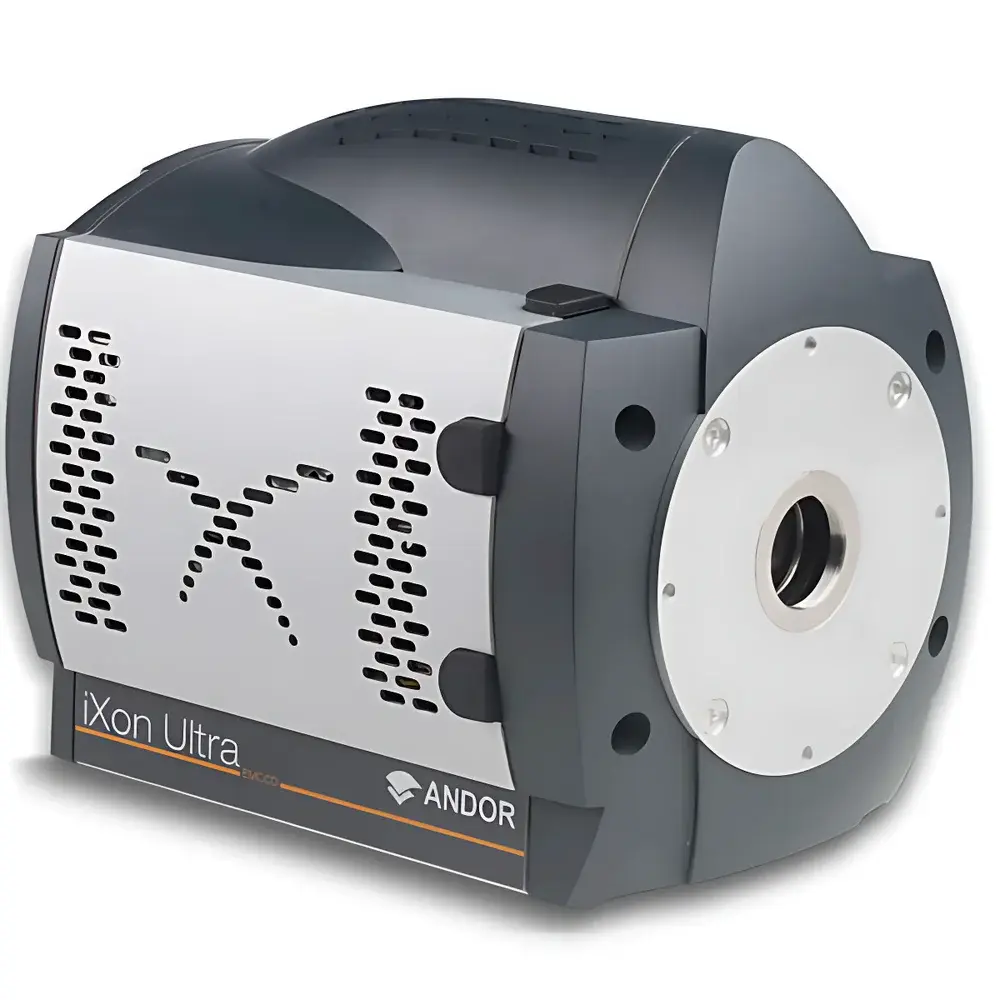
Andor iXon Ultra 888 EMCCD Camera
| Brand | Andor |
|---|---|
| Origin | United Kingdom |
| Model | iXon Ultra 888 |
| Sensor Format | 1024 × 1024 pixels |
| Pixel Size | 13 µm |
| Quantum Efficiency | >95% (peak, back-illuminated) |
| Technology | Electron-Multiplying CCD (EMCCD) |
| Primary Application | Single-molecule fluorescence microscopy, live-cell super-resolution imaging |
Overview
The Andor iXon Ultra 888 is a high-performance, back-illuminated electron-multiplying charge-coupled device (EMCCD) camera engineered for quantitative low-light scientific imaging—particularly in demanding life science applications where single-photon detection sensitivity, temporal fidelity, and spatial precision are critical. Leveraging deep-depletion silicon architecture and thermoelectric cooling to –100 °C, the iXon Ultra 888 achieves photon-limited signal detection with sub-electron effective read noise—even at high frame rates—enabling reliable visualization of transient molecular events without compromising cellular physiology. Its 1024 × 1024 pixel array, combined with 13 µm square pixels, delivers an optimal balance of field-of-view, resolution, and full-well capacity for widefield and TIRF-based modalities. Unlike conventional CCDs or sCMOS sensors, the iXon Ultra 888 integrates on-chip electron multiplication gain (up to 5000×), effectively overcoming read noise floor limitations while preserving linearity and quantitative integrity across dynamic ranges up to 16-bit.
Key Features
- Back-illuminated EMCCD sensor with peak quantum efficiency exceeding 95% in the 500–700 nm range—optimized for common fluorophores including GFP, mCherry, Alexa Fluor dyes, and Cy5.
- Thermoelectric cooling to –100 °C with vacuum-sealed cold finger architecture, ensuring ultra-low dark current (<0.0001 e⁻/pix/s) and stable operation during extended time-lapse acquisitions.
- Real-time electron multiplication gain control with calibrated lookup tables—enabling reproducible, traceable amplification settings compliant with GLP/GMP documentation requirements.
- High-speed USB 3.0 interface supporting sustained frame rates up to 25 fps at full resolution (1024 × 1024), scalable to >500 fps in cropped ROI modes—ideal for rapid kinetic assays and SRRF-Stream acquisition.
- Hardware-based intelligent clocking (ICC) technology to suppress spurious noise sources including clock-induced charge (CIC) and multiplication register non-uniformity.
- Integrated mechanical shutter and programmable trigger I/O for precise synchronization with laser illumination, stage movement, and peripheral hardware (e.g., piezo Z-drives, AOTFs).
Sample Compatibility & Compliance
The iXon Ultra 888 is routinely deployed in ISO 17025-accredited core imaging facilities and FDA-regulated biopharmaceutical development labs. It supports compliance-critical workflows through native compatibility with standardized metadata embedding (TIFF + OME-XML), audit-trail-enabled acquisition logs, and full support for 21 CFR Part 11–compliant software environments via Andor’s Fusion SDK and third-party platforms (e.g., Micro-Manager, NIS-Elements, SlideBook). The camera meets CE marking requirements under the EU Electromagnetic Compatibility Directive 2014/30/EU and RoHS 2011/65/EU. Its optical interface (C-mount and optional F-mount adapters) ensures seamless integration with upright and inverted research-grade microscopes—including Zeiss Axio, Nikon Eclipse Ti, and Leica DMi8 platforms—without requiring intermediate relay optics that degrade MTF.
Software & Data Management
Andor’s proprietary Solis and Fusion software suites provide turnkey acquisition, real-time processing, and export pipelines validated for publication-grade data handling. Solis offers intuitive wizard-driven protocols for SRRF-Stream, TIRF, FRAP, and single-particle tracking—each preserving raw photon counts and gain calibration metadata. Fusion SDK enables custom Python/C++ integration for automated pipeline deployment in high-throughput screening environments. All acquired datasets include embedded EXIF-like headers containing exposure time, EM gain setting, sensor temperature, and hardware timestamping—facilitating retrospective validation and cross-platform reproducibility analysis per ISO/IEC 17025 Clause 7.7.
Applications
- Live-cell super-resolution imaging using SRRF-Stream, enabling ~100 nm resolution at video rates without phototoxicity or exogenous labeling artifacts.
- Single-molecule localization microscopy (SMLM), including PALM and STORM, where high photon yield per frame and minimal localization uncertainty are essential.
- Fluorescence correlation spectroscopy (FCS) and number & brightness (N&B) analysis requiring shot-noise-limited intensity time series.
- Ion channel electrophysiology correlation studies using simultaneous patch-clamp and Ca²⁺/voltage-sensitive dye imaging.
- Quantitative Förster resonance energy transfer (FRET) measurements in fixed and living specimens with ratiometric stability across multi-hour experiments.
FAQ
What distinguishes the iXon Ultra 888 from standard sCMOS cameras in low-light applications?
The iXon Ultra 888 provides deterministic single-photon sensitivity with sub-electron effective read noise via EM gain—whereas sCMOS sensors exhibit higher intrinsic read noise (>1 e⁻ RMS) and lack true photon-counting capability at equivalent speeds.
Is the EM gain calibrated and stable over time?
Yes. Each iXon Ultra 888 undergoes factory calibration of EM gain versus voltage, stored in non-volatile memory; gain drift is <0.3% over 24 h at constant temperature.
Can the camera be used in regulated GxP environments?
Yes. When operated with Fusion software in 21 CFR Part 11 mode, it supports electronic signatures, audit trails, and role-based access control—validated for use in QC release testing per USP and ICH Q5C.
Does the system support hardware triggering for synchronization with pulsed lasers?
Yes. The camera features dual TTL-compatible input/output lines with <100 ns jitter, configurable for external start, frame trigger, or strobe output modes.
What cooling performance is guaranteed under continuous operation?
The vacuum-cooled sensor maintains ≤ –95 °C at ambient temperatures up to 30 °C, with thermal stability of ±0.1 °C over 8 h—verified per Andor’s Certificate of Calibration (CoC).




