
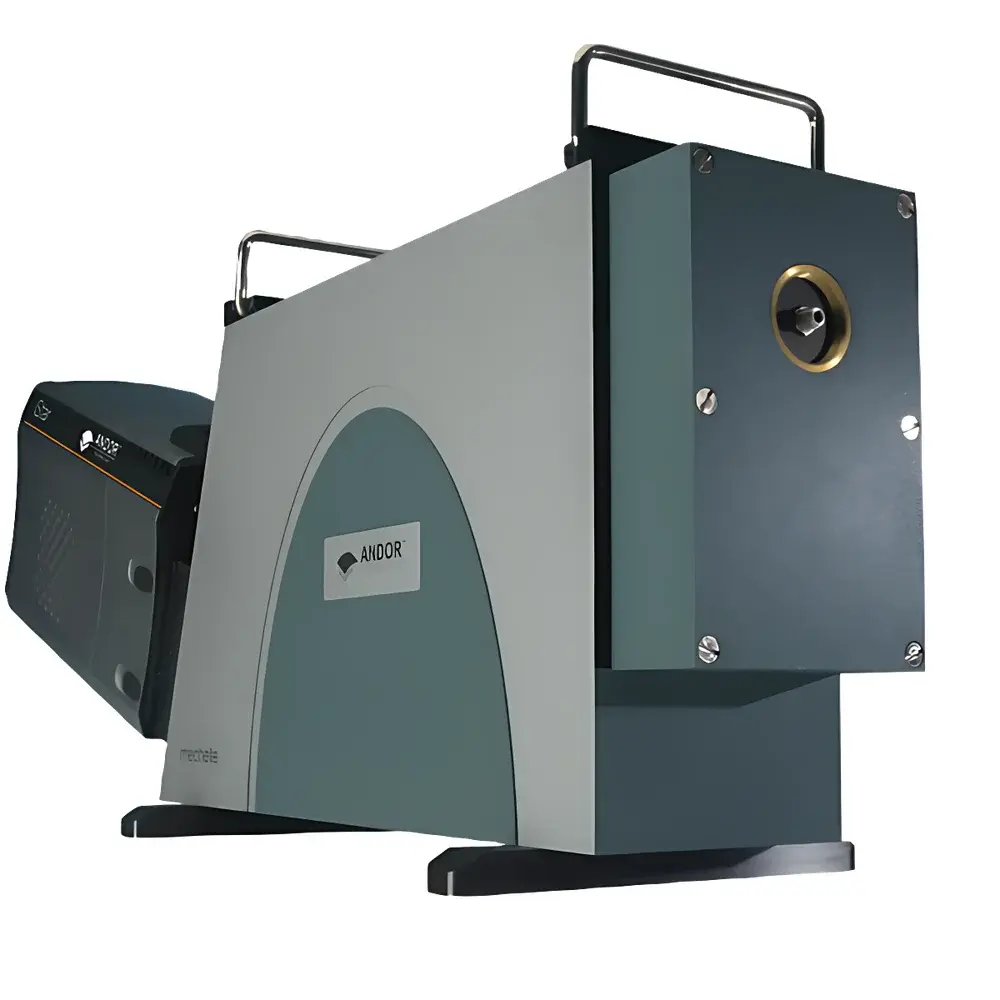
Andor Mechelle 5000 Echelle Spectrograph
| Brand | Andor |
|---|---|
| Origin | United Kingdom |
| Model | Mechelle 5000 |
| Spectral Range | 200–975 nm |
| Optical Architecture | Fixed, pre-aligned echelle spectrograph with no moving parts |
| Detector Format | Integrated CCD or sCMOS detector (user-selectable) |
| Resolution | High-resolution echelle dispersion (R ≈ 20,000–40,000 depending on slit and detector configuration) |
| Wavelength Coverage | Simultaneous full-range acquisition without scanning |
Overview
The Andor Mechelle 5000 is a high-performance, fixed-configuration echelle spectrograph engineered for simultaneous broadband spectral acquisition across the ultraviolet to near-infrared range (200–975 nm). Unlike scanning monochromators or tunable filter-based systems, the Mechelle 5000 employs a robust echelle grating architecture coupled with cross-dispersion optics to project the entire spectrum onto a two-dimensional detector array in a single exposure. This eliminates mechanical wavelength scanning, thereby ensuring exceptional measurement reproducibility, reduced thermal drift, and immunity to mechanical hysteresis—critical attributes for long-term stability in laboratory, industrial, and field-deployable spectroscopic applications. Its rigid, pre-aligned optical bench minimizes alignment sensitivity and supports operation under moderate environmental fluctuations, making it suitable for integration into OEM systems, plasma diagnostics platforms, and atomic emission analysis workflows where temporal resolution and spectral fidelity are paramount.
Key Features
- Simultaneous full-spectrum acquisition from 200 nm to 975 nm in a single exposure—no motorized grating rotation or filter wheel actuation required
- Fixed echelle optical path with integrated cross-disperser and optimized collimation optics, delivering high spectral resolution (R ≈ 20,000–40,000, dependent on entrance slit width and detector pixel scale)
- Modular detector interface supporting scientific-grade back-illuminated CCD or low-noise sCMOS sensors (e.g., Andor iStar, Neo, or Zyla platforms), enabling flexibility in sensitivity, dynamic range, and frame rate
- Thermally stabilized housing with optional active cooling (−15 °C to −60 °C) to suppress dark current and enhance signal-to-noise ratio for weak-emission measurements
- Standard C-mount and SM1-threaded interfaces for seamless integration with telescopes, microscopes, fiber-optic couplers, or custom optical train assemblies
- Compliance with CE, RoHS, and UKCA directives; designed and manufactured in Belfast, Northern Ireland, under ISO 9001-certified quality management systems
Sample Compatibility & Compliance
The Mechelle 5000 is optimized for light sources exhibiting discrete line spectra (e.g., arc lamps, laser-induced plasmas, ICP emissions) as well as broad-band continuum sources requiring high-fidelity spectral deconvolution. It accepts input via free-space optics or standard 0.5–1.0 mm core multimode optical fibers (SMA905 or FC/PC terminated). The instrument’s spectral calibration is traceable to NIST-certified emission lines (e.g., Hg, Ne, Ar, Cd), and factory calibration reports include wavelength accuracy (±0.01 nm RMS) and pixel-to-wavelength mapping coefficients. For regulated environments—including pharmaceutical QC labs, environmental monitoring stations, and academic facilities operating under GLP or GMP frameworks—the system supports audit-trail-enabled software logging and can be configured to meet FDA 21 CFR Part 11 requirements when paired with Andor’s Solis or SDK-controlled acquisition environments.
Software & Data Management
Control and data reduction are performed using Andor’s Solis Spectroscopy Software (Windows-based), which provides real-time spectral preview, multi-region-of-interest (ROI) extraction, background subtraction, intensity normalization, and peak centroiding with sub-pixel accuracy. Raw FITS and HDF5 export formats ensure compatibility with third-party analysis pipelines (e.g., Python/SciPy, MATLAB, Igor Pro, or LabVIEW). The Mechelle 5000 also supports direct integration via Andor’s Software Development Kit (SDK), enabling custom automation in Python, C++, or .NET environments. All acquired spectra retain embedded metadata—including exposure time, detector temperature, grating position (fixed), and calibration timestamp—facilitating traceability and batch processing in regulated analytical workflows.
Applications
- Atomic emission spectroscopy (AES) for elemental analysis in metallurgy, geology, and semiconductor process monitoring
- Laser-induced breakdown spectroscopy (LIBS) for rapid in-situ material identification and mapping
- Astronomical spectroscopy for stellar classification and radial velocity measurements using small-to-medium aperture telescopes
- Plasma diagnostics in fusion research and industrial plasma etching chambers
- Environmental monitoring of trace gas emissions via UV-Vis absorption or fluorescence signatures
- Time-resolved spectroscopy in pump-probe experiments when synchronized with ultrafast laser systems (via TTL trigger inputs)
FAQ
Does the Mechelle 5000 require wavelength recalibration between experiments?
No—its fixed echelle configuration and thermally stable mechanical design eliminate routine recalibration. A single NIST-traceable calibration suffices for extended operation; optional daily reference lamp checks are supported via software.
Can the Mechelle 5000 be used with pulsed light sources such as Q-switched lasers?
Yes. With external TTL triggering and sub-microsecond electronic shutter control (via detector gating), it supports time-gated spectral acquisition down to nanosecond-scale windows when paired with Andor iStar intensified detectors.
Is fiber coupling standardized, and what is the typical throughput efficiency?
The system accepts SMA905-terminated fibers with 0.22 NA; throughput depends on fiber core size and alignment but typically exceeds 65% across 350–800 nm with a 50 µm slit and 100 µm fiber core.
How is spectral stray light managed in the echelle design?
Stray light suppression is achieved through multi-stage baffling, optimized grating blaze matching, and order-sorting filters mounted directly in the collimated beam path—ensuring < 1×10⁻⁴ stray light rejection at ±5 nm from strong emission lines.
Related Products





