
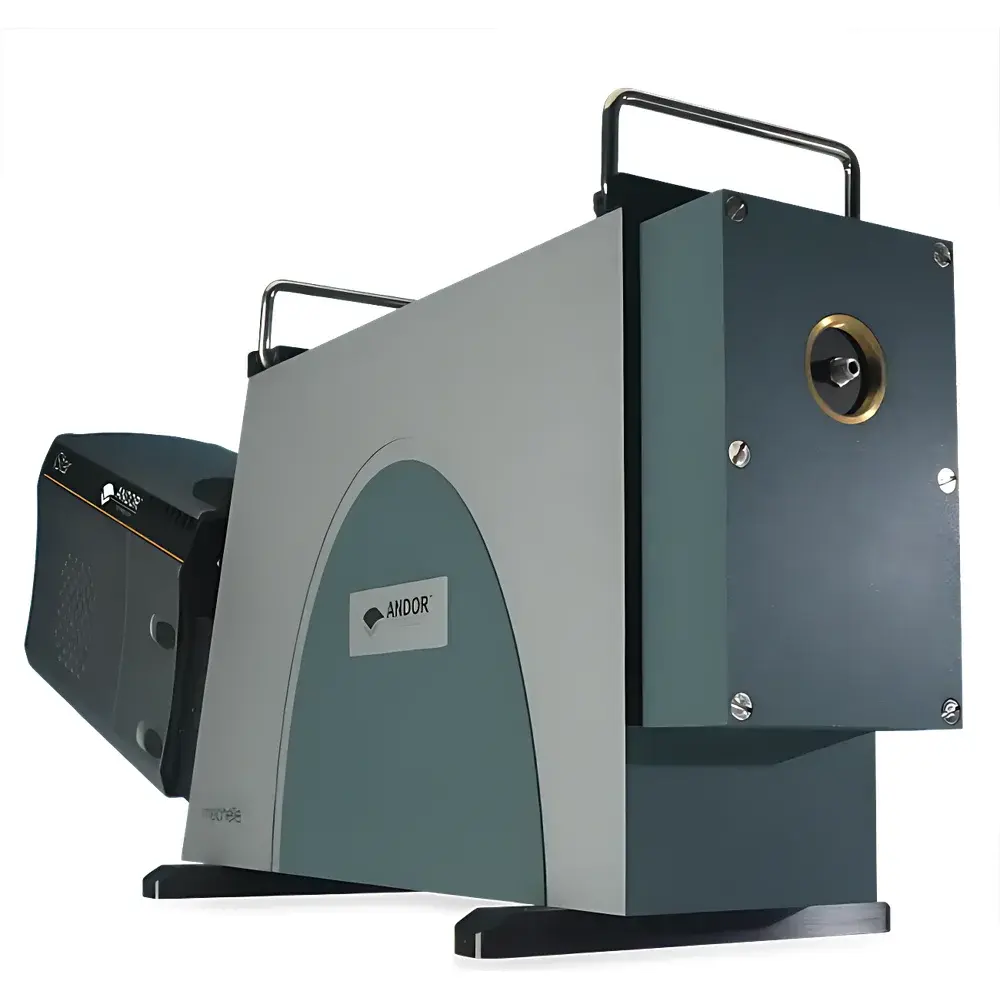
Andor Mechelle 5000 Echelle Spectrograph
| Brand | Oxford Instruments |
|---|---|
| Origin | United Kingdom |
| Model | Mechelle 5000 |
| Wavelength Range | 200–975 nm |
| Optical Configuration | Fixed-grating, pre-aligned echelle spectrograph |
| Detector Integration | Integrated CCD/CMOS detector option |
| Cooling | Thermoelectric (TE) cooled detector |
| Purge Environment | N₂-purged optical path |
| Temperature Stabilization | Auto-temperature correction system |
| Mechanical Design | Compact, rigid monolithic housing |
| Moving Parts | None |
Overview
The Andor Mechelle 5000 is a high-resolution, fixed-format echelle spectrograph engineered for simultaneous broadband spectral acquisition across the deep ultraviolet to near-infrared range (200–975 nm). Unlike scanning monochromators or tunable grating systems, the Mechelle 5000 employs a patented echelle optical architecture that disperses light orthogonally using a coarse, high-blaze-angle echelle grating and a cross-disperser—typically a prism or secondary grating—to separate overlapping spectral orders. This two-dimensional dispersion enables full-spectrum capture in a single exposure without mechanical scanning, delivering exceptional temporal fidelity for time-resolved emission studies, plasma diagnostics, and transient chemical kinetics. Its all-fixed-optics design eliminates motorized gratings, filter wheels, or slit drives—reducing mechanical drift, alignment sensitivity, and long-term calibration instability. The instrument is optimized for integration with Andor’s iXon or Zyla scientific cameras, supporting both back-illuminated CCD and sCMOS detectors with deep depletion and UV-enhanced coatings.
Key Features
- Simultaneous Full-Spectrum Acquisition: Captures the entire 200–975 nm range in one exposure, preserving signal correlation across wavelengths and enabling true snapshot spectroscopy.
- Patented Echelle Optical Layout: Utilizes a high-efficiency, low-scatter echelle grating combined with a prism cross-disperser to resolve >60,000 spectral lines with minimal order overlap and high inter-order separation.
- Auto-Temperature Correction System: Monitors internal thermal gradients in real time and applies pixel-level wavelength recalibration, ensuring sub-pixel spectral stability over multi-hour acquisitions.
- N₂-Purged Optical Path: Sealed, continuously purged compartment eliminates atmospheric absorption bands (e.g., O₂ at 760 nm, H₂O vapor below 250 nm), critical for UV-VIS integrity and reproducible quantitative analysis.
- Pre-Aligned Detector/Spectrograph Integration: Factory-aligned optical train with calibrated focal plane ensures plug-and-play compatibility with Andor detectors—no user collimation or focus adjustment required.
- Compact & Mechanically Robust Housing: Monolithic aluminum chassis with vibration-damped mounting interfaces minimizes microphonic noise and supports operation on optical tables, vacuum chambers, or industrial process enclosures.
Sample Compatibility & Compliance
The Mechelle 5000 is compatible with fiber-coupled, free-space, and direct-imaging input configurations. It accepts standard 1/4″ or 1/2″ core multimode fibers (e.g., Ocean Insight QP series, Thorlabs FG series) via SMA905 or FC/PC adapters. For plasma and arc sources, it supports gated intensifiers (e.g., Andor IStar) for ns-scale time-resolved measurements. The spectrograph meets CE marking requirements for electromagnetic compatibility (EMC Directive 2014/30/EU) and low-voltage safety (LVD Directive 2014/35/EU). Its sealed, N₂-purged enclosure complies with ISO 8573-1:2010 Class 2 air purity standards when integrated into laboratory gas supply networks. While not certified for intrinsic safety, its passive optical design and absence of high-voltage components make it suitable for use in Class I, Division 2 hazardous locations when installed per NEC Article 500 guidelines.
Software & Data Management
Control and data acquisition are managed through Andor’s SOLIS software platform (v6.10+), which provides native support for echelle spectrum deconvolution, order stitching, and wavelength calibration using Hg/Ar/Ne lamp spectra or built-in polynomial fitting routines. SOLIS includes GLP-compliant audit trail logging, electronic signature capability, and export options compliant with ASTM E1394-18 (standard format for spectral data exchange). Raw 2D echelle images can be exported as FITS or HDF5 files for custom processing in Python (using specutils, astropy) or MATLAB. The system supports remote operation via TCP/IP and integrates with LabVIEW through Andor’s ActiveX and .NET SDKs. All calibration files—including pixel-to-wavelength maps and flat-field corrections—are stored with versioned metadata and timestamped checksums to satisfy FDA 21 CFR Part 11 requirements for traceability in regulated QC environments.
Applications
- Laser-induced breakdown spectroscopy (LIBS) for elemental mapping in metallurgy and geoscience
- Inductively coupled plasma optical emission spectrometry (ICP-OES) with multi-element quantification
- Time-resolved combustion diagnostics and flame chemiluminescence analysis
- Astronomical calibration source characterization and echelle reference lamp validation
- UV-VIS absorption and fluorescence lifetime spectroscopy in photochemistry labs
- Process analytical technology (PAT) deployment for real-time reaction monitoring in API synthesis
FAQ
Does the Mechelle 5000 require external wavelength calibration lamps?
Yes—while factory-calibrated, routine recalibration using Hg, Ar, or Ne emission lamps is recommended every 72 hours for metrology-grade applications or after environmental temperature shifts exceeding ±3°C.
Can the Mechelle 5000 be used under vacuum or in inert gas environments?
The spectrograph itself is not vacuum-rated; however, its N₂-purged internal volume isolates the optics from ambient atmosphere. It may be mounted inside a glovebox or purged enclosure provided external feedthroughs maintain purge integrity.
Is spectral resolution specified per pixel or per resolving power (R = λ/Δλ)?
Resolution is defined by the echelle configuration: R ≈ 30,000–40,000 (FWHM) across the visible range, corresponding to ~0.01–0.015 nm at 500 nm with a 16-µm pixel detector.
What detector cooling specifications are supported?
Thermoelectric cooling down to –80°C (relative to ambient) is standard; liquid nitrogen-cooled variants are available upon request for ultra-low dark current applications.
How is stray light performance characterized?
Stray light rejection exceeds OD 6 (0.0001% transmission) at ±10 nm from strong emission lines, verified per ISO 14687:2022 Annex C using tungsten-halogen continuum sources.



