
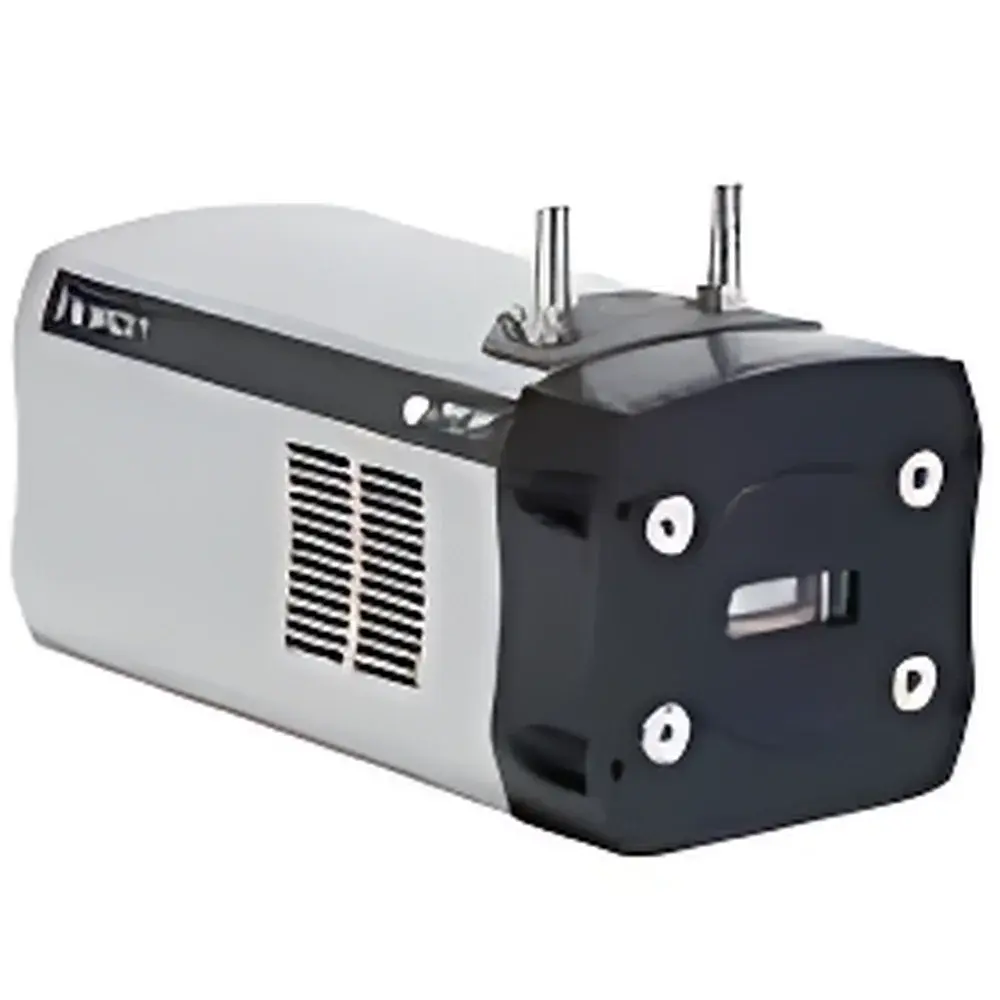
Andor Newton Series High-Performance Spectroscopic CCD Camera
| Brand | Andor |
|---|---|
| Origin | United Kingdom |
| Model | Newton Series |
| Sensor Formats | 2048 × 512 & 1024 × 256 |
| Cooling Temperature | Down to –100 °C (thermoelectric) |
| Vacuum Encapsulation | UltraVac™ |
| Interface | USB 2.0 |
| Compliance | CE, RoHS, ISO 9001-certified manufacturing |
| Software Support | Andor SOLIS®, SDK for LabVIEW, MATLAB, Python |
| Typical Read Noise | <3 e⁻ RMS (at 1 MHz) |
| Dark Current | <0.001 e⁻/pix/s at –100 °C |
Overview
The Andor Newton Series High-Performance Spectroscopic CCD Camera is an engineered solution for demanding low-light spectral acquisition in research-grade spectroscopy, Raman imaging, fluorescence lifetime analysis, and time-resolved photoluminescence applications. Built around back-illuminated, deep-depletion CCD sensors with pixel architectures of 2048 × 512 and 1024 × 256, the Newton platform delivers exceptional quantum efficiency (>95% peak QE in visible–NIR range) and ultra-low temporal noise—enabling high-fidelity spectral line profiling and quantitative intensity mapping. Its core measurement principle relies on photon-to-electron conversion within a thermally stabilized silicon lattice, where spectral dispersion is achieved externally via grating or prism-based spectrometers. The camera operates as a calibrated, linear-intensity detector, supporting both single-shot and kinetic acquisition modes with precise synchronization to external triggers (TTL, optical, or software-controlled). Designed for integration into vacuum-compatible or cryogenic optical benches, it serves as a primary detection engine in synchrotron beamlines, laser laboratories, and metrology facilities requiring trace-level signal fidelity.
Key Features
- Ultra-deep thermoelectric cooling to –100 °C, minimizing dark current to <0.001 e⁻/pix/s—critical for long-exposure spectral integration without thermal drift.
- Andor’s proprietary UltraVac™ vacuum encapsulation ensures permanent hermetic seal integrity; no periodic re-pumping or maintenance required over typical instrument lifetimes (>10 years under standard lab conditions).
- Back-illuminated, deep-depletion CCD architecture optimized for high QE across 200–1100 nm, including enhanced response in UV (with optional quartz window) and extended NIR (up to 1100 nm).
- USB 2.0 interface enables plug-and-play operation with full 16-bit digitization, real-time histogram monitoring, and hardware-level binning (1×1 to 8×8) for dynamic range optimization.
- Programmable clocking architecture supports multiple readout speeds (100 kHz to 3 MHz), adjustable gain settings, and non-destructive correlated double sampling (CDS) to suppress reset noise.
- Robust mechanical design compliant with ISO 9001 manufacturing standards; CE- and RoHS-certified for deployment in regulated academic and industrial environments.
Sample Compatibility & Compliance
The Newton Series is compatible with all standard C-mount and F-mount spectrograph couplings, including fiber-optic input (SMA 905), direct slit coupling, and microscope port integration. It supports both ambient and controlled-environment operation (e.g., glove-boxes, vacuum chambers up to 10⁻⁶ mbar), provided feedthrough compatibility is maintained. From a regulatory standpoint, the system conforms to IEC 61326-1 (EMC for laboratory equipment), meets essential requirements of the EU Machinery Directive 2006/42/EC, and supports audit-ready data provenance when used with Andor SOLIS® software configured for GLP/GMP workflows (including 21 CFR Part 11-compliant electronic signatures and audit trails upon optional license activation).
Software & Data Management
Andor SOLIS® is the native acquisition and analysis suite, offering intuitive spectral calibration (pixel-to-wavelength mapping via Hg/Ar lamp references), real-time background subtraction, multi-region-of-interest (ROI) extraction, and export to industry-standard formats (FITS, TIFF, CSV, HDF5). A comprehensive SDK provides native drivers for LabVIEW, MATLAB, and Python (via PyAndor), enabling custom automation in CI/CD pipelines or integration with Python-based spectral libraries (e.g., SciPy, Astropy). All raw frame data retain embedded metadata—including exposure time, temperature, gain, and timestamp—ensuring traceability per ISO/IEC 17025 requirements for accredited testing laboratories.
Applications
- Raman spectroscopy: Resolving sub-wavenumber peaks in carbon nanotube G/D band analysis and pharmaceutical polymorph identification.
- Time-resolved fluorescence: Capturing nanosecond-scale decay kinetics using gated acquisition synchronized to pulsed lasers.
- Astronomical spectroscopy: Low-noise stellar spectral classification in medium-resolution echelle systems.
- Plasma diagnostics: Line-ratio thermometry in fusion-relevant argon/oxygen discharge spectra.
- Environmental monitoring: Quantitative detection of trace metal emissions (e.g., Pb, Cd, As) via laser-induced breakdown spectroscopy (LIBS).
FAQ
What sensor formats are available in the Newton Series?
The Newton Series offers two standard configurations: 2048 × 512 pixels and 1024 × 256 pixels, both with 13.5 µm square pixels and optional AR-coating options for UV or NIR optimization.
Is liquid nitrogen cooling supported?
No—the Newton Series uses exclusively thermoelectric (Peltier) cooling; its –100 °C capability represents the practical limit of multi-stage solid-state refrigeration and eliminates the operational overhead of cryogen handling.
Can the camera be synchronized with external laser pulses?
Yes—hardware trigger inputs (TTL-compatible) support start-delay-stop timing with sub-microsecond jitter, enabling pump-probe and gated-integration experiments.
Does the system support radiometric calibration?
Yes—NIST-traceable quantum efficiency curves are supplied with each unit; absolute irradiance calibration is achievable using calibrated light sources and Andor’s spectral responsivity module in SOLIS®.
What is the typical warranty and service coverage?
Andor provides a standard 24-month limited warranty; extended service plans include on-site calibration verification, preventive maintenance, and priority firmware/software update access.





