
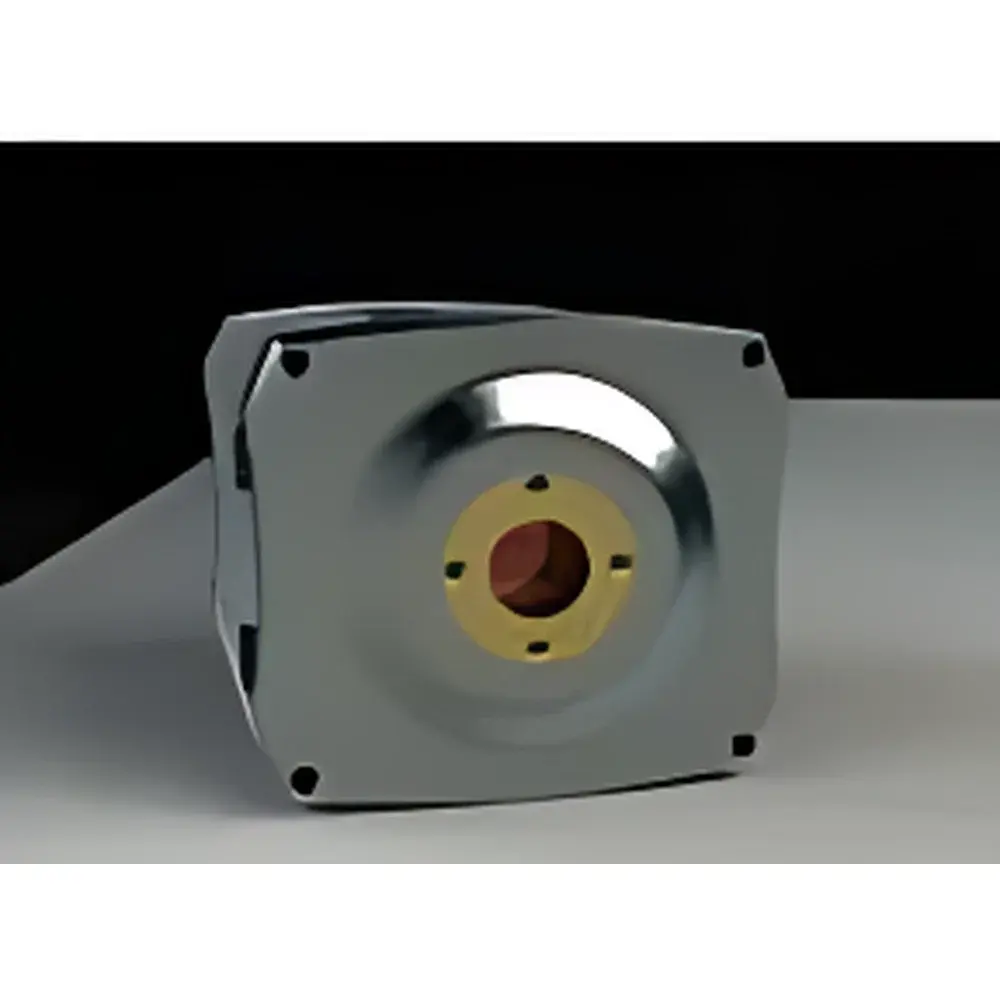
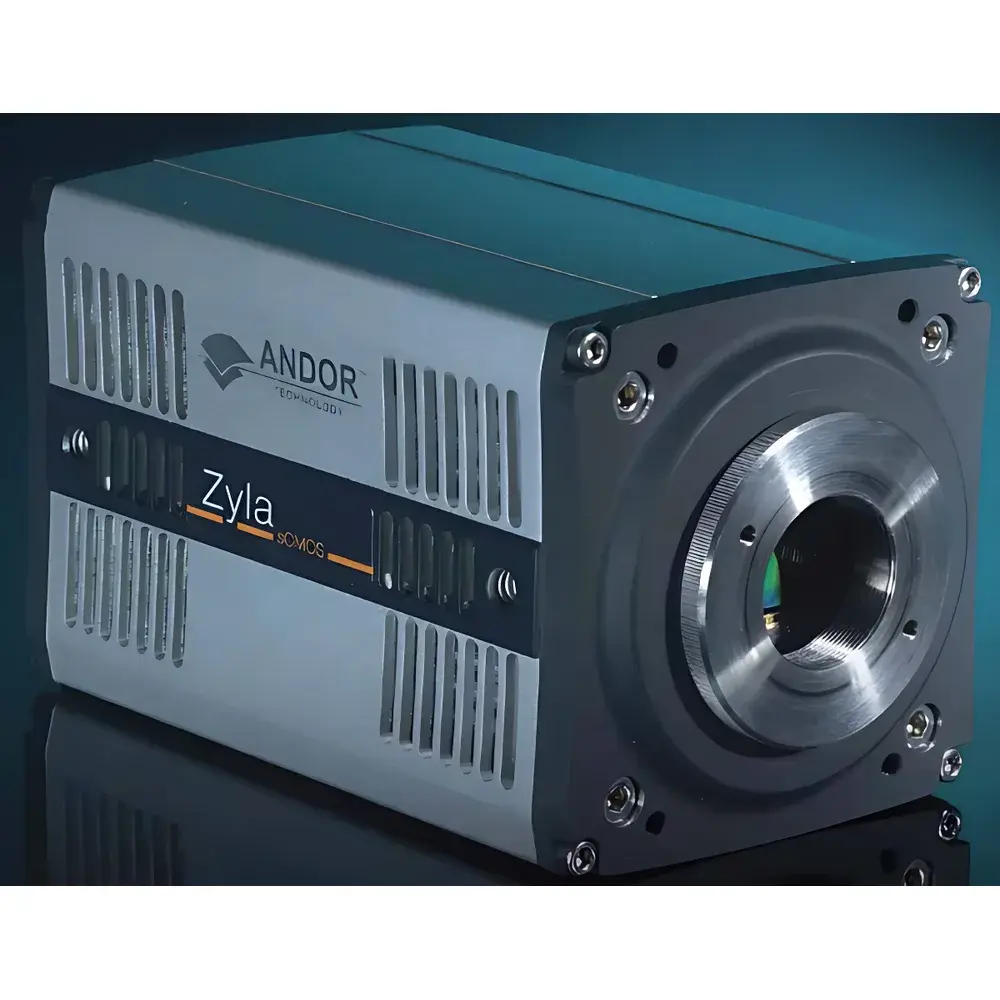
Andor sCMOS Scientific Camera
| Brand | Andor |
|---|---|
| Origin | United Kingdom |
| Model | sCMOS |
| Pixel Count | 2560 × 2160 (5.5 MP) |
| Pixel Size | 6.5 µm × 6.5 µm |
| Sensor Area | 16.64 mm × 14.0 mm |
| Cooling Temperature | −40 °C |
| Readout Speeds | 560 MHz / 166 MHz / 110 MHz / 22 MHz |
| Max Frame Rate | 100 fps @ full resolution |
| Dynamic Range | >14 bit @ 30 fps |
| Readout Modes | Multi-ROI |
| Interface | Camera Link & USB 2.0 |
| Software | Andor SDK & Solis |
Overview
The Andor sCMOS Scientific Camera is a high-performance, thermoelectrically cooled imaging sensor engineered for demanding quantitative applications in physical, biological, and astronomical research. Based on back-illuminated scientific CMOS (sCMOS) architecture, it delivers a unique balance of low-noise performance, high spatial resolution, and rapid frame acquisition—enabling precise photon-limited detection without compromising temporal fidelity. Unlike traditional CCD architectures, this sensor leverages parallel column-level analog-to-digital conversion to achieve high-speed readout while maintaining sub-electron read noise and deep well capacity. Its −40 °C thermoelectric cooling significantly suppresses dark current—reducing thermal signal contributions to negligible levels across typical exposure durations (10 ms–10 s), thereby enhancing signal-to-noise ratio (SNR) in low-light modalities such as fluorescence lifetime imaging, adaptive optics wavefront sensing, and time-resolved X-ray tomography.
Key Features
- Back-illuminated sCMOS sensor with 5.5 megapixel resolution (2560 × 2160) and 6.5 µm pixel pitch, optimized for high quantum efficiency (>80% peak QE) across visible to near-UV wavelengths
- Four selectable readout speeds (22 MHz, 110 MHz, 166 MHz, 560 MHz), supporting flexible trade-offs between speed, noise, and dynamic range
- Full-frame acquisition at up to 100 frames per second (fps) with 30,000 e⁻ full-well capacity
- Active thermoelectric cooling to −40 °C, delivering dark current <0.1 e⁻/pixel/s—validated under ISO 15739-compliant conditions
- Multi-Region-of-Interest (Multi-ROI) readout mode enabling simultaneous high-speed sub-aperture capture across user-defined zones, ideal for multi-point tracking or spectral line monitoring
- Dual interface support: Camera Link Base (for deterministic, high-bandwidth transfer in synchronized systems) and USB 2.0 (for plug-and-play integration in benchtop setups)
Sample Compatibility & Compliance
This camera is compatible with standard C-mount and F-mount optical interfaces, facilitating seamless integration into inverted/epifluorescence microscopes, vacuum-compatible beamlines, and open-air wind tunnel imaging rigs. It meets CE marking requirements for electromagnetic compatibility (EMC Directive 2014/30/EU) and low-voltage safety (LVD Directive 2014/35/EU). Firmware and driver stacks are designed for compliance with GLP/GMP documentation workflows, including timestamped metadata embedding (EXIF + custom tags), hardware-triggered acquisition logging, and audit-ready configuration export. While not FDA 21 CFR Part 11-certified out-of-the-box, the Andor SDK supports implementation of electronic signature controls and data integrity safeguards required for regulated environments when deployed with validated host software.
Software & Data Management
The camera ships with Andor Solis—a modular, cross-platform application for acquisition control, real-time visualization, and basic quantitative analysis (intensity profiling, centroid tracking, histogram statistics). For system integrators and OEMs, the Andor SDK provides comprehensive C/C++, Python (via ctypes), and MATLAB bindings—including low-level register access, ROI parameterization, and asynchronous event handling. All acquired images include embedded metadata: exposure time, sensor temperature, gain setting, trigger source, and synchronization status—ensuring traceability per ISO/IEC 17025 clause 7.5.2. Raw data output is supported in TIFF (uncompressed), HDF5 (with compression options), and Andor’s native SIF format—preserving bit-depth fidelity and enabling post-acquisition calibration correction.
Applications
- Adaptive optics wavefront sensing and closed-loop correction in large telescopes (e.g., ESO VLT, Keck Observatory subsystems)
- Time-resolved particle image velocimetry (PIV) in supersonic wind tunnels, capturing transient shock structures at kHz-equivalent effective rates via burst-mode triggering
- In-line process monitoring of plasma ignition dynamics in fusion diagnostics, leveraging multi-ROI to simultaneously track ion emission lines and continuum background
- High-content screening in live-cell microscopy, where 100 fps acquisition enables robust kymograph generation for microtubule transport kinetics
- X-ray phase-contrast tomography reconstruction, benefiting from the sensor’s large field-of-view (16.6 × 14.0 mm) and uniform response across the active area (non-uniformity <0.5% RMS)
- Solar granulation studies requiring diffraction-limited resolution combined with cadence sufficient to resolve p-mode oscillations (~5-minute periods)
FAQ
What cooling method is used, and how is temperature stability maintained?
The camera employs a two-stage thermoelectric cooler (TEC) with PID-controlled feedback loop, achieving ±0.1 °C stability over 8-hour continuous operation at −40 °C ambient. No liquid nitrogen or external chillers are required.
Is the sensor sensitive to UV wavelengths below 350 nm?
Yes—the back-illuminated architecture and optional UV-enhanced AR coating (available as factory option) extend quantum efficiency to 200 nm, making it suitable for synchrotron-based soft X-ray imaging when coupled with appropriate scintillators.
Can multiple cameras be synchronized for stereo or multi-angle acquisition?
Yes—hardware TTL trigger input/output ports support master-slave configurations with sub-microsecond jitter; firmware timestamps are referenced to a common PPS (pulse-per-second) signal for cross-camera temporal alignment.
Does the camera support binning or on-chip averaging?
No—sCMOS architecture does not perform hardware binning. However, software binning (2×2, 4×4) is fully supported in Solis and SDK, preserving metadata integrity and enabling SNR optimization without sacrificing flexibility in ROI definition.
What is the warranty coverage and service support structure?
Andor provides a standard 24-month parts-and-labor warranty, with extended service plans available globally through authorized distributors. Field-replaceable modules (cooling assembly, interface board) reduce mean time to repair (MTTR) to <72 hours for most regions.





