
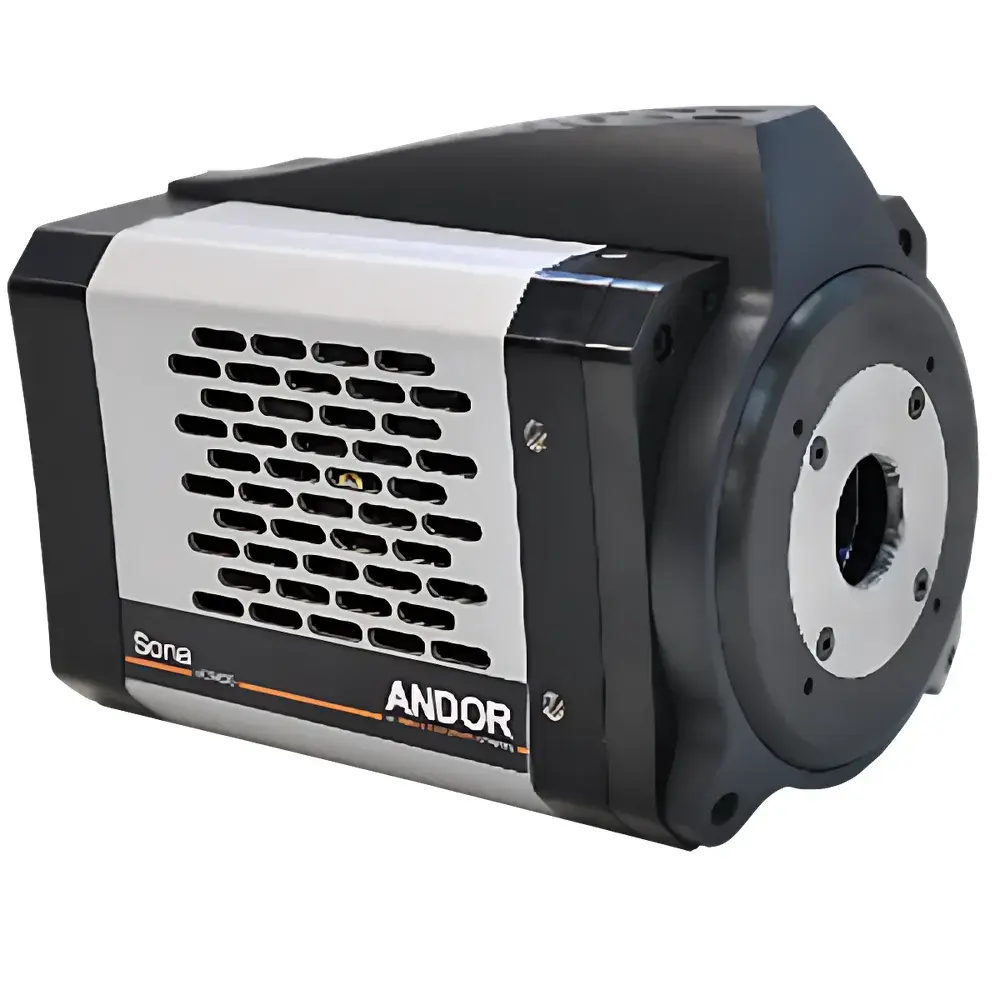
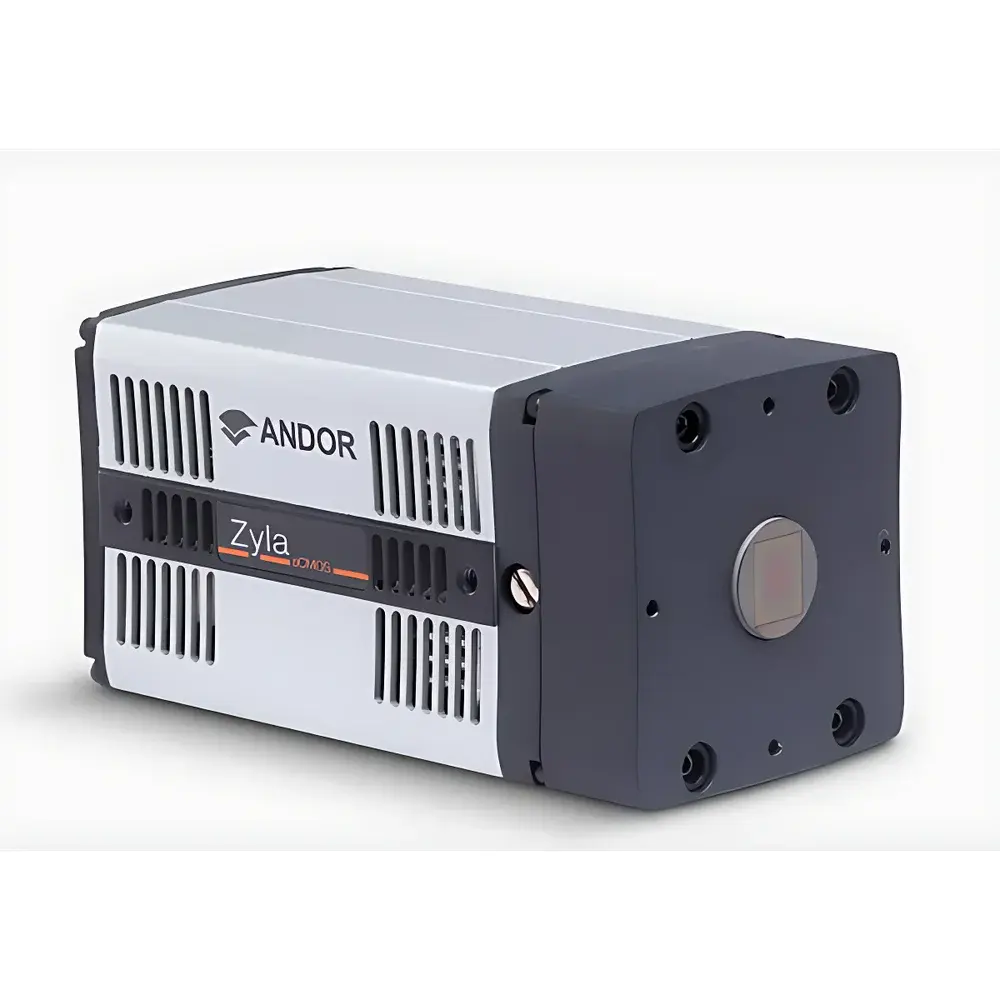
Andor Sona/Neo/Zyla High-Speed, High-Sensitivity sCMOS Cameras
| Brand | Andor |
|---|---|
| Origin | United Kingdom |
| Model Series | Sona, Neo, Zyla |
| Sensor Resolution | 2048 × 2048 |
| Pixel Size | 11 µm |
| Readout Speed | 48 fps (full frame, Sona 4.2B-11) |
| Peak Quantum Efficiency | 95% |
| Cooling | Vacuum-cooled to −45 °C (Sona/Marana), −40 °C (Neo), −5 °C (Zyla) |
Overview
The Andor Sona, Neo, and Zyla series represent a family of scientific-grade sCMOS cameras engineered for quantitative, low-light imaging across demanding disciplines including live-cell microscopy, adaptive optics, time-resolved spectroscopy, synchrotron beamline detection, and astronomical survey applications. These cameras operate on the principle of complementary metal-oxide-semiconductor (sCMOS) image sensing—leveraging pixel-level analog-to-digital conversion, correlated double sampling (CDS), and on-chip binning capabilities to achieve high dynamic range, sub-electron read noise, and exceptional photon capture fidelity. The Sona platform employs back-illuminated (BI) sCMOS sensors with peak quantum efficiency (QE) of 95% at ~600 nm, optimized for maximum photon collection in visible-to-near-IR wavelengths. Combined with vacuum-based thermoelectric cooling down to −45 °C, dark current is suppressed to <0.001 e⁻/pixel/s—enabling long-exposure, low-noise acquisition without compromising temporal resolution. All models support both rolling and global shutter modes (Neo and Zyla), ensuring flexibility for motion-artifact-free imaging or high-speed synchronization with pulsed light sources.
Key Features
- Back-illuminated sensor architecture (Sona & Marana): 95% peak QE, 11 µm pixel pitch, 2048 × 2048 active array
- Vacuum-sealed cooling: −45 °C (Sona/Marana), −40 °C (Neo), −5 °C (Zyla) — enabling stable thermal management during extended acquisitions
- Ultra-low read noise: as low as 0.9 e⁻ RMS (Zyla 5.5, rolling shutter); 1.6 e⁻ RMS (Sona 4.2B-11)
- High full-well capacity: up to 85,000 e⁻ per pixel (Sona/Marana), supporting wide linear dynamic range (>30,000:1)
- Flexible interface options: USB 3.2 Gen 1 (5 Gbps) and Camera Link (3-tap or 10-tap) for deterministic latency and sustained bandwidth
- Hardware-triggered acquisition with programmable exposure timing (down to 1 µs), precise TTL sync compatibility, and onboard FPGA-based preprocessing
- Real-time pixel correction: factory-calibrated gain, offset, and defect maps applied in firmware for consistent quantitative output
Sample Compatibility & Compliance
The Sona/Neo/Zyla platforms are designed for integration into regulated and research-grade optical systems requiring traceable performance. Each camera undergoes full factory calibration against NIST-traceable photometric standards, delivering calibrated electron-counting linearity across >99.9% of the active sensor area. Firmware supports metadata embedding compliant with MIAME and OME-TIFF specifications, facilitating reproducible data exchange in collaborative environments. For GLP/GMP-aligned workflows, optional Andor SDK extensions provide audit-trail logging, user-access controls, and electronic signature support aligned with FDA 21 CFR Part 11 requirements. Mechanical interfaces conform to standard C-mount and F-mount configurations; custom OEM flange designs are available under NDA. All units comply with CE, UKCA, RoHS, and FCC Class A emission standards.
Software & Data Management
Cameras are fully supported by Andor’s SOLIS™ software suite (v6.x+), offering intuitive acquisition control, real-time histogram analysis, multi-dimensional time-lapse sequencing, and ROI-based statistics export. The Andor SDK (C/C++, Python, MATLAB, LabVIEW) enables deep integration into custom instrument control architectures—including synchronization with laser pulsers, piezo stages, and spectral engines. Raw image streams are delivered in lossless 16-bit TIFF or HDF5 formats, preserving full bit-depth integrity. Optional Andor Fusion software provides advanced deconvolution, drift correction, and single-molecule localization (SMLM) pipeline support—including ThunderSTORM and NanoJ compatibility. All firmware updates are digitally signed and validated prior to installation to ensure system integrity.
Applications
- Live-cell & developmental biology: Tracking intracellular transport, organelle dynamics, and CRISPR-mediated genome editing events with minimal phototoxicity
- Neuroscience: Wide-field calcium imaging across cortical slices or organoids at >30 fps with single-photon sensitivity
- Astronomy & space situational awareness: Large-format FOV (32 mm diagonal) enables efficient NEO tracking and adaptive optics wavefront sensing
- Dynamic X-ray & neutron imaging: High-speed radiography and tomography with scintillator-coupled detection
- Quantum optics & cold atom physics: Single-shot detection of Bose-Einstein condensates and quantum interference fringes
- Particle image velocimetry (PIV): Dual-frame burst acquisition synchronized with laser sheet illumination for fluid flow vector mapping
- Solar astronomy: High-cadence imaging of solar granulation and flare dynamics using narrowband Hα or Ca II filters
FAQ
What distinguishes the Sona from the Neo and Zyla series?
The Sona series uses back-illuminated sCMOS sensors with 95% QE and 11 µm pixels, optimized for ultimate sensitivity in low-light regimes. The Neo offers higher resolution (5.5 MP) with dual shutter modes and deeper cooling (−40 °C), while the Zyla emphasizes speed (up to 100 fps) and cost-performance balance with front-illuminated architecture.
Can these cameras be used in vacuum or cryogenic environments?
No—the cameras are rated for ambient operation only (5–40 °C ambient, non-condensing). Vacuum or cryostat integration requires external optical coupling via fiber or lens relay; internal vacuum cooling is self-contained and not intended for external chamber use.
Is hardware triggering supported for synchronization with external equipment?
Yes—all models feature TTL-compatible input/output trigger ports with sub-microsecond jitter, supporting external start/stop, exposure gating, and frame synchronization with lasers, shutters, or motion controllers.
How is calibration data managed and preserved across firmware updates?
Pixel-level gain, offset, and defect maps are stored in non-volatile memory and automatically re-applied after firmware updates. Users may export/import calibration sets via SOLIS for cross-instrument consistency.
Does Andor provide OEM integration support for custom instrumentation?
Yes—Andor offers full mechanical, electrical, and software OEM packages including custom flanges, embedded firmware modules, SDK licensing, and regulatory documentation support for medical or industrial device integration.



