
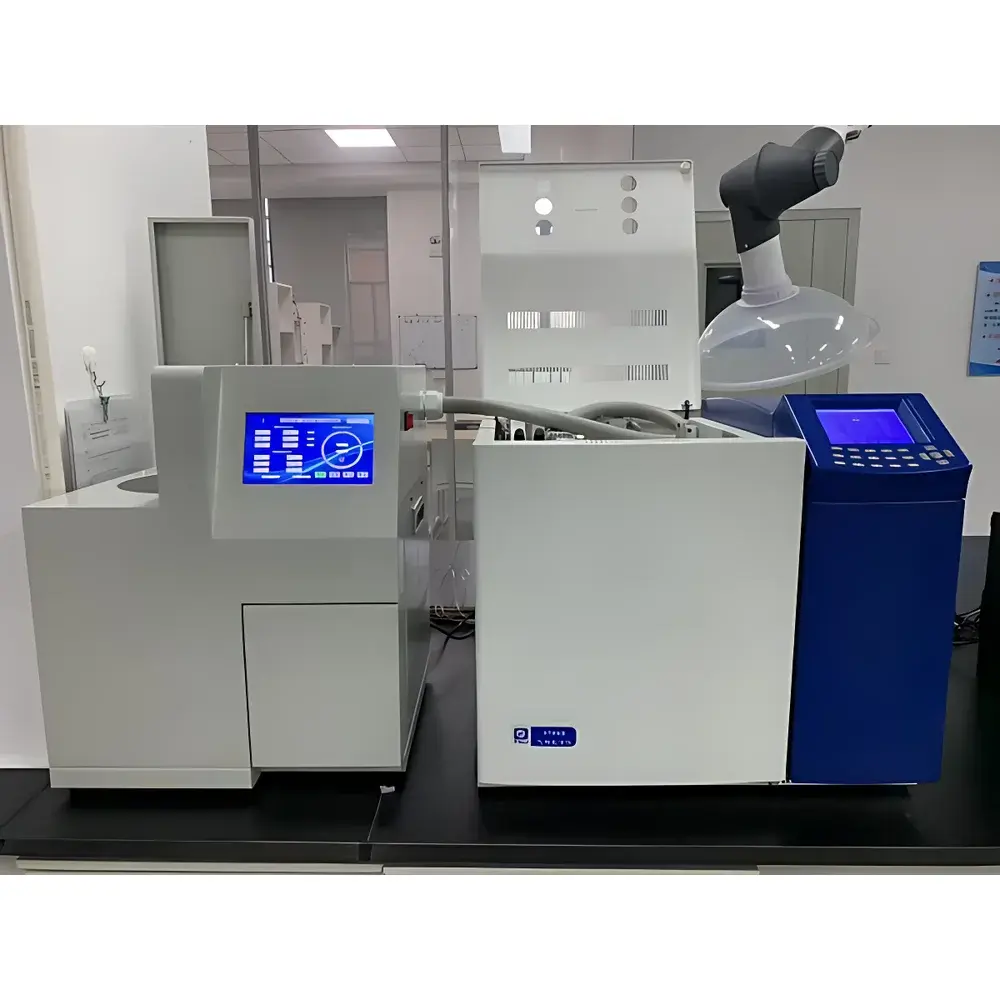
ANHS-20A PLUS Automated Headspace Sampler with GC7900 Dual-FID Gas Chromatograph for VOC Analysis in Cigarette Packaging Paper
| [Brand | Beifen Sanpu |
|---|---|
| Origin | Beijing, China |
| Manufacturer Type | Direct Manufacturer |
| Instrument Type | Laboratory Gas Chromatograph |
| Application Scope | General-Purpose VOC Analysis |
| Oven Temperature Range | 100–350 °C |
| Ramp Rate | 0.1–40 °C/min |
| Cool-down Time (100–350 °C) | ~6 min |
| Carrier Gas Flow Control Range | 0–1200 mL/min |
| Carrier Gas Pressure Control Range | 0–970 kPa |
| Injector Max Operating Temperature | 100–350 °C |
| Injector Pressure Setpoint Range | 0–970 kPa |
| Injector Total Flow Setpoint Range | 0–1000 mL/min] |
Overview
The ANHS-20A PLUS Automated Headspace Sampler coupled with the GC7900 dual-flame ionization detector (FID) gas chromatograph is a purpose-engineered analytical system designed for the precise quantification of volatile organic compounds (VOCs) in cigarette packaging materials—specifically cigarette wrapping paper (including tipping paper) per the Chinese tobacco industry standard YC/T 207–2006. This method employs static headspace sampling followed by capillary gas chromatographic separation and dual-FID detection, enabling trace-level analysis of 16 regulated VOCs including benzene, toluene, xylenes, alcohols, ketones, and esters. The system operates on established principles of vapor-phase equilibrium partitioning, where analytes migrate from the solid matrix into the headspace above the sample under controlled thermal conditions, followed by injection onto a fused-silica column (HP-1 and HP-1wax) for high-resolution separation. Its architecture supports rigorous compliance with regulatory testing workflows used in quality control laboratories within tobacco manufacturing, packaging suppliers, and third-party certification facilities.
Key Features
- Integrated automated headspace sampling (ANHS-20A PLUS) with programmable vial pressurization (0.2 s), loop fill time, and precise transfer line temperature control (up to 120 °C) to minimize condensation and adsorption losses.
- Dual-FID detection configuration ensures redundancy, improved signal-to-noise ratio, and independent calibration verification for critical VOCs such as benzene and ethyl acetate.
- Thermally stable oven with rapid heating/cooling capability (0.1–40 °C/min ramp rate; full cool-down from 350 °C to 100 °C in approximately 6 minutes) enables high-throughput batch analysis without thermal carryover.
- Independent, pressure- and flow-controlled inlet modules support consistent split/splitless injection across diverse sample matrices and carrier gas types (N2, He, H2).
- Full parameter programmability—including oven program (e.g., 50 °C hold × 9 min → 9 °C/min → 180 °C hold × 3 min), injector temperature (50–350 °C), and detector settings (FID H2: 45 mL/min, air: 450 mL/min, temp: 300 °C)—ensures method reproducibility.
- Robust mechanical design and factory-aligned gas delivery pathways reduce maintenance frequency and improve long-term retention time stability (RSD < 0.15% over 24 h).
Sample Compatibility & Compliance
This system is validated specifically for cigarette wrapping paper and tipping paper per YC/T 207–2006. Sample preparation follows strict procedural guidance: 80 cm² specimens are rolled inward (printed side facing center) and immersed in 1000 µL glycerol triacetate within crimp-top headspace vials. Equilibration occurs at 80 °C for 50 minutes under agitation. The method has been applied successfully to other low-mass, porous cellulose-based substrates, including laminated foils and coated board, though matrix-specific validation is required prior to routine use. From a regulatory standpoint, the platform supports audit-ready operation under GLP-compliant environments. Data acquisition software can be configured to meet FDA 21 CFR Part 11 requirements—including electronic signatures, audit trails, and user access controls—when deployed with compliant chromatography data systems (CDS).
Software & Data Management
Data acquisition and processing are performed using vendor-supplied or third-party CDS platforms compatible with ASTM E260 and ISO 17025 documentation frameworks. Peak integration parameters (baseline correction, threshold, retention time windows) are locked during sequence execution to prevent post-run manipulation. Calibration curves are generated using area-normalized response factors, with forced origin constraints as mandated by YC/T 207–2006. All raw chromatograms, method files, audit logs, and calibration reports are stored in timestamped, immutable archives. Export formats include CSV, PDF, and AIA (.cdf) for external review or LIMS integration. System suitability tests—including resolution between ortho-xylene and styrene, tailing factor for ethanol, and repeatability of retention times—are embedded into daily startup protocols.
Applications
- Quantitative determination of residual solvents in gravure- and flexo-printed cigarette packaging papers.
- Batch release testing for VOC compliance against YC/T 207–2006 limits (e.g., total VOC ≤ 1.0 mg/m²; benzene ≤ 0.01 mg/m²).
- Method development and validation studies for alternative packaging substrates (e.g., biopolymer-coated papers, metallized films).
- Investigation of migration kinetics during accelerated aging (40 °C/75% RH) to assess shelf-life VOC profiles.
- Supporting root-cause analysis in QC deviations related to ink formulation changes, drying efficiency, or solvent substitution.
FAQ
What VOCs are targeted under YC/T 207–2006?
The standard specifies quantification of 16 priority compounds: benzene, toluene, ethylbenzene, o-, m-, p-xylene, styrene, acetone, methyl ethyl ketone, cyclohexanone, n-propanol, isopropanol, n-butanol, ethyl acetate, butyl acetate, and methyl acetate.
Is derivatization required for this method?
No. YC/T 207–2006 relies on direct headspace analysis without chemical derivatization, leveraging the inherent volatility of target analytes and optimized equilibration conditions.
Can this system analyze non-tobacco packaging materials?
Yes—subject to method adaptation and full validation per ISO/IEC 17025. Applications have included food-grade cartons, pharmaceutical blister lidding, and cosmetic folding boxes.
How is carryover minimized during high-concentration sample runs?
The system employs bake-out routines (350 °C oven hold × 15 min), inertized transfer lines, and dedicated blank vial rinsing sequences between samples to maintain carryover below 0.1% of the preceding peak area.
Does the dual-FID configuration require separate calibration for each detector?
Yes. Independent calibration curves are generated for each FID using the same standard series to verify inter-detector response consistency and detect potential drift or contamination effects.




