
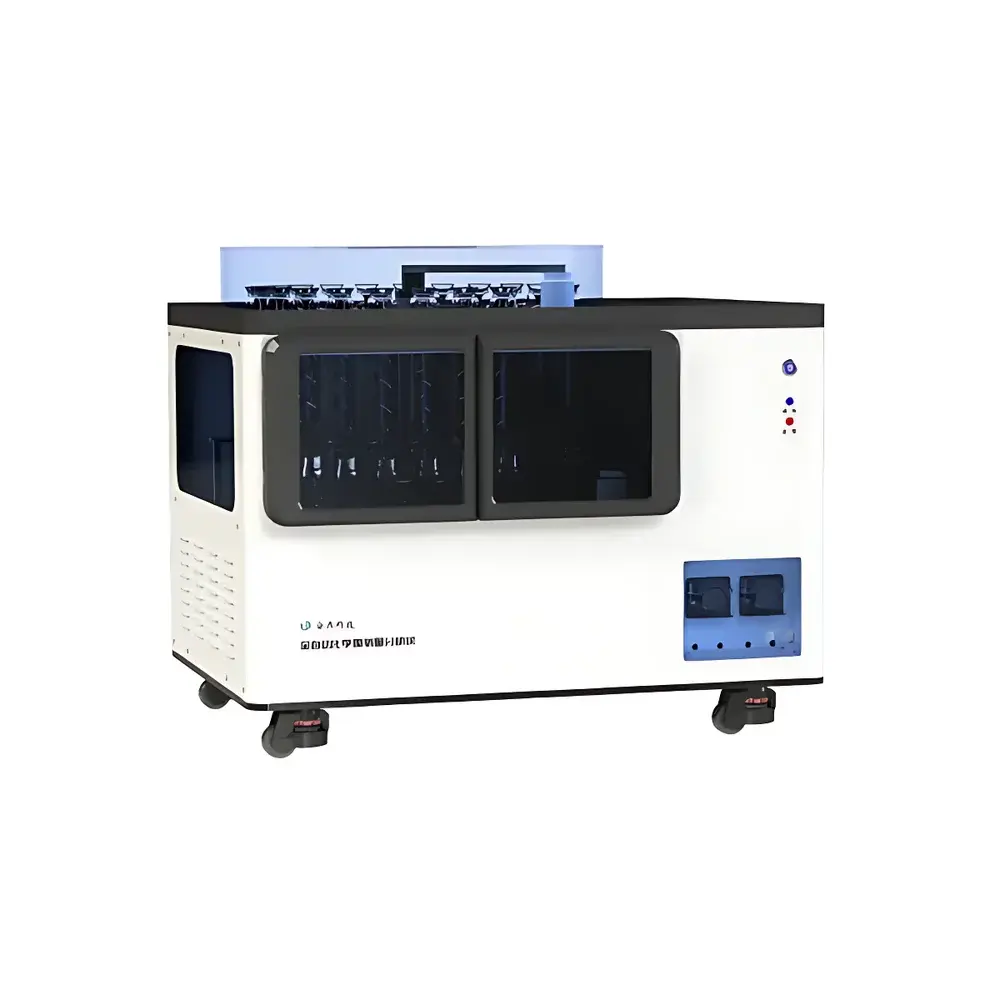
Anjie AJ-5750 Automated Chemical Oxygen Demand (COD) Analyzer
| Brand | Anjie |
|---|---|
| Origin | Shanghai, China |
| Model | AJ-5750 |
| Instrument Type | Laboratory Benchtop Analyzer |
| Measurement Principle | Rapid Digestion Method (Closed-Tube, Reflux-Based) |
| Measurement Range | 16–700 mg/L COD |
| Accuracy | ≤5% (vs. Certified Reference Materials) |
| Repeatability | RSD ≤2.0% |
| Analysis Time | 14 minutes per sample |
| Batch Capacity | ≥21 samples |
| Safety Design | Fully Enclosed Digestion Chamber with Spherical Condenser |
| Operational Alert | Real-Time Reagent Vacuum Loss Detection |
| Compliance Context | Designed to support ISO 6060, ASTM D1252–06 (Method B), and HJ 828–2017 (Chinese EPA Standard) |
Overview
The Anjie AJ-5750 Automated Chemical Oxygen Demand (COD) Analyzer is a laboratory-grade benchtop instrument engineered for precise, high-throughput quantification of chemical oxygen demand in water and wastewater matrices. It implements a standardized rapid digestion methodology based on closed-tube reflux oxidation under acidic potassium dichromate conditions—fully aligned with internationally recognized protocols including ISO 6060 (Water quality — Determination of chemical oxygen demand), ASTM D1252–06 (Standard Test Methods for Chemical Oxygen Demand of Water), and China’s HJ 828–2017 (Determination of COD in water—Potassium dichromate method). Unlike open-reflux or colorimetric-only systems, the AJ-5750 integrates thermally controlled digestion, automated reagent dispensing, and post-digestion spectrophotometric analysis within a single integrated platform. Its core architecture eliminates manual handling of hot, corrosive digestates, significantly reducing operator exposure risk while maintaining metrological integrity across batched analyses.
Key Features
- Fully enclosed digestion chamber with integrated spherical condenser design—ensures complete reflux retention, minimizes volatile loss, and enhances thermal uniformity during 150 °C digestion cycles.
- Automated 21-position sample carousel enabling unattended batch processing; compatible with standard 16-mm borosilicate digestion tubes.
- Real-time vacuum monitoring system triggers audible and visual alerts upon reagent delivery failure or insufficient aspiration pressure—preventing incomplete digestion and ensuring procedural fidelity.
- Pre-calibrated optical path optimized for absorbance measurement at 600 nm (post-dichromate reduction), supporting direct quantification without manual wavelength selection.
- Rugged industrial-grade chassis with corrosion-resistant internal surfaces and dual-stage cooling fans for thermal management between runs.
- Embedded firmware supports method recall, user-defined calibration curves, and audit-ready operation logs compliant with GLP documentation requirements.
Sample Compatibility & Compliance
The AJ-5750 accepts raw, filtered, or centrifuged aqueous samples—including surface water, domestic sewage, industrial effluents (e.g., from petrochemical, pharmaceutical, and textile facilities), and process water streams. It accommodates turbid and moderately colored matrices without pre-dilution in the 16–700 mg/L range. For higher-concentration samples (>700 mg/L), built-in dilution functionality (via optional external peristaltic module) maintains accuracy while preserving traceability. The system meets functional equivalence to ISO/IEC 17025:2017 clause 7.2.2 (method validation) when operated per manufacturer-specified protocols and verified using NIST-traceable COD reference standards (e.g., potassium hydrogen phthalate solutions). Routine performance verification aligns with EPA 40 CFR Part 136 requirements for wastewater laboratories.
Software & Data Management
The AJ-5750 operates via an embedded Linux-based control interface with touchscreen navigation and USB export capability. All analytical sequences—including digestion temperature ramping, timing, reagent volumes, and photometric acquisition—are stored as executable method files with version timestamps. Raw absorbance data, calculated COD values, QC flag status (e.g., “digestion timeout”, “low vacuum”), and operator ID are logged automatically into a tamper-evident binary file structure. Export formats include CSV and PDF reports compliant with 21 CFR Part 11 Annex 11 principles—supporting electronic signatures, audit trails, and role-based access control when integrated into LIMS environments. No cloud dependency; local storage retains ≥10,000 test records.
Applications
- Environmental monitoring labs performing routine compliance testing against national discharge limits (e.g., China’s GB 8978–1996, EU Urban Wastewater Treatment Directive).
- Public health institutions assessing source water quality and treatment efficacy in drinking water supply chains.
- Industrial QA/QC departments validating pretreatment performance prior to biological treatment stages.
- Research laboratories conducting kinetic studies of organic pollutant degradation under controlled oxidative conditions.
- Academic teaching labs requiring reproducible, safety-optimized COD instruction modules aligned with APHA Standard Methods 5220D.
FAQ
Does the AJ-5750 require external calibration standards for daily use?
No—factory-installed calibration curves are validated against CRM materials; however, daily verification using a mid-range certified control sample (e.g., 200 mg/L KHP) is recommended per ISO/IEC 17025 internal quality control guidelines.
Can the instrument handle saline or high-chloride wastewater samples?
Yes—when used with mercury sulfate masking agent (supplied separately), the AJ-5750 mitigates chloride interference up to 2000 mg/L Cl⁻, consistent with ASTM D1252–06 Method B specifications.
Is method validation documentation provided with the system?
Yes—the delivery package includes a Technical Validation Report detailing precision (RSD), trueness (recovery %), limit of detection estimation, and inter-laboratory comparison data per ISO 5725-2.
What maintenance intervals are specified for long-term reliability?
Digestion heater calibration verification every 6 months; condenser cleaning and vacuum line inspection every 200 runs; full optical path alignment recommended annually by authorized service engineers.







