
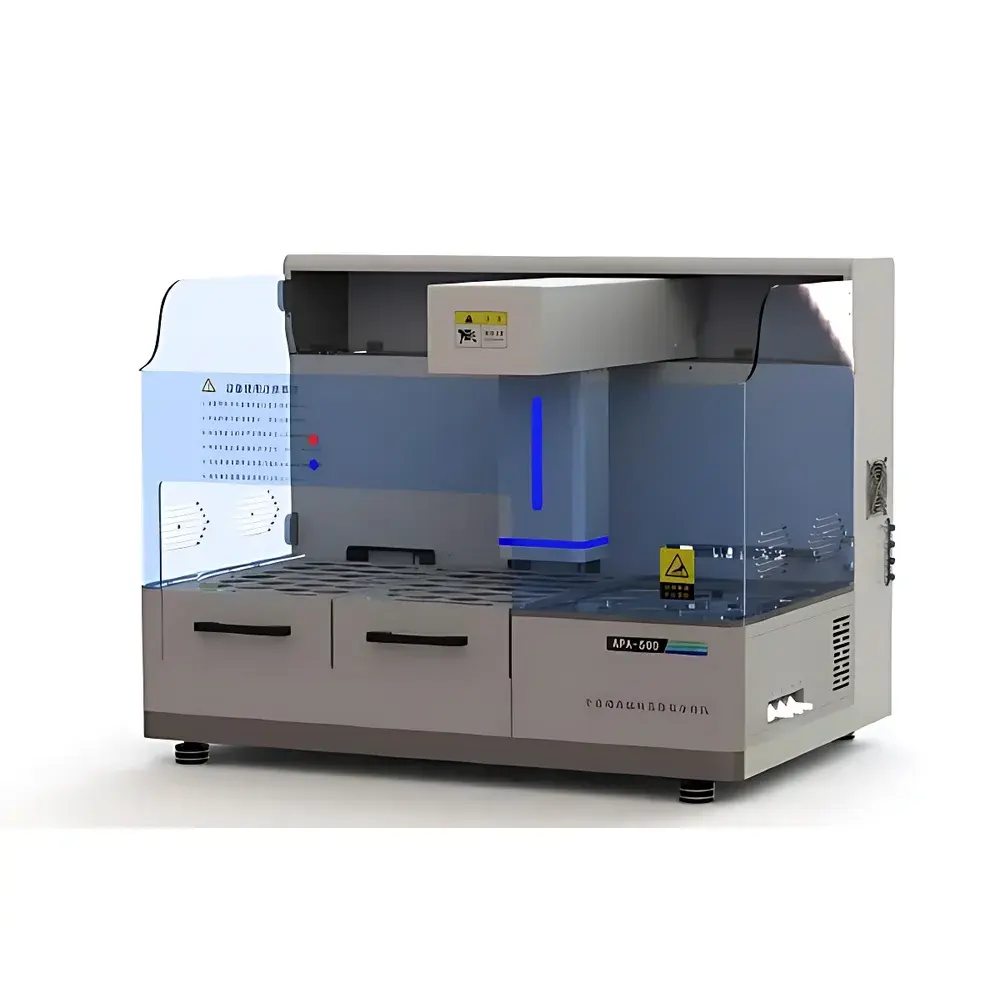
ANJIE APA-500 Automated Permanganate Index Analyzer
| Brand | ANJIE |
|---|---|
| Origin | Shanghai, China |
| Model | APA-500 |
| Principle | Potassium Permanganate Oxidation with ORP Endpoint Detection |
| Type | Online Analyzer |
| Range | 0–5 mg/L |
| Repeatability | ±2% RSD |
| Accuracy | ±5% of reading |
| LOD | 0.05 mg/L |
| Resolution | 1 µL |
| Cycle Time | 4 min per sample |
| Temperature Control | 40–100 °C (adjustable water bath) |
| Environmental Monitoring | Integrated ambient temperature, humidity, and atmospheric pressure sensors |
| Sample Handling | Motorized adaptive gripper (pneumatic-free) |
| Endpoint Detection | RGB-spectral colorimetric endpoint simulation with real-time video recording |
| Compliance | Designed for ISO 8467:2021, EPA Method 4500-PERM, and GB/T 5750.7–2023 |
Overview
The ANJIE APA-500 Automated Permanganate Index Analyzer is an online, fully integrated instrumental system engineered for precise, trace-level determination of the permanganate index (CODMn) in natural waters, drinking water, surface water, and wastewater effluents. It implements the standardized potassium permanganate oxidation method—defined in ISO 8467:2021, EPA Method 4500-PERM, and China’s GB/T 5750.7–2023—wherein soluble organic and inorganic reductants are oxidized by KMnO4 under acidic or alkaline conditions at controlled temperature, followed by quantitative back-titration with sodium oxalate. The APA-500 replaces manual titrimetric workflows with a closed-loop, software-defined analytical architecture: all fluidic sequencing, thermal regulation, endpoint recognition, and data capture are governed by deterministic control logic—not mechanical presets or user calibration overrides. Its core measurement principle relies on potentiometric redox potential (ORP) tracking combined with high-fidelity RGB spectral analysis to emulate human visual endpoint judgment, eliminating subjective interpretation while preserving regulatory alignment with classical titration methodology.
Key Features
- Fully software-controlled operation: All assay parameters—including oxidation temperature (40–100 °C), reaction time, titrant delivery volume, and endpoint threshold—are programmable via intuitive GUI; no hardware switches, jumpers, or analog dials.
- True syringe-driven injection system: Precision micro-syringes (1 µL resolution) deliver reagents and samples without cross-contamination or carryover; no rotary valves, multi-port manifolds, or passive flow paths that compromise volumetric fidelity.
- Micro-boiling water bath oxidation module: Patented vapor containment geometry minimizes steam dispersion during high-temperature oxidation, enabling safe operation outside fume hoods—even in open-lab environments.
- Integrated environmental metrology: Onboard sensors continuously log ambient temperature, relative humidity, and barometric pressure; deviations beyond user-defined thresholds trigger audit-trail alerts and optional method recalibration prompts.
- Pneumatic-free adaptive gripper: Electromechanical sample cup handling ensures silent, vibration-minimized transfer with force feedback–based grip optimization—eliminating compressed air infrastructure, leakage risks, and pressure-related drift.
- Human-vision-simulated endpoint detection: A calibrated RGB photometric sensor captures real-time chromatic evolution during titration, mapping absorbance changes against CIE 1931 color space coordinates; endpoint is determined using dynamic sigmoidal curve fitting aligned with physiological cone-cell response models.
- Full-video analytical traceability: Each assay generates synchronized time-stamped video (H.264, 1080p) of the reaction vessel interior, archived alongside raw sensor data, metadata, and audit logs for GLP/GMP-compliant review.
Sample Compatibility & Compliance
The APA-500 accepts standard 50 mL borosilicate glass sample cups (ISO/IEC 17025–compatible geometry) and accommodates turbid, colored, or particulate-laden matrices without pre-filtration—provided suspended solids do not exceed 50 mg/L (per ISO 8467 guidance). It complies with regulatory data integrity requirements under FDA 21 CFR Part 11 (electronic records/signatures), supports ALCOA+ principles (Attributable, Legible, Contemporaneous, Original, Accurate), and maintains full audit trails for all configuration changes, environmental anomalies, and result modifications. Method validation documentation—including ICH Q2(R2)–aligned precision, accuracy, LOD/LOQ, and robustness assessments—is provided with instrument qualification packages.
Software & Data Management
The embedded Linux-based control platform runs ANJIE Analytical Suite v3.2—a validated application supporting role-based access control (RBAC), electronic signatures, and automated report generation in PDF/A-2b and CSV formats. Data export includes raw ORP traces, RGB intensity timelines, video metadata (FFmpeg-compatible JSON sidecar), and environmental context logs. The system supports OPC UA connectivity for integration into SCADA or LIMS environments and includes built-in TLS 1.2 encryption for remote diagnostics and firmware updates. All data storage adheres to ISO/IEC 27001–aligned retention policies, with optional encrypted NAS backup and cloud-synced archival.
Applications
The APA-500 serves laboratories requiring regulatory-grade CODMn data across environmental monitoring networks (e.g., national river basin surveillance programs), municipal drinking water quality assurance, hydrological research stations, public health laboratories (CDC/PHI), geological survey agencies assessing aquifer vulnerability, and accredited third-party testing facilities operating under CNAS, UKAS, or ILAC-MRA frameworks. Its low LOD (0.05 mg/L) and high repeatability (±2% RSD) make it especially suitable for oligotrophic source water evaluation and long-term trend analysis where inter-laboratory comparability is critical.
FAQ
Does the APA-500 require a fume hood for routine operation?
No—the micro-boiling water bath and patented vapor containment design suppress steam dispersion to non-hazardous levels, satisfying OSHA 1910.1200 and EU Directive 2004/40/EC exposure limits without auxiliary ventilation.
Can the system be validated for GLP compliance?
Yes—full IQ/OQ/PQ protocols, 21 CFR Part 11 configuration files, and raw data archiving templates are included in the validation support package.
Is method adaptation required for high-altitude sites?
No—the onboard barometric pressure sensor automatically adjusts oxidation temperature setpoints and titration kinetics models per ISO 8467 Annex B guidelines for altitudes up to 4,500 m.
What sample throughput can be expected in unattended operation?
At 4 minutes per cycle and with optional 48-position autosampler integration, the system achieves up to 360 determinations per 24-hour period with <0.5% carryover between high/low concentration samples.
How is endpoint uncertainty quantified and reported?
Each analysis reports endpoint confidence interval derived from RGB variance analysis over the final 3 seconds of titration, expressed as ±ΔE*ab (CIELAB color difference units) alongside conventional mg/L results.
Related Products







