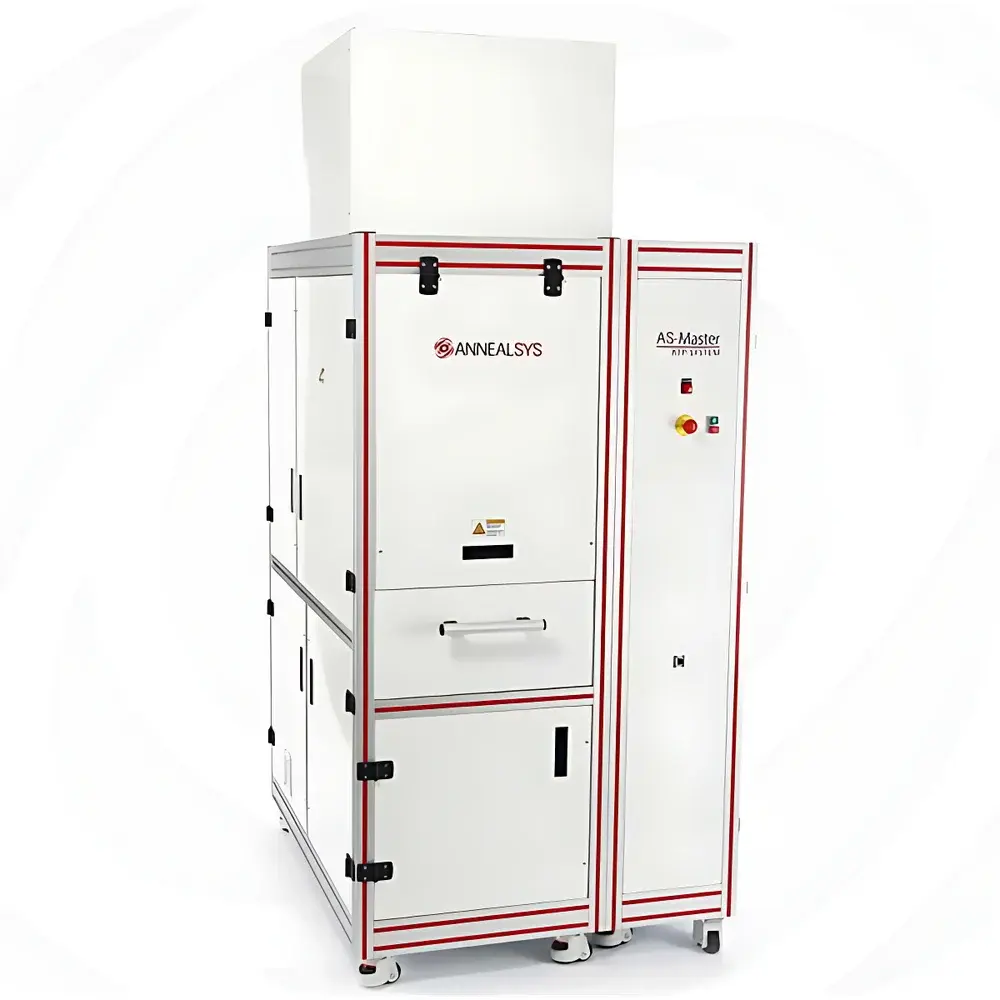
Annealsys AS-master High-Vacuum Rapid Thermal Annealing System
| Brand | Annealsys |
|---|---|
| Origin | France |
| Model | AS-master |
| Instrument Type | High-Vacuum Rapid Thermal Annealing Furnace |
| Maximum Sample Diameter | 200 mm (8-inch wafers) |
| Temperature Range | Ambient to 1450 °C |
| Max Heating Rate | 150 °C/s |
| Max Cooling Rate | 200 °C/s |
| Temperature Accuracy | ±1 °C |
| Temperature Uniformity | ±1% across wafer surface |
| Vacuum Level | ≤1×10⁻⁶ hPa |
| Gas Lines | 4-channel MFC-controlled (N₂, Ar, O₂, custom mix) |
| Heating Source | Halogen infrared lamps with power-based regulation |
| Chamber | Water-cooled quartz tube with double-wall stainless-steel cold-wall construction |
| Temperature Monitoring | Dual K-type thermocouples + dual pyrometers (low-range: 150–1100 °C |
| high-range | 400–1500 °C) |
| Cooling Method | Forced-air (low-noise, no compressed air required for thermal cycling) |
| Control System | Digital PID with real-time feedback loop |
Overview
The Annealsys AS-master is a high-vacuum rapid thermal annealing (RTA) system engineered for precision semiconductor process development and production-scale thermal treatment. Operating on the principle of radiant heating via high-intensity halogen infrared lamps, the AS-master delivers exceptional thermal responsiveness and spatial uniformity—critical for advanced node fabrication where transient thermal budgets directly impact dopant activation, silicide formation, oxide densification, and defect annihilation. Its cold-wall design, water-cooled quartz chamber, and optimized gas inlet geometry ensure minimal thermal memory, sub-second thermal ramp fidelity, and wafer-level temperature homogeneity better than ±1% across 200 mm substrates. Unlike voltage-controlled lamp systems, the AS-master employs closed-loop power regulation—decoupling heating performance from lamp aging—and thereby maintains long-term reproducibility without recalibration or hardware replacement.
Key Features
- Ultra-fast thermal cycling: Programmable heating rates up to 150 °C/s and cooling rates up to 200 °C/s, enabling millisecond-scale thermal profiles required for flash annealing and ultra-shallow junction formation.
- High-precision temperature control: Dual-sensor architecture combining K-type thermocouples (for low-temperature stability) and two calibrated pyrometers (150–1100 °C and 400–1500 °C ranges) ensures traceable accuracy within ±1 °C over the full operating range.
- High-vacuum compatibility: Integrated turbomolecular pumping system achieves base pressure ≤1×10⁻⁶ hPa, supporting oxygen-sensitive processes such as SiGe epitaxy, metal gate oxidation, and low-k dielectric curing.
- Process gas flexibility: Four independently controlled mass flow controllers (MFCs) support N₂, Ar, O₂, and premixed gases—including forming gas (N₂/H₂)—with VCR or double-ferrule ¼″ fittings for leak-tight integration into cleanroom gas delivery networks.
- Cold-wall thermal architecture: Double-walled stainless-steel chamber with active water cooling (2–4 bar, 30–50 L/min) eliminates thermal hysteresis between runs and guarantees repeatable thermal history—essential for GLP-compliant R&D and qualification lots.
- Wafer-centric gas injection: Radial gas inlets positioned flush with the wafer surface minimize boundary-layer stagnation and eliminate cold spots during high-rate heating, ensuring uniform reaction kinetics across the entire substrate.
Sample Compatibility & Compliance
The AS-master accommodates standard 200 mm (8-inch) silicon, SOI, GaAs, SiC, and compound semiconductor wafers—including patterned, bonded, or metallized substrates—with optional edge exclusion handling. Its vacuum-tight quartz chamber and inert-gas-compatible seals meet SEMI S2/S8 safety standards. The system supports process documentation per ISO 9001 and is fully compatible with FDA 21 CFR Part 11–compliant electronic record architectures when integrated with validated SCADA or MES interfaces. All thermal profiles are timestamped, version-controlled, and auditable—enabling full traceability for qualification under JEDEC JESD22-A108 (temperature cycling), ASTM F1470 (anneal uniformity), and IEC 61215 (PV cell processing).
Software & Data Management
The AS-master operates via Annealsys’ RTA-Control Suite—a Windows-based engineering interface supporting multi-step recipe programming, real-time thermal mapping visualization, and automated data logging (CSV/SQLite export). Each run records full sensor time-series (lamp power, chamber pressure, gas flows, pyrometer signals), with configurable alarm thresholds and interlock logic compliant with IEC 61508 SIL-2 requirements. Audit trails include user ID, timestamp, parameter set hash, and system state snapshot—meeting GLP/GMP validation criteria. Optional OPC UA connectivity enables seamless integration into factory-wide automation platforms (e.g., CIM, FabLink XE) and statistical process control (SPC) dashboards.
Applications
- Dopant activation and diffusion control in sub-28 nm CMOS and FinFET nodes
- Silicide phase formation (NiSi, CoSi₂) and agglomeration suppression
- Low-κ dielectric densification and porosity stabilization
- High-k/metal gate stack annealing with oxygen partial pressure control
- III-V heterostructure interdiffusion management (InGaAs, GaN-on-Si)
- Carbon implant damage recovery and graphene CVD pre-annealing
- MEMS release annealing and piezoelectric thin-film crystallization (AlN, ZnO)
FAQ
What vacuum level does the AS-master achieve, and how is it maintained?
The system reaches ≤1×10⁻⁶ hPa using a certified turbomolecular pump backed by a dry scroll forepump, monitored continuously by a Bayard-Alpert gauge and capacitance manometer.
Can the AS-master be qualified for GMP manufacturing environments?
Yes—the platform supports IQ/OQ/PQ documentation packages, 21 CFR Part 11-compliant user access controls, and electronic signature workflows when paired with validated software modules.
Is lamp replacement required after a certain number of cycles?
Halogen lamps are rated for ≥10,000 thermal cycles; due to power-based regulation—not voltage-based—the system automatically compensates for filament resistance drift, preserving original thermal uniformity without recalibration.
Does the system support in-situ optical monitoring?
The quartz chamber includes standardized optical viewports (UV-VIS-NIR compatible); optional integration with ellipsometers or reflectometers is supported via flange-mounted feedthroughs and synchronization triggers.
What electrical and utility infrastructure is required for installation?
Three-phase 400 V AC supply (75–105 kW depending on configuration), chilled water at 2–4 bar (ΔP ≤1 bar, 30–50 L/min), and optionally 6 bar compressed air for pneumatic valve actuation—though thermal cycling itself requires no compressed air.
Related Products