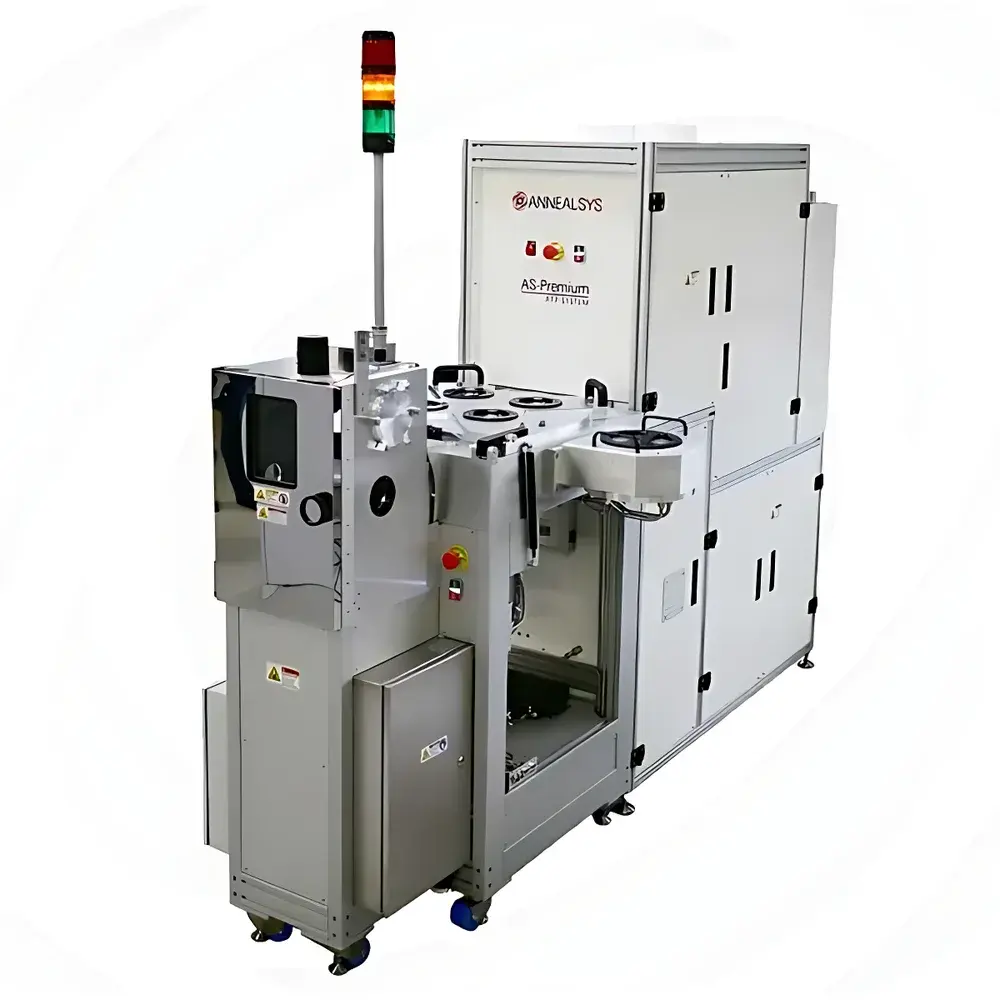
Annealsys AS-Premium High-Vacuum Rapid Thermal Annealing System with Load-Lock
| Brand | Annealsys |
|---|---|
| Origin | France |
| Model | AS-Premium |
| Instrument Type | High-Vacuum Rapid Thermal Annealing Furnace |
| Sample Size | 150 mm (6") / 200 mm (8") / 300 mm (12") wafers (configurable) |
| Temperature Range | 0–1200 °C |
| Max. Ramp Rate | 150 °C/s |
| Max. Cool-Down Rate | 200 °C/min (from 1000 °C to 400 °C) |
| Temperature Accuracy | ±1% of setpoint |
| Temperature Uniformity | ±1% across wafer surface |
| Vacuum Base Pressure | ≤1×10⁻⁶ hPa (with turbomolecular pump and load-lock) |
| Heating Configuration | Dual-side (top + bottom) halogen lamp array |
| Standard Temperature Sensors | Pyrometer (non-contact, real-time wafer surface monitoring) + Embedded thermocouple (susceptor reference) |
| Control System | SIMATIC S7-based PLC with 7″ HMI touchscreen interface |
| Programmable Recipes | Up to 50 stored profiles, each with up to 50 temperature/time/gas/vacuum segments |
| Gas Delivery | 4-channel MFC-controlled (N₂, Ar, O₂, forming gas, etc.) |
| Cooling | Water-cooled chamber + N₂ backside purge for substrate quenching |
Overview
The Annealsys AS-Premium is a high-vacuum, dual-zone rapid thermal annealing (RTA) system engineered for precision thermal processing of semiconductor wafers and advanced functional materials. Based on the fundamental principle of radiative heating via high-intensity halogen lamps, the AS-Premium delivers controlled, transient thermal cycles with sub-second response time and exceptional spatial and temporal repeatability. Its core architecture integrates a load-locked process chamber, turbomolecular pumping, and symmetrical top/bottom lamp arrays—enabling oxygen-free environments critical for silicon surface smoothing, III-V compound semiconductor activation, SiC contact formation, and other oxidation-sensitive applications. Designed to meet the stringent demands of R&D labs and pilot-line fabrication, the system supports wafer diameters up to 300 mm (12″), with optional configurations for 150 mm (6″) and 200 mm (8″) substrates. The platform complies with ISO 9001 manufacturing standards and incorporates hardware-level safeguards aligned with SEMI S2/S8 safety guidelines.
Key Features
- Dual-side infrared heating using high-stability halogen lamps with independent top/bottom power control for optimized thermal symmetry and reduced edge effects
- Integrated load-lock module enabling batch processing without breaking high vacuum (≤1×10⁻⁶ hPa), minimizing contamination and enabling seamless integration with gloveboxes or cluster tools
- Real-time, closed-loop temperature regulation via dual-sensor architecture: non-contact pyrometry (wafer surface measurement) combined with calibrated thermocouple feedback (susceptor reference)
- Fast digital PID controller delivering temperature reproducibility better than ±1% over repeated cycles, validated per ASTM F1523-22 for RTP system qualification
- Modular gas delivery system with four mass flow controllers (MFCs), supporting inert (N₂, Ar), oxidizing (O₂), reducing (5% H₂/95% N₂), and reactive atmospheres under precise pressure regulation (10⁻³–10³ Pa range)
- Water-cooled stainless-steel chamber and nitrogen-assisted backside cooling for rapid thermal quenching (200 °C/min from 1000 °C to 400 °C), essential for metastable phase retention and defect engineering
- Compact benchtop footprint (505 × 504 × 420 mm) with full automation: vacuum sequencing, gas purging, ramp/soak/cool profiling, and interlock monitoring managed through Siemens SIMATIC S7 PLC
Sample Compatibility & Compliance
The AS-Premium accommodates standard semiconductor wafers (Si, SiC, GaAs, InP, GaN) and emerging substrates including flexible metal foils, glass, and ceramic carriers. It supports both bare and encapsulated structures—graphite and SiC-coated graphite susceptors are available to minimize cross-contamination and enhance emissivity stability during high-temperature cycling. Process compatibility extends to low-k dielectrics, piezoelectric thin films (e.g., AlN, ZnO), pyroelectric oxides (e.g., LiNbO₃), and chalcogenide absorbers (e.g., CIGS). All operational parameters—including temperature setpoints, gas flows, vacuum levels, and dwell times—are logged with timestamped audit trails, satisfying GLP/GMP documentation requirements and FDA 21 CFR Part 11 data integrity criteria when paired with optional electronic signature modules.
Software & Data Management
The embedded HMI runs on a deterministic real-time OS and provides intuitive recipe navigation, live parameter visualization (including pyrometer signal stability plots), and event-triggered data export in CSV/Excel format. System logs include vacuum curves, lamp power traces, sensor drift diagnostics, and alarm history—each tagged with user ID, timestamp, and execution context. Optional Ethernet/IP or OPC UA connectivity enables integration into factory MES platforms. Data files are structured to support post-processing in MATLAB, Python (NumPy/Pandas), or JMP for statistical process control (SPC) analysis. Firmware updates follow IEC 62443-3-3 cybersecurity protocols, ensuring secure remote maintenance and version traceability.
Applications
- Ion implantation activation annealing (Si, Ge, SiC, GaN) with minimal dopant diffusion
- Ohmic and Schottky contact formation for III-V and wide-bandgap devices
- Rapid thermal oxidation (RTO) and nitridation (RTN) for gate stack engineering
- Sol-gel film densification and crystallization (e.g., PZT, BST, TiO₂)
- Gettering layer activation in SOI and power device substrates
- Selenization and sulfurization steps in thin-film photovoltaic fabrication (CIGS, CZTS)
- Low-temperature annealing of amorphous oxide semiconductors (e.g., IGZO) for display backplanes
- Thermal budget optimization in MEMS packaging and heterogeneous integration processes
FAQ
What vacuum level does the AS-Premium achieve with the standard turbomolecular pump and load-lock?
The base pressure is ≤1×10⁻⁶ hPa under clean, baked conditions—verified per ISO 20483 Annex B procedures.
Can the system be qualified for GMP-compliant production use?
Yes—when configured with 21 CFR Part 11-compliant software options, IQ/OQ documentation packages, and calibration certificates traceable to NIST standards.
Is double-side heating mandatory, or can single-side operation be selected?
The chamber supports both configurations; dual-side is standard, but top-only or bottom-only modes are programmable for asymmetric thermal profiles.
How is temperature uniformity validated across the wafer?
Uniformity is measured using a calibrated multi-point thermocouple wafer (ASTM F1523-22 compliant) at multiple setpoints (500 °C, 900 °C, 1100 °C) and reported as peak-to-peak deviation relative to setpoint.
Does the system support remote diagnostics and predictive maintenance?
Lamp aging trends, pump vibration spectra, and cooling water conductivity are monitored continuously; optional cloud-based analytics provide failure mode forecasting and service alerts.
Related Products