

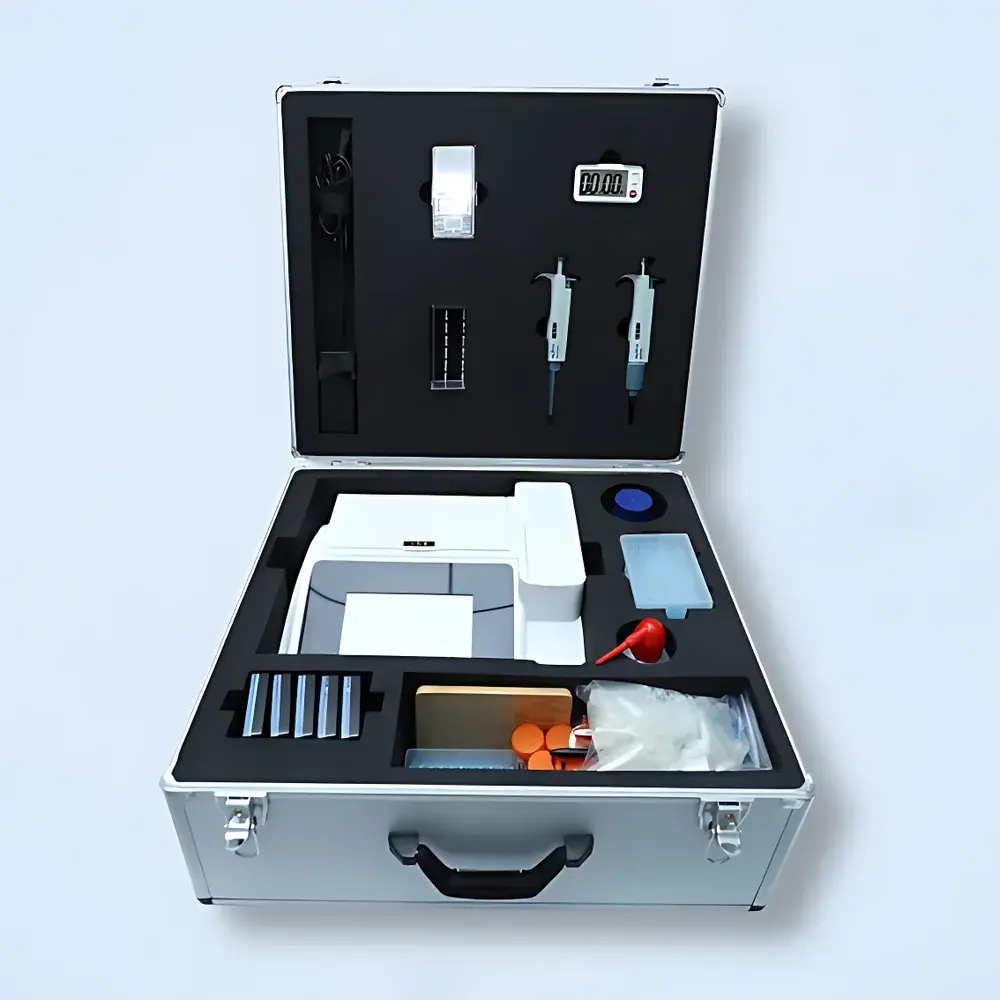
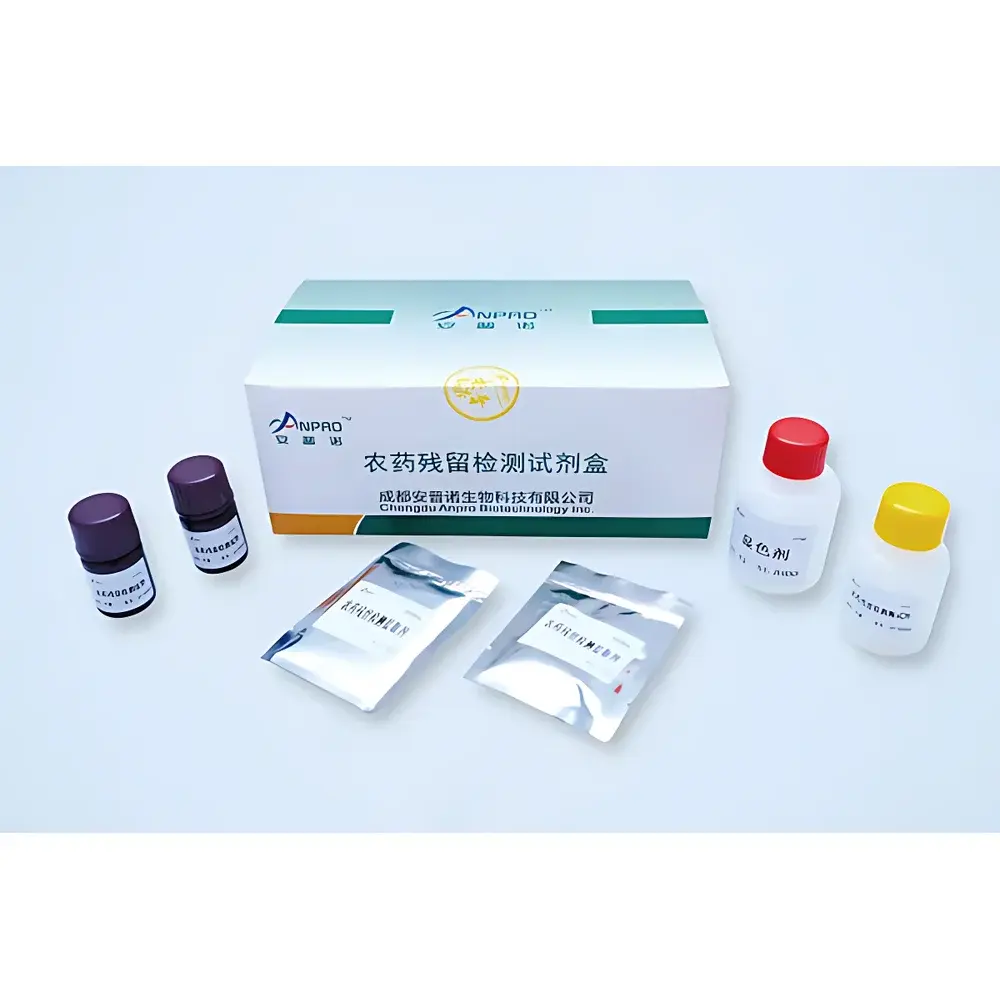
ANPRO NJ-IA 20-Channel Pesticide Residue Rapid Tester (Enzyme Inhibition Method, GB 5009.199 Compliant)
| Brand | ANPRO |
|---|---|
| Origin | Sichuan, China |
| Manufacturer Type | Direct Manufacturer |
| Region of Origin | Domestic (China) |
| Model | NJ-IA |
| Detection Method | Enzyme Inhibition Assay |
| Measurement Range | 0–100% Inhibition Rate |
| Number of Detection Channels | 20 |
| Measurement Error | < 0.01 Absorbance Units |
| LOD (Dichlorvos) | ≤ 0.2 mg/L |
| Additional LODs | Parathion ≤ 0.8 mg/L, Chlorpyrifos ≤ 0.16 mg/L, Phoxim ≤ 0.2 mg/L, Methamidophos ≤ 1.2 mg/L, Carbaryl ≤ 0.24 mg/L, Malathion ≤ 1.5 mg/L, Carbofuran ≤ 0.04 mg/L, Methomyl ≤ 0.1 mg/L, Isoprocarb ≤ 0.28 mg/L, Omethoate ≤ 0.44 mg/L, Dichlorvos ≤ 0.1 mg/L |
Overview
The ANPRO NJ-IA is a 20-channel benchtop spectrophotometric analyzer engineered for rapid, quantitative screening of organophosphorus and carbamate pesticide residues in agricultural commodities. It operates on the enzymatic inhibition principle defined in GB 5009.199–2022 (“National Food Safety Standard – Determination of Organophosphorus and Carbamate Pesticide Residues in Foods by Enzyme Inhibition Method”). The instrument measures the degree of acetylcholinesterase (AChE) activity inhibition caused by pesticide presence in extracted samples. Inhibition rates are calculated via dual-wavelength photometric detection (typically 412 nm reference, 610 nm or 405 nm assay wavelength), applying the Lambert–Beer law to quantify absorbance changes relative to blank and control standards. This method delivers semi-quantitative results aligned with regulatory threshold levels for field-deployable food safety monitoring.
Key Features
- 20 independent optical detection channels with synchronized timing control, enabling parallel analysis of up to 20 samples per run without cross-contamination or signal interference.
- Integrated sample preparation module housed within the instrument enclosure—including homogenizer, centrifuge adapter, filtration support, and reagent dispensing guides—reducing reliance on external lab infrastructure.
- Onboard thermal printer compliant with ISO/IEC 19794-5 for immediate hardcopy generation of test reports, including sample ID, timestamp, inhibition rate (%), pass/fail status against preset thresholds, and operator ID.
- Embedded microprocessor with non-volatile memory capable of storing ≥10,000 test records with full audit trail (date/time stamp, user login, calibration history, raw absorbance values).
- Pre-programmed calibration curves for 12 priority pesticides (e.g., carbofuran, dichlorvos, chlorpyrifos) based on GB 5009.199 reference protocols; supports user-defined curve import via USB interface.
- Auto-zeroing function with real-time drift compensation across all channels, minimizing baseline instability during extended operation.
Sample Compatibility & Compliance
The NJ-IA accepts homogenized aqueous extracts from fruits, vegetables, grains, tea leaves, dairy products, and herbal matrices following standardized extraction procedures (e.g., QuEChERS-based dilution or acetone/water partitioning). Sample volume requirements range from 50–200 µL per channel. The system complies with GB 5009.199–2022 for method validation parameters including repeatability (RSD ≤ 5% at 50% inhibition level), linearity (r² ≥ 0.995 over 10–90% inhibition), and specificity against common interferents (e.g., ascorbic acid, chlorophyll, tannins). While not certified under ISO/IEC 17025, the instrument meets functional requirements for GLP-aligned routine screening in food inspection laboratories, agro-processing QA/QC units, and municipal food safety surveillance programs.
Software & Data Management
Data export is supported via USB 2.0 port in CSV and XML formats compatible with LIMS platforms (e.g., LabWare, STARLIMS) and national food safety information systems (e.g., China’s National Food Safety Risk Monitoring Platform). Firmware includes configurable data upload protocols supporting HTTP POST and FTPS transmission with TLS 1.2 encryption. Audit logs record all critical events—including calibration initiation, result modification attempts, and firmware updates—with SHA-256 hash integrity verification. Optional software package ANPRO DataLink v3.1 provides advanced reporting tools: inhibition trend visualization, batch statistical summaries (mean, SD, CV%), and automated compliance flagging per MRLs listed in GB 2763–2021.
Applications
- Routine pre-market screening of fresh produce at wholesale markets and border inspection points.
- In-process quality assurance in juice, jam, and dried fruit manufacturing facilities.
- Field-level verification for Good Agricultural Practice (GAP) certification audits.
- Regulatory sampling campaigns conducted by provincial CDCs and market supervision bureaus.
- Educational use in food science curricula for teaching enzymatic assay fundamentals and food contaminant risk assessment.
FAQ
Does the NJ-IA require daily recalibration?
No—factory-calibrated optical modules maintain stability for ≥30 days under standard ambient conditions (15–30°C, RH < 80%). A quick 3-point verification using supplied control standards is recommended before each shift.
Can the instrument differentiate between organophosphates and carbamates?
No—it reports total cholinesterase inhibition, which reflects cumulative exposure to both classes. Confirmatory identification requires GC-MS or LC-MS/MS per GB 23200 series standards.
Is the device compliant with FDA 21 CFR Part 11?
It supports electronic signatures and audit trails but lacks full Part 11 validation documentation; suitable for non-GMP environments where ALCOA+ principles apply.
What maintenance is required beyond routine cleaning?
Annual optical alignment verification and AChE reagent lot qualification are advised. No consumable parts require replacement outside of standard cuvettes and enzyme kits.
How are inhibition rates converted to concentration estimates?
Using built-in calibration curves derived from reference standards; absolute quantification is not performed—results are interpreted relative to action thresholds defined in GB 2763–2021.




