
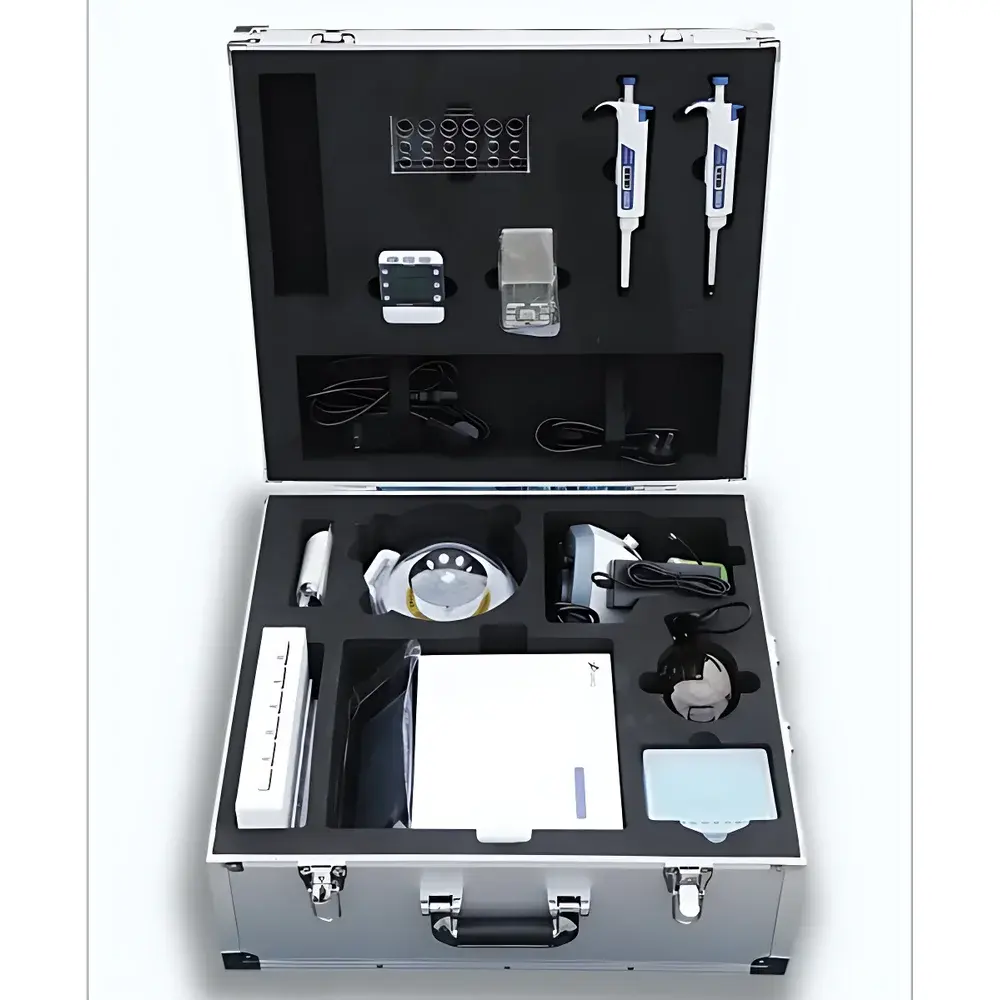
ANPRO SKJ-IA-05 Herbal Medicine Heavy Metal Analyzer for Cadmium, Lead, and Copper
| Brand | ANPRO |
|---|---|
| Origin | Sichuan, China |
| Manufacturer Type | Direct Manufacturer |
| Regional Classification | Domestic (China) |
| Model | SKJ-IA-05 |
| Function Type | Multi-analyte Quantitative Detection |
| Sample Versatility | Universal for Herbal Materials, Decoction Pieces, Animal-derived Herbs |
| Optical Wavelength | 410 nm |
| Detection Time per Sample | ≤25 minutes |
| Repeatability (RSD) | ≤0.2% |
| Detection Channels | 6-channel simultaneous measurement |
| Detection Range | Cd 0.1–5 mg/kg, Pb 0.2–10 mg/kg, Cu 2–50 mg/kg |
| Accuracy | Cd ≥80%, Pb ≥80%, Cu ≥75% |
| Compliance Reference | Chinese Pharmacopoeia (2020 Ed., Vol. IV, General Chapter 0412 & 2341) |
Overview
The ANPRO SKJ-IA-05 Herbal Medicine Heavy Metal Analyzer is a field-deployable, multi-channel quantitative spectrophotometric system engineered for rapid, on-site assessment of cadmium (Cd), lead (Pb), and copper (Cu) in traditional herbal medicines—including crude plant materials, processed decoction pieces, and animal-derived medicinal substances. It operates on the principle of colorimetric complexation followed by absorbance measurement at 410 nm, aligned with standardized wet-chemistry protocols referenced in the Chinese Pharmacopoeia (2020 Edition, General Chapters 0412 “Heavy Metals” and 2341 “Determination of Residues”). Unlike conventional ICP-MS or AAS systems requiring centralized laboratories and extensive sample preparation, the SKJ-IA-05 integrates pre-calibrated reagent kits, embedded calibration curves, and solid-phase extraction modules to deliver pharmacopeia-compliant semi-quantitative to quantitative results within 25 minutes per batch of up to six samples. Its design prioritizes operational safety—eliminating direct handling of heavy metal standard solutions—and supports decentralized quality control across the herbal supply chain: from cultivation sites and processing facilities to wholesale acquisition centers and GMP-compliant manufacturing units.
Key Features
- Six independent optical detection channels enabling parallel analysis of up to six samples without cross-contamination or sequential delay
- Pre-loaded, lot-specific calibration curves stored in firmware—ensuring traceability and eliminating manual curve generation or standard dilution steps
- Integrated thermal-controlled reaction module maintaining consistent incubation temperature (37 ± 1 °C) for reproducible complex formation kinetics
- High-resolution 7-inch resistive touchscreen interface with intuitive icon-driven workflow navigation, supporting multilingual UI (English, Chinese)
- Built-in thermal printer for immediate hard-copy documentation compliant with GLP record-keeping requirements
- GPS-enabled geotagging and timestamping of each assay result, facilitating spatial mapping of contamination hotspots during field surveys
- USB and Wi-Fi connectivity for secure data export to LIMS or national herbal monitoring platforms (e.g., CNHPC Herbal Quality Surveillance System)
Sample Compatibility & Compliance
The SKJ-IA-05 is validated for use with dried, powdered, or macerated samples of >200 commonly traded herbal species, including Angelica sinensis, Rehmannia glutinosa, Scutellaria baicalensis, and Animalia-derived materials such as Calculus Bovis and Os Draconis. Sample preparation follows pharmacopeial guidance: acid digestion (HNO3/H2O2) followed by centrifugation and filtration (0.45 µm). The system meets the analytical performance criteria outlined in ISO/IEC 17025:2017 for field-deployable screening devices and has undergone third-party verification by the Sichuan Provincial Institute for Drug Control. While not intended for definitive regulatory release testing under ICH Q5, it fulfills the screening threshold requirements specified in USP Chapter (Elemental Impurities – Limits) and aligns with WHO Technical Report Series No. 992 Annex 3 (Guidelines on Good Agricultural and Collection Practices for Medicinal Plants).
Software & Data Management
Firmware v3.2.1 includes audit-trail functionality compliant with FDA 21 CFR Part 11 principles: user authentication (PIN + role-based access), electronic signatures for result approval, immutable storage of raw absorbance values, and full session logs (operator ID, time/date, GPS coordinates, reagent lot numbers). Data exports support CSV and PDF formats; encrypted Wi-Fi transmission uses TLS 1.2. The optional ANPRO Cloud Connect module enables automated synchronization with enterprise-grade databases and supports API integration with ERP systems (e.g., SAP S/4HANA Plant Maintenance modules) for real-time non-conformance flagging.
Applications
- Routine screening of incoming herbal batches at GMP-certified TCM manufacturing facilities prior to extraction or formulation
- On-farm validation of soil remediation efficacy in Cd/Pb-contaminated cultivation zones (e.g., Hunan, Guangxi provinces)
- Regulatory surveillance by provincial drug administration agencies during market inspections
- Research applications in ethnopharmacology labs assessing elemental bioaccumulation patterns across harvesting seasons or geographical origins
- Training and capacity building for rural quality assurance officers in primary collection cooperatives
FAQ
What regulatory standards does the SKJ-IA-05 comply with?
It conforms to analytical validation parameters in Chinese Pharmacopoeia 2020 Edition (Chapters 0412, 2341), ISO/IEC 17025:2017 (Clause 7.2.2 for field methods), and provides data suitable for preliminary compliance assessment against USP and WHO GAP Annex 3.
Can the instrument detect other heavy metals beyond Cd, Pb, and Cu?
No—its optical configuration, reagent chemistry, and firmware are optimized exclusively for cadmium, lead, and copper quantification per current pharmacopeial requirements.
Is method validation documentation available for audit purposes?
Yes—each unit ships with a Certificate of Conformance, full validation report (including precision, accuracy, LOD/LOQ, and ruggedness studies), and third-party verification certificate issued by the Sichuan Provincial Institute for Drug Control.
How is reagent stability managed across different environmental conditions?
All reagent kits are lyophilized and vacuum-sealed with desiccant; shelf life is 18 months at 2–8 °C or 6 months at ambient temperature (≤30 °C, RH <60%). Batch-specific calibration data is encoded in QR labels scanned automatically during initialization.
Does the system support remote software updates?
Yes—over-the-air (OTA) firmware updates are delivered via secure HTTPS channel with cryptographic signature verification to ensure integrity and authenticity.





