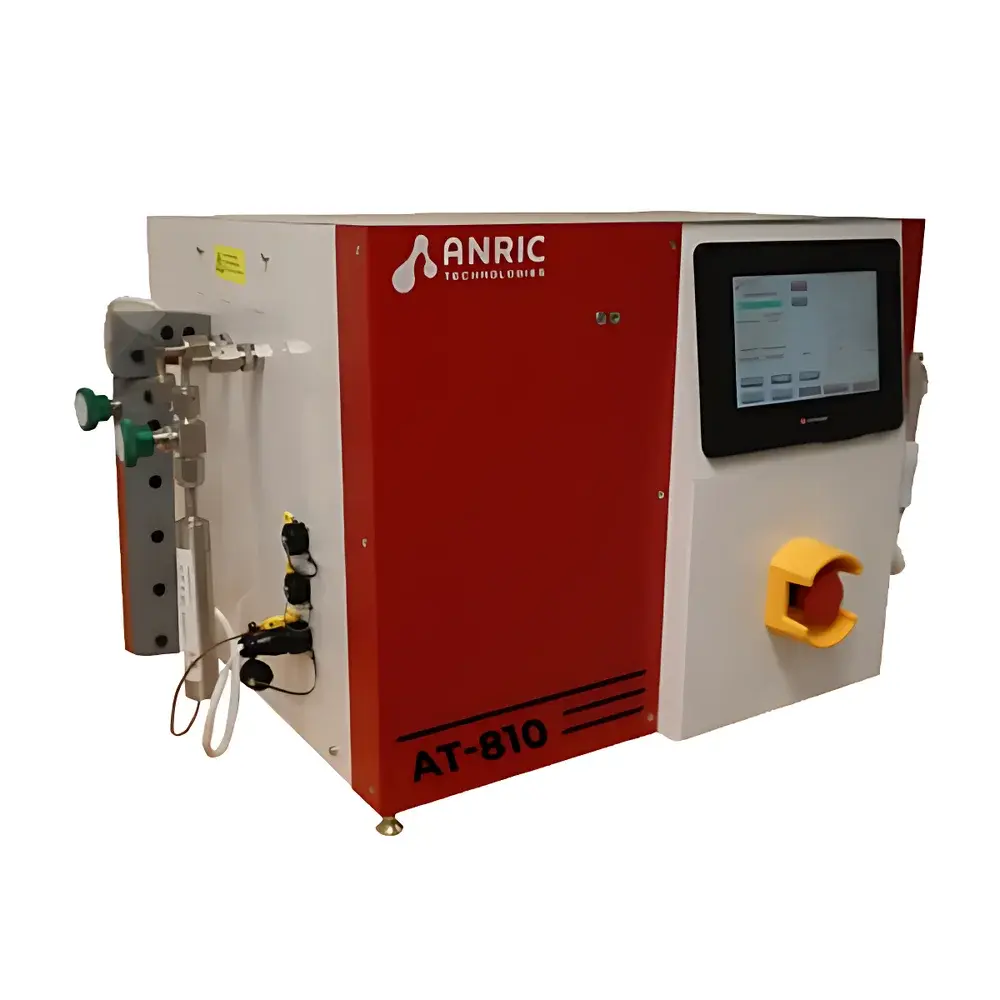
ANRIC AT810 Benchtop Atomic Layer Deposition System
| Brand | ANRIC |
|---|---|
| Origin | USA |
| Manufacturer Type | Authorized Distributor |
| Origin Category | Imported |
| Model | AT810 |
| Pricing | Upon Request |
Overview
The ANRIC AT810 is a compact, benchtop-scale atomic layer deposition (ALD) system engineered for precision thin-film synthesis in semiconductor R&D, academic laboratories, and pilot-line fabrication environments. It operates on the fundamental ALD principle—sequential, self-limiting surface reactions between gaseous precursors and co-reactants—enabling sub-nanometer thickness control, exceptional conformality on high-aspect-ratio structures (e.g., trenches, pores), and reproducible stoichiometry across diverse substrates. Unlike CVD or PECVD systems, the AT810 eliminates gas-phase reactions through pulsed, temporally separated precursor dosing and inert-gas purging, ensuring monolayer-by-monolayer growth with minimal intermixing. Its fully heated, semiconductor-grade metal piping—from precursor delivery to chamber inlet—prevents condensation and ensures consistent vapor-phase transport, critical for thermally sensitive or low-vapor-pressure precursors. The system integrates rapid-response, high-precision mass flow controllers (MFCs) with integrated inert-gas purge capability, enabling sub-second pulse widths and cycle times optimized for both kinetic-limited and diffusion-limited processes.
Key Features
- Benchtop footprint (≈0.5 m²) compatible with Class 100–1000 cleanrooms and standard lab benches.
- Full aluminum chamber fabricated to semiconductor-grade surface finish specifications; maximum operating temperature: 300°C ±1°C.
- High-temperature, semiconductor-grade fast-pulse ALD valves with integrated ultra-fast MFCs and programmable N₂ purge timing.
- Heated precursor lines and source heaters (up to 150°C ±2°C, optional upgrade to 180°C) with jacketed thermal management.
- 7-inch industrial-grade touchscreen HMI powered by a dedicated PLC—no external PC required for operation, programming, or real-time monitoring.
- Modular precursor manifold supporting up to three organometallic precursors and three reactive co-reactants (standard configuration: 3+2; expandable to 3+3 via software-enabled third-reagent control).
- Streamlined chamber geometry with minimized internal volume (<1.2 L) for rapid pressure stabilization, reduced precursor consumption, and improved process repeatability.
- Comprehensive hardware and software interlocks—including over-temperature cutoffs, vacuum loss detection, gas line pressure monitoring, and door safety switches—for safe multi-user operation.
Sample Compatibility & Compliance
The AT810 accommodates wafers up to 6 inches in diameter (circular) or 7 inches square, with customizable chucks for non-standard geometries (e.g., rectangular, diced dies, powders, or high-profile substrates up to 11 mm height). Its fully sealed, VCR-compliant metallic fluid path meets SEMI F20 and ASTM F1941 standards for particle generation and outgassing performance. All wetted surfaces are electropolished 316L stainless steel or anodized aluminum, minimizing trace metal contamination. The system supports GLP/GMP-aligned process documentation when paired with optional external PC control and audit-trail-enabled software (compliant with FDA 21 CFR Part 11 requirements upon configuration). Gas supply specifications require ≥99.9995% purity N₂ (with inline particulate and moisture filters) and clean dry air (CDA) at 90–110 psi; all gas interfaces utilize 1/4″ VCR compression fittings per SEMI E13.
Software & Data Management
The embedded PLC-based HMI provides intuitive recipe-driven operation via a responsive 7-inch capacitive touchscreen. Users define full ALD cycles—including precursor pulse duration, purge time, reactor temperature, chuck temperature, and sequence logic—for standard binary films, ternary compounds (e.g., AlₓSc₁₋ₓN), nanolaminates (e.g., TiN/TiO₂ stacks), and doped layers. A built-in recipe library includes validated protocols for Al₂O₃ (H₂O- and O₃-assisted), TiO₂, HfO₂, SiO₂, Pt, Ir, and MoO₃. Real-time process visualization displays chamber pressure, precursor line temperatures, MFC setpoints/actuals, and cycle progression. Optional PC-link functionality enables remote scripting (via Modbus TCP), automated log export (CSV/Excel), and integration into centralized MES or LIMS platforms. Firmware updates and diagnostic logs are accessible via USB port without system downtime.
Applications
The AT810 serves as a versatile platform for developing and qualifying ALD processes in microelectronics, MEMS, photovoltaics, and functional coatings. Typical use cases include: conformal gate dielectrics (Al₂O₃, HfO₂) on finFET or nanosheet transistor test structures; ultrathin passivation layers for perovskite solar cells; catalyst-support interfaces in electrochemical devices; corrosion-resistant nanocoatings on medical implants; and seed layers for selective-area epitaxy. Its static-mode capability enables uniform film growth on porous scaffolds and powder beds, while high-exposure mode facilitates deep penetration into >20:1 aspect-ratio trenches. Researchers routinely employ it for combinatorial screening of precursor chemistries, interface engineering studies, and qualification of novel precursors prior to cluster-tool integration.
FAQ
What vacuum pump specifications are required?
A minimum 12 cfm wet pump with fluorinated oil (e.g., Fomblin Y-type) is mandatory; 19.5 cfm or higher is recommended for AT810 due to its larger chamber volume versus AT410/610 models.
Is ozone generation supported natively?
Yes—optional ATOzone module integrates an on-board ozone generator (up to 10 wt% O₃ in O₂) with real-time ambient ozone monitoring and fail-safe interlock coupling.
Can the system operate under glovebox integration?
Yes—dedicated glovebox interface kits include feedthroughs for power, signal, gas lines, and vacuum, with inert-atmosphere compatibility verified per ISO 14644-1 Class 5 protocols.
What level of process repeatability can be expected?
With calibrated precursors and stabilized thermal conditions, thickness uniformity across 6″ wafers is typically ≤±1.2% (3σ), verified by ex-situ ellipsometry and XRR.
Are third-party precursor delivery modules supported?
Yes—the system’s open I/O architecture allows integration of external bubbler controllers, liquid injection units, or plasma sources via analog/digital signals and Modbus RTU.