
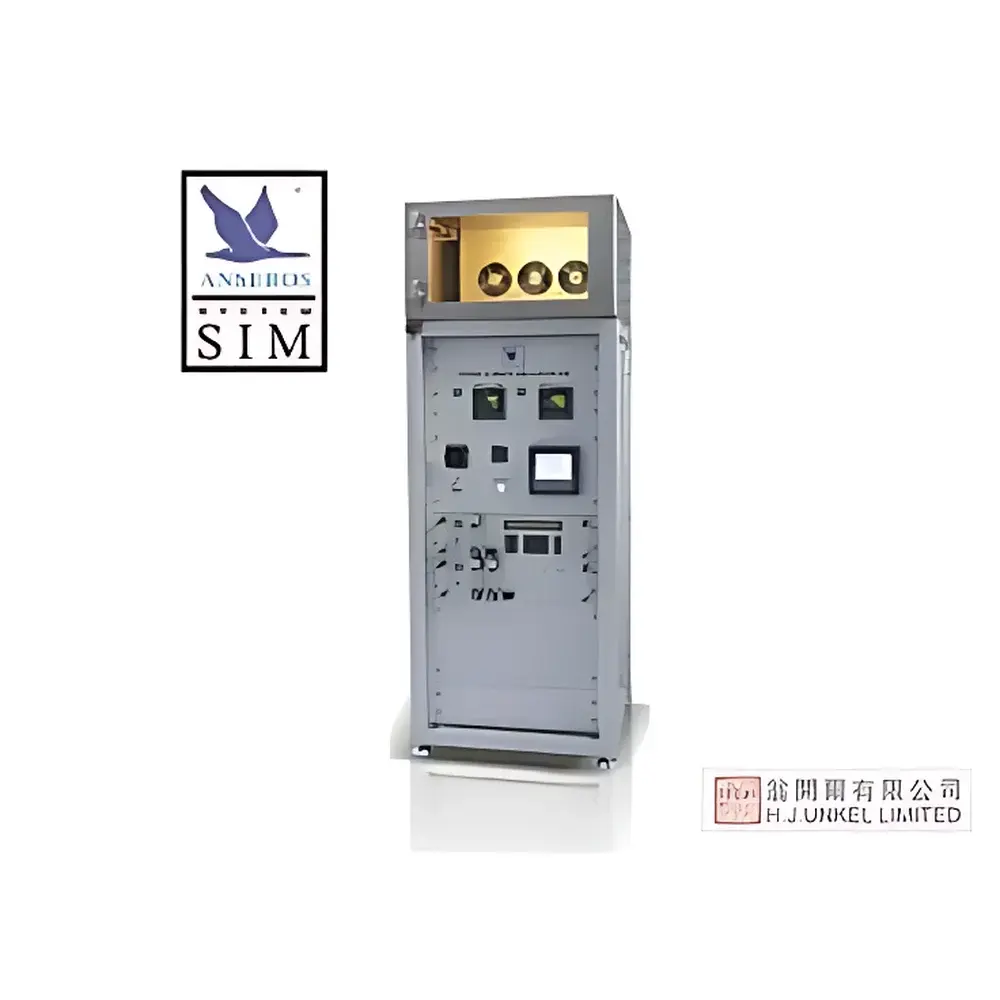
Anseros SIM 6050-T Ozone Aging Test Chamber
| Brand | Anseros |
|---|---|
| Origin | Germany |
| Model | SIM 6050-T |
| Temperature Range | 15–70 °C (RT = 23 °C) |
| Humidity Range | 30–80 % RH |
| Ozone Concentration Control Range | 20–200 pphm |
| Ozone Measurement Principle | Non-dispersive UV absorption |
| Ozone Detection Limit | 1 pphm |
| Response Time | 5 s |
| Temperature Accuracy | ±5 K |
| Humidity Accuracy | −1 to +4 % RH |
| Airflow Velocity in Test Chamber | 600 mm/s |
| Air Exchange Rate | 400 L/h |
| Chamber Internal Dimensions | 425 × 460 × 270 mm |
| External Dimensions | 670 × 620 × 510 mm |
| Power Supply | 230 V / 50 Hz |
Overview
The Anseros SIM 6050-T Ozone Aging Test Chamber is a precision-engineered environmental test system designed for accelerated evaluation of ozone-induced degradation in elastomeric materials—particularly rubber cables, seals, gaskets, and automotive hose assemblies. It operates on the fundamental principle that ozone attack on unsaturated polymer chains (e.g., natural rubber, SBR, NBR) initiates surface cracking under tensile stress, with kinetics governed by the empirical relationship τ·Cn = const., where τ is time-to-crack initiation (hours), C is ozone concentration (pphm), and n is a material-specific exponent typically ranging from 0.5 to 1.2. The SIM 6050-T replicates this mechanism under controlled, repeatable conditions: regulated temperature (15–70 °C), relative humidity (30–80 % RH), dynamic airflow (600 mm/s), and precisely dosed ozone (20–200 pphm). Its non-dispersive ultraviolet (UV) absorption ozone analyzer ensures trace-level detection (LOD: 1 pphm), real-time feedback control (PID algorithm), and automatic thermal/pressure compensation—enabling compliance with ASTM D1149, ISO 1431-1, and GB/T 7762 standards for ozone resistance testing.
Key Features
- Integrated ozone generation, measurement, and closed-loop PID control system with ±1 pphm accuracy across the 20–200 pphm operating range
- Non-dispersive UV absorption ozone sensor featuring auto-zeroing every 2 seconds, eliminating span drift and ensuring long-term baseline stability
- Thermally insulated stainless-steel test chamber with tempered glass observation door and uniform air distribution ducting
- Programmable PLC-based controller supporting multi-step test profiles—including static (unstressed) and dynamic (tensile-strained) exposure modes
- Real-time monitoring of chamber temperature (±5 K), humidity (−1 to +4 % RH), ozone concentration, and airflow velocity (600 mm/s)
- Modular architecture: ozone generator, UV analyzer, and control unit housed in a dedicated 1600 × 550 × 600 mm cabinet for service accessibility and EMI isolation
Sample Compatibility & Compliance
The SIM 6050-T accommodates standardized test specimens per ASTM D1149 Type A (dumbbell-shaped) and Type B (ring-shaped), as well as custom fixtures for cable bending, seal compression, or hose loop configurations. Its 425 × 460 × 270 mm usable internal volume allows simultaneous testing of up to 12 specimens under identical environmental conditions. All operational parameters—including ozone dose rate, temperature ramping, and humidity hold times—are fully configurable to meet requirements of ISO 1431-1:2018 (rubber—resistance to ozone cracking—part 1: static strain test), ASTM D1149-19 (standard test method for rubber deterioration—ozone cracking), and IEC 60811-507 (electrical insulating materials—test methods for polymeric compounds). The system supports GLP-aligned documentation via optional data logging and audit-trail-capable software interfaces.
Software & Data Management
While the base SIM 6050-T utilizes an embedded PLC HMI for local operation, it provides RS-485 and analog 4–20 mA outputs for integration into centralized laboratory data acquisition systems (e.g., LabVIEW, DeltaV, or custom SCADA). Optional Ethernet-enabled firmware enables remote parameter setting, real-time trend visualization, and CSV export of time-stamped ozone concentration, temperature, and humidity datasets. All logged data include metadata tags (operator ID, test ID, calibration timestamp) to satisfy 21 CFR Part 11 requirements when paired with validated electronic signature modules. Calibration logs, maintenance records, and sensor zero/span verification events are retained internally for ≥12 months—supporting internal quality audits and regulatory inspections.
Applications
- Accelerated lifetime prediction of EPDM, CR, and FKM seals used in HVAC, aerospace, and medical device enclosures
- Qualification of insulation integrity for power transmission cables exposed to high-altitude or urban ozone environments
- Material screening during rubber compound development—correlating antioxidant package efficacy with crack onset time
- Validation of vulcanization process consistency via inter-batch ozone resistance repeatability (RSD < 3.2 % at 50 pphm, n = 6)
- Failure analysis of field-failed components by back-calculating equivalent service-life exposure using τ·Cn extrapolation
FAQ
What ozone concentration ranges does the SIM 6050-T support, and how is stability maintained?
The system delivers 20–200 pphm with ±1 pphm accuracy. Stability is achieved through continuous UV absorption measurement, real-time PID adjustment of ozone generator output, and automatic thermal (0–60 °C ±1 °C) and barometric (600–1500 mbar ±2 mbar) compensation.
Can the chamber operate at both static and dynamic strain conditions?
Yes. The SIM 6050-T is compatible with standardized static test fixtures (ASTM D1149 Type A/B) and optional dynamic loading rigs—including motorized tensile stages and rotating bend jigs—for simulating service-induced strain states.
Is the UV ozone sensor factory-calibrated, and what is its recalibration interval?
Each sensor ships with NIST-traceable calibration certificate. Recommended recalibration interval is 12 months under continuous operation; however, built-in auto-zero functionality minimizes drift between scheduled verifications.
Does the system comply with FDA or EU GMP documentation requirements?
When configured with optional audit-trail software and electronic signature modules, the SIM 6050-T meets ALCOA+ principles and supports 21 CFR Part 11 compliance for regulated pharmaceutical and medical device testing environments.
What maintenance is required for the ozone generator and UV cell?
The corona-discharge ozone generator requires annual inspection of electrode alignment and ceramic dielectric integrity. The UV absorption cell requires biannual optical path cleaning using certified lint-free swabs and isopropanol—no consumables or replacement lamps are needed due to solid-state LED source design.



