
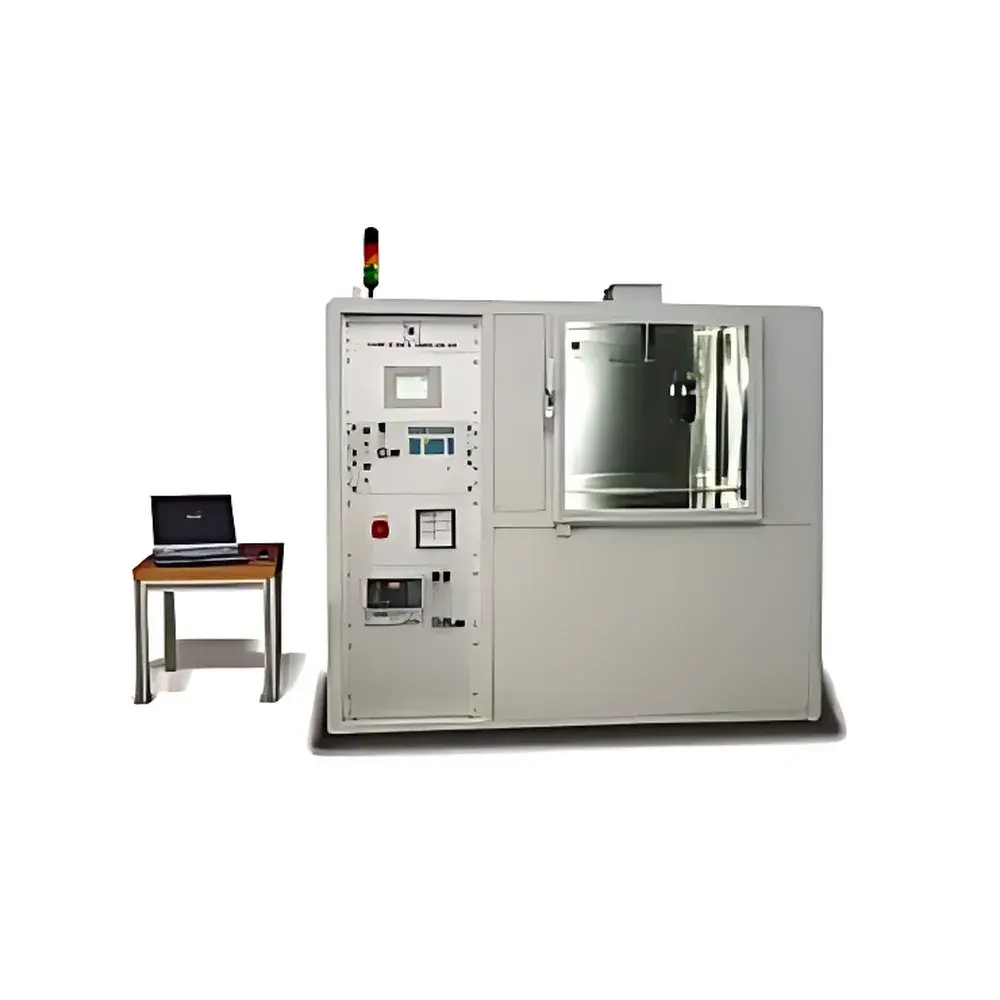
Anseros SIM 7500 Ozone Aging Test Chamber
| Brand | Anseros |
|---|---|
| Origin | Germany |
| Model | SIM 7500 |
| Temperature Range | 26–60 °C (RT = 23 °C) |
| Humidity Range | 30–80 % RH |
| Ozone Concentration Control Range | 20–200 pphm |
| Ozone Measurement Principle | Non-dispersive ultraviolet (NDUV) absorption |
| Ozone Detection Limit | 1 pphm |
| Response Time | 5 s |
| Temperature Accuracy | ±5 K |
| Humidity Accuracy | −1 to +4 % RH |
| Airflow Velocity | 600 mm/s |
| Air Exchange Rate | 400 L/h |
| Chamber Internal Dimensions | 425 × 460 × 270 mm (standard) |
| Power Supply | 230 V / 50 Hz |
Overview
The Anseros SIM 7500 Ozone Aging Test Chamber is a precision-engineered environmental test system designed for accelerated evaluation of ozone resistance in elastomeric materials—particularly rubber compounds used in cables, seals, gaskets, and automotive components. It operates on the fundamental principle that ozone-induced cracking in unsaturated rubbers follows a predictable kinetic relationship: τ·Cn = Const., where τ is time-to-crack (hours), C is ozone concentration (pphm), and n is a material-specific exponent derived from polymer microstructure. By precisely controlling ozone concentration (20–200 pphm), temperature (15–70 °C), and relative humidity (30–80 % RH), the SIM 7500 enables reproducible acceleration of oxidative degradation under standardized stress conditions. Its NDUV-based ozone sensor provides real-time, drift-free monitoring with 1 pphm detection limit and automatic thermal/pressure compensation—ensuring metrological integrity across extended test durations. The chamber complies with core requirements of ISO 1431-1 (rubber—determination of resistance to ozone cracking—part 1: static strain), ASTM D1149, and GB/T 7762, serving as a validated platform for predictive service-life modeling and material qualification.
Key Features
- Integrated PID-controlled ozone generation and feedback regulation, achieving ±1 pphm stability at setpoint and <10 min 95 % settling time
- Non-dispersive ultraviolet (NDUV) ozone analyzer with dual automatic zeroing (every 2 s), eliminating span drift and enabling long-term measurement repeatability (±0.2 % of reading)
- Uniform laminar airflow (600 mm/s) and high air exchange rate (400 L/h) ensure homogeneous ozone distribution and eliminate local concentration gradients
- Dual-zone climate control: independent regulation of chamber temperature (±5 K accuracy) and humidity (−1 to +4 % RH accuracy), with <20 min stabilization to 95 % RH setpoint
- PLC-based user interface with programmable test profiles, event logging, and password-protected parameter locking for GLP-compliant operation
- Stainless-steel interior chamber (electropolished AISI 316L) resistant to ozone corrosion; ozone-safe sealing materials (e.g., FKM, PTFE) throughout gas path
Sample Compatibility & Compliance
The SIM 7500 accommodates standard test specimens per ISO 1431-1—including Type I dumbbell specimens (20 ± 2 % static elongation), dynamic flexure fixtures, and custom jig-mounted components. Its design supports both static and dynamic aging protocols, enabling evaluation of vulcanized NR, SBR, CR, EPDM, NBR, and HNBR compounds. The chamber meets mechanical and environmental validation criteria outlined in ISO/IEC 17025 for accredited testing laboratories and aligns with regulatory expectations for material stability data submitted under FDA 21 CFR Part 11 (when paired with compliant software). All ozone exposure data—including timestamped concentration, temperature, humidity, and duration—are recorded with audit-trail capability, satisfying GMP documentation requirements for medical device elastomer qualification.
Software & Data Management
The integrated control system records all operational parameters at user-defined intervals (1 s to 60 min resolution) and exports timestamped CSV files compatible with LIMS and statistical analysis platforms (e.g., JMP, Minitab). Raw sensor outputs—including UV absorbance, temperature-compensated ozone density (g·O3/m3), and pressure-corrected ppmv/v—are stored with metadata (operator ID, test ID, calibration certificate number). Optional Ethernet/IP connectivity enables remote monitoring via secure HTTPS interface, while built-in alarm logic triggers email/SMS notifications upon deviation from preset thresholds (e.g., ozone >±5 pphm, T >±2 K). Data integrity is preserved through write-once storage architecture and cryptographic hash verification of exported datasets.
Applications
- Predictive lifetime assessment of cable jacketing (e.g., cross-linked polyethylene, EPR) exposed to outdoor ozone-rich environments
- Comparative ranking of antioxidant efficacy in NBR vs. hydrogenated NBR (HNBR) formulations—validating the role of residual double-bond saturation in ozone resistance
- Qualification of sealing systems for aerospace hydraulic lines, where ozone-induced microcracking compromises barrier integrity
- Accelerated aging validation for medical-grade elastomers (e.g., silicone, thermoplastic elastomers) per ISO 10993-12 biocompatibility testing guidelines
- Root-cause analysis of field failures in automotive weatherstrips, leveraging Arrhenius-type extrapolation from multi-concentration test series
FAQ
What ozone concentration range does the SIM 7500 support, and how is it calibrated?
The chamber delivers 20–200 pphm ozone with NIST-traceable calibration using primary standard generators. Calibration is performed annually or after sensor replacement, with full report including uncertainty budget per ISO/IEC 17025 Annex A.
Can the SIM 7500 operate under dynamic strain conditions?
Yes—it accepts third-party dynamic fixtures (e.g., reciprocating bend, torsional twist) mounted within the chamber volume. Airflow design ensures uninterrupted ozone delivery during motion without turbulence-induced concentration fluctuation.
Is humidity control mandatory for ISO 1431-1 compliance?
While ISO 1431-1 specifies “ambient humidity,” the SIM 7500’s controlled RH capability (30–80 % RH) allows users to isolate humidity effects on crack initiation kinetics—supporting advanced failure mode analysis beyond minimum standard requirements.
How does the NDUV sensor maintain zero stability over extended runs?
The optical path includes an internal reference cell refreshed every 2 seconds; combined with temperature-compensated photodiode array and auto-zero algorithm, it achieves <0.05 pphm/day zero drift—eliminating manual recalibration during 1000-hour tests.
What maintenance is required for long-term reliability?
Scheduled tasks include quarterly ozone generator electrode cleaning, annual UV lamp replacement, and biannual verification of humidity sensor hysteresis per ISO 4618. Full service logs are retained in onboard memory and exportable for QA audits.



