
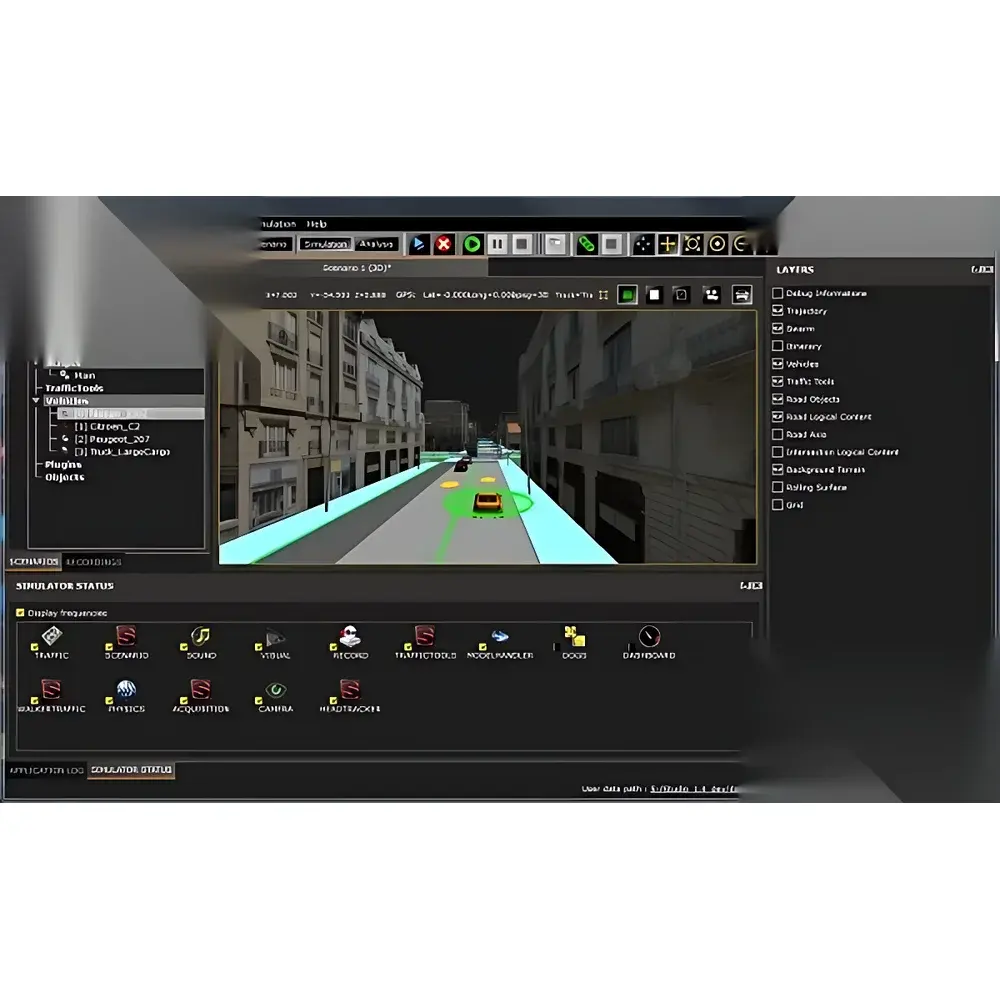
ANSYS Driving Simulation and Traffic Scenario Editor Platform
| Brand | ANSYS (USA) |
|---|---|
| Origin | Imported |
| Manufacturer Type | Authorized Distributor |
| Model | ANSYS Driving Simulation & Traffic Scenario Editor |
Overview
The ANSYS Driving Simulation and Traffic Scenario Editor Platform is a high-fidelity, physics-based co-simulation environment engineered for autonomous vehicle (AV) development, ADAS validation, and intelligent lighting system testing. Built on ANSYS’ industry-proven multiphysics simulation foundation, the platform integrates geometric modeling, semantic traffic logic, vehicle dynamics, and physically accurate sensor simulation—including camera, LiDAR, and millimeter-wave radar—within a real-time, closed-loop architecture. Its core simulation methodology relies on ray-tracing–enabled photorealistic rendering, bidirectional scattering distribution function (BSDF)-driven material optics, and time-synchronized multi-domain coupling (mechanical, electromagnetic, optical, and behavioral). This enables traceable, repeatable, and standards-aligned virtual testing across SAE J3016 Levels 2–5, supporting ISO 26262 functional safety workflows and ISO/PAS 21448 (SOTIF) scenario coverage analysis.
Key Features
- Open-architecture traffic scenario editor with parametric road geometry tools: supports straight segments, clothoids, arcs, elevation profiles, variable cross-slopes, overpasses, interchanges, ramps, and lane-level attributes (width, direction, speed limit, type, marking style—solid/dashed, color, texture).
- Semantic traffic flow definition engine: enables rule-based and script-driven behavior modeling for vehicles, pedestrians, and traffic agents—including abrupt maneuvers (lane changes, emergency braking), jaywalking, intersection negotiation, and configurable interaction logic (e.g., collision vs. avoidance).
- Modular vehicle dynamics framework: accepts user-defined chassis parameters (wheelbase, track width, mass, CG height), powertrain characteristics (torque curves, max speed), steering kinematics, tire models (Pacejka, MF-Tyre), and integration of third-party solvers such as CarSim or custom C/C++/Python-based models.
- Physics-based optical simulation powered by ANSYS OMS (Optical Material Scanner): imports BSDF data measured from real-world surfaces (asphalt, concrete, vehicle paint, signage, foliage) to drive ray-traced illumination, glare, reflection, and scattering effects under dynamic sky models (geolocation-aware solar position, spectral sky radiance, IES/XMP point/area sources).
- Multi-sensor physical emulation: camera models include lens distortion, Bayer pattern demosaicing, temporal noise, and dynamic range; LiDAR includes beam divergence, pulse energy, surface reflectivity dependence, and interference modeling; mmWave radar incorporates antenna array patterns, Doppler shift, RCS-based target detection, and multipath propagation.
- Real-time co-simulation interface via standardized APIs (FMI 2.0, ROS 2, DDS, TCP/IP, Simulink S-Function, C++ SDK, Python bindings) for seamless integration with perception stacks, planning controllers, ECU hardware-in-the-loop (HIL), VR motion platforms, and test data replay systems.
Sample Compatibility & Compliance
The platform supports import of OpenStreetMap (OSM) and CityGML-based HD maps, enabling rapid generation of geo-referenced urban, highway, and rural environments. It complies with international standards governing simulation fidelity and verification: ISO 23150 (automotive simulation validation), ISO/IEC/IEEE 15288 (systems engineering lifecycle), and aligns with regulatory expectations for auditability under UN R157 (ALKS) and NHTSA AV TEST guidelines. Sensor simulation outputs are structured for traceability to ISO 16750 (environmental stress), ISO 20653 (ingress protection), and ISO 11270 (headlamp photometry). All scenario definitions, parameter configurations, and simulation logs support GLP/GMP-compliant metadata tagging and version-controlled revision history.
Software & Data Management
Scenario definitions are stored in human-readable XML and HDF5 formats, enabling automated regression testing and CI/CD pipeline integration. The embedded scripting environment supports Python 3.8+ and C++17 for custom traffic logic, scenario mutation, and Monte Carlo test case generation. Data export includes synchronized timestamped streams of ground truth pose, sensor raw output (point clouds, image buffers, radar FFTs), and perception inference results. Audit trails meet FDA 21 CFR Part 11 requirements for electronic records and signatures, including immutable logging of user actions, parameter edits, and simulation execution metadata.
Applications
- Validation of perception algorithms under edge-case lighting conditions (dawn/dusk transitions, tunnel ingress/egress, specular glare from wet pavement).
- SOTIF-driven scenario stress-testing: generation of rare but critical interactions (child occlusion behind parked vehicles, cyclist swerving into blind spots).
- Headlamp system development per ECE R112, SAE J2049, and IIHS nighttime dynamic evaluation protocols—including ADB, matrix LED, and adaptive driving beam (ADB) control logic verification.
- Functional safety analysis per ISO 26262 ASIL-B/D: fault injection into sensor models (e.g., LiDAR dropout, camera lens flare saturation) to assess fail-operational behavior.
- Regulatory compliance testing for NCAP programs (Euro NCAP, IIHS, C-NCAP) requiring standardized pedestrian AEB, LKA, and FCW scenarios.
- Controller-in-the-loop (CIL) and vehicle-in-the-loop (VIL) testing with real ECUs and actuator interfaces.
FAQ
Does the platform support co-simulation with third-party vehicle dynamics solvers?
Yes—it provides native FMI 2.0 import/export and direct C++/Python API bindings for CarSim, IPG CarMaker, and custom-built models.
Can sensor models be calibrated against real-world measurement data?
Yes—camera intrinsic/extrinsic parameters, LiDAR beam patterns, and mmWave radar RCS libraries can be refined using empirical datasets via built-in optimization modules.
Is the ray-tracing renderer GPU-accelerated?
Yes—the rendering engine leverages NVIDIA OptiX and CUDA-enabled GPUs for real-time photorealism at 30+ FPS with 4K resolution and full global illumination.
How does the platform ensure reproducibility across simulation runs?
All stochastic elements (traffic agent decisions, sensor noise, environmental perturbations) are seeded deterministically; identical input configurations yield bit-identical outputs.
What headlamp photometric standards are supported out-of-the-box?
ECE R112, SAE J2049, GB 25991, and IIHS dynamic test sequences—including 25-m target wall illuminance mapping, iso-lux contours, and chromaticity analysis per CIE 1931.




