
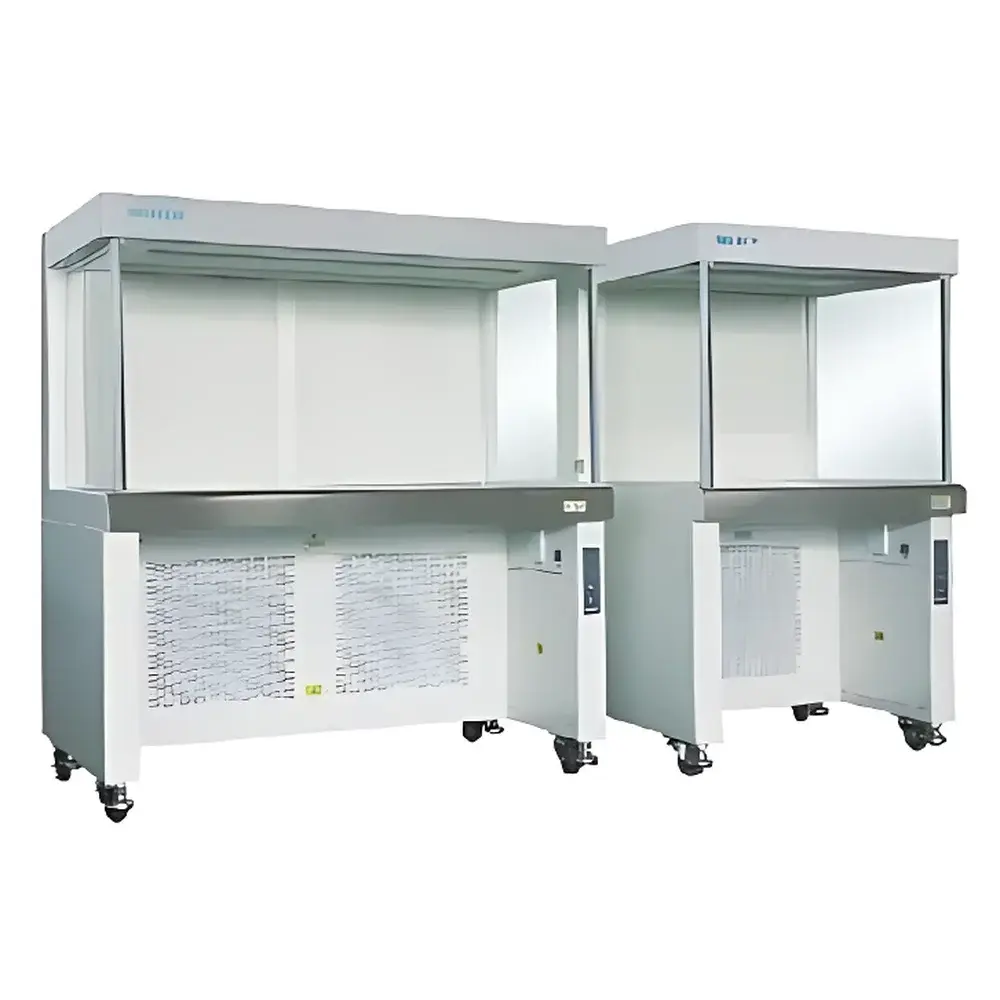
AnTai HS-1300-U Horizontal Laminar Flow Clean Bench
| Brand | AnTai |
|---|---|
| Origin | Jiangsu, China |
| Model | HS-1300-U |
| Cleanliness Class | ISO Class 5 (equivalent to Fed. Std. 209E Class 100) |
| Airflow Pattern | Horizontal unidirectional laminar flow |
| Noise Level | ≤62 dB(A) |
| Operating Configuration | Dual-user, single-face workstation |
| Average Air Velocity | 0.3–0.6 m/s (adjustable) |
| Vibration (half-peak) | ≤3 µm |
| Illuminance | ≥300 lx |
| Power Supply | AC 220 V, 50 Hz |
| Max. Power Consumption | 0.4 kW |
| Net Weight | 160 kg |
| Work Area Dimensions (W×D×H) | 1180 × 650 × 570 mm |
| External Dimensions (W×D×H) | 1300 × 825 × 1430 mm |
| Pre-filter Airflow Control | Adjustable aluminum damper |
| Filter Type | Ultra-thin, bag-type HEPA filter (no separator design) |
| Work Surface | Imported stainless steel |
| Side Panels | Tempered glass |
Overview
The AnTai HS-1300-U Horizontal Laminar Flow Clean Bench is an ISO Class 5-certified laboratory containment system engineered for precision-sensitive operations requiring particle-free ambient conditions. It operates on the principle of horizontal unidirectional laminar airflow—air is drawn through a pre-filter, conditioned via a centrifugal blower, and then passed through a high-efficiency particulate air (HEPA) filter (≥99.99% @ 0.3 µm) before exiting uniformly across the work surface at controlled velocity (0.3–0.6 m/s). This airflow geometry minimizes turbulence-induced re-entrainment and ensures consistent protection of samples—rather than personnel—from airborne particulates. Unlike vertical-flow hoods, the HS-1300-U directs filtered air horizontally outward from the rear plenum toward the operator, making it suitable for non-hazardous applications where sample sterility and process integrity are paramount, including microelectronics assembly, optical component handling, calibration of precision instruments, and aseptic preparation of non-toxic reagents.
Key Features
- Ultra-thin, separatorless HEPA filter module integrated into a minimized static pressure chamber—reducing internal volume while maintaining uniform velocity distribution and extending filter service life.
- Imported 304 stainless steel work surface with seamless welded edges and rounded corners for easy decontamination and compliance with ISO 14644-1 surface cleanliness requirements.
- Tempered glass side panels (6 mm thickness) provide lateral containment without obstructing visibility or impeding ergonomic access; panels are mounted on low-friction sliders for smooth repositioning.
- Digitally calibrated, touch-sensitive airflow control interface enabling stepless adjustment of blower speed—supporting user-defined velocity profiles across the full operational range (0.3–0.6 m/s).
- Aluminum multi-vane pre-filter damper allows manual balancing of intake airflow to accommodate variable room static pressure conditions and maintain stable laminar behavior under dynamic HVAC environments.
- Integrated LED task lighting (≥300 lx at work surface) with diffused optics to eliminate glare and shadow zones—calibrated per IEC 60598-1 photometric standards.
Sample Compatibility & Compliance
The HS-1300-U is validated for use in ISO Class 5 cleanroom-adjacent environments and conforms to key international performance benchmarks: Fed. Std. 209E Class 100 (now superseded but retained for legacy reference), ISO 14644-1:2015 Annex B (laminar flow device testing protocols), and JIS Z 8122:2010 (Japanese standard for clean bench performance evaluation). It is not designed for biohazardous or volatile chemical handling; therefore, it does not meet NSF/ANSI 49 or EN 12469 requirements for biosafety cabinets. Its construction materials—including food-grade stainless steel, borosilicate glass components, and halogen-free wiring—support GLP-compliant documentation and routine audit readiness. All electrical components comply with IEC 61010-1:2010 for laboratory equipment safety.
Software & Data Management
The HS-1300-U operates as a standalone hardware platform with no embedded firmware or network connectivity. However, its analog-digital hybrid control architecture supports external integration via 4–20 mA or 0–10 V signal interfaces for centralized facility monitoring systems (e.g., BMS or SCADA). Optional RS-485 Modbus RTU output enables logging of real-time airflow velocity, blower RPM, and operational hours—facilitating preventive maintenance scheduling and traceability per FDA 21 CFR Part 11 Annex 11 principles when paired with validated third-party data acquisition software. Calibration certificates (traceable to NIM, China) and filter integrity test reports (via DOP/PAO scanning) are supplied with each unit.
Applications
- Microelectronic device packaging and wafer-level probing in Class 100–1000 cleanrooms.
- Calibration and alignment of interferometers, laser diodes, and fiber-optic assemblies.
- Aseptic dispensing of cell culture media, buffers, and sterile solvents in QC laboratories.
- Preparation of reference standards for spectroscopic and chromatographic analysis.
- Assembly and inspection of MEMS sensors, optical lenses, and precision mechanical subassemblies.
FAQ
Is the HS-1300-U certified for biological safety?
No. It provides product protection only—not personnel or environmental protection—and must not be used with infectious agents, toxins, or volatile organic compounds.
What is the recommended HEPA filter replacement interval?
Under continuous operation (8 h/day, 5 days/week), filter life averages 18–24 months; actual service life depends on ambient particulate loading and pre-filter maintenance frequency.
Can this unit be installed in a non-cleanroom environment?
Yes—but upstream air quality must meet ISO Class 8 (Fed. Std. 209E Class 100,000) to avoid premature filter clogging and ensure laminar stability.
Does the unit include validation documentation?
Each shipment includes a Factory Acceptance Test (FAT) report covering airflow uniformity mapping, illumination measurement, noise assessment, and electrical safety verification—all traceable to national metrology institutes.
Is stainless steel surface passivation performed prior to delivery?
Yes. The work surface undergoes citric acid-based passivation per ASTM A967-22, followed by water-break-free verification and certificate of conformance.



