
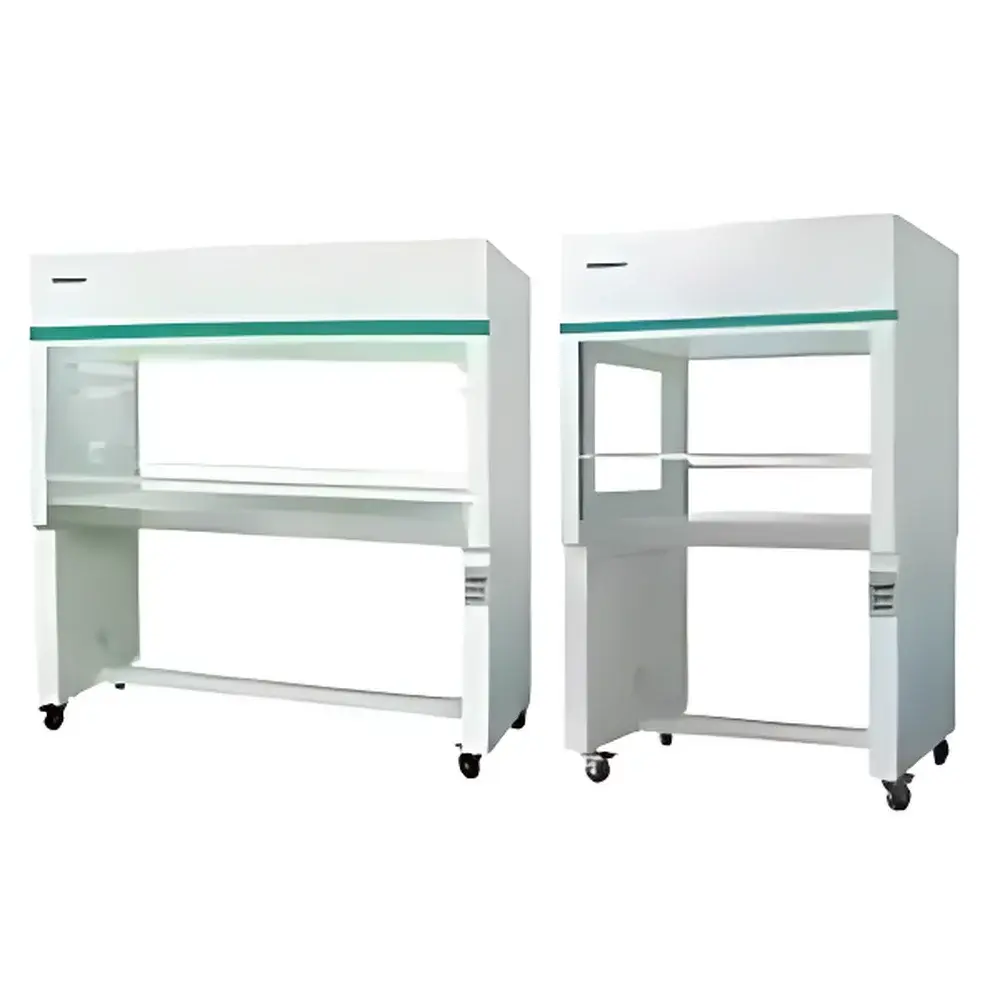
AnTai SW-CJ-2F Vertical Laminar Flow Clean Bench
| Origin | Jiangsu, China |
|---|---|
| Manufacturer Type | Authorized Distributor |
| Origin Category | Domestic (China) |
| Models | SW-CJ-2F, SW-CJ-2FD, SW-CJ-1F, SW-CJ-1FD |
| Price Range | USD 1,400 – 2,800 (FOB China) |
| Instrument Type | Vertical Laminar Flow Clean Bench |
| Cleanliness Class | ISO 5 (Class 100) |
| Noise Level | ≤62 dB(A) |
| User Capacity | Dual-Operator, Single-Face Configuration |
| Airflow Pattern | Vertical Unidirectional Flow |
| Work Surface Velocity | ≥0.3 m/s (adjustable) |
| Illuminance | ≥300 lx |
| Power Supply | AC 220 V / 50 Hz, Single-Phase |
| Input Power | 500 VA |
| Net Weight | 170 kg |
| Working Area Dimensions | 1360 × 690 × 520 mm (W × D × H) |
| Overall Dimensions | 1500 × 750 × 1600 mm (W × D × H) |
| HEPA Filter Specification & Quantity | 610 × 610 × 50 mm, 2 units |
| Fluorescent Lamp / UV Lamp | 14 W × 2 / 5 W × 2 |
| Microbial Contamination | ≤0.5 CFU/plate (90 mm Petri dish, 1-hour exposure) |
| Compliance | GB/T 16292–2010, YY 0569–2011, ISO 14644-1:2015 |
Overview
The AnTai SW-CJ-2F Vertical Laminar Flow Clean Bench is an ISO 5 (Class 100) certified laboratory containment system engineered for routine aseptic operations in low-risk biological and pharmaceutical environments. Unlike biosafety cabinets, this clean bench provides unidirectional vertical airflow—filtered through dual high-efficiency particulate air (HEPA) filters—to create a particle-free work zone where ambient contaminants are excluded, not contained. The airflow velocity is precisely maintained at ≥0.3 m/s across the entire working surface, ensuring consistent laminar flow integrity per ISO 14644-1:2015 Annex B test protocols. Designed for non-hazardous applications, it supports procedures requiring sterility assurance without operator protection against biohazards or chemical vapors. Its structural architecture features a fully enclosed vertical airflow chamber with a quasi-sealed work surface, minimizing turbulence-induced cross-contamination from lateral drafts.
Key Features
- Vertical laminar airflow system with dual 610 × 610 × 50 mm HEPA filters (≥99.995% @ 0.3 µm), independently tested and certified to ISO 14644-3:2019 filter integrity standards
- One-piece seamless stainless steel work surface (304 grade), corrosion-resistant and compliant with ISO 14644-5:2004 surface cleanliness requirements for easy decontamination
- Dual-operator configuration with single-face access; optimized ergonomic depth (690 mm) and height (520 mm working zone) for extended procedural comfort
- Interlocked lighting and UV germicidal irradiation system: fluorescent lamps (14 W × 2) and UV-C lamps (5 W × 2) cannot operate simultaneously, preventing accidental UV exposure during active work
- Integrated noise-dampened blower assembly achieving ≤62 dB(A) at 1 m distance—measured per ISO 7779:2010 acoustic testing methodology
- Electrical safety compliance with GB/T 16292–2010 (Chinese national standard for cleanroom testing) and YY 0569–2011 (medical device clean bench performance criteria)
Sample Compatibility & Compliance
The SW-CJ-2F is validated for use with non-pathogenic microorganisms, cell culture media preparation, sterile reagent dispensing, plant tissue culture inoculation, and pharmaceutical formulation under Grade A conditions as defined in EU GMP Annex 1 (2022). It does not meet containment requirements for Risk Group 2+ agents per WHO Laboratory Biosafety Manual (4th ed.) or CDC/NIH Biosafety in Microbiological and Biomedical Laboratories (BMBL, 6th ed.). All electrical components conform to IEC 61010-1:2010 safety standards for laboratory equipment. The unit undergoes factory verification of microbial performance using settle plate methodology (90 mm Petri dishes, Tryptic Soy Agar, 1-hour exposure), yielding ≤0.5 CFU/plate—consistent with ISO 14698-1:2003 microbiological contamination control benchmarks.
Software & Data Management
This clean bench operates as a standalone mechanical system with no embedded software or digital interface. All operational parameters—including airflow velocity, illumination output, and UV cycle timing—are manually calibrated and verified via external metrology tools (e.g., hot-wire anemometer, lux meter, UV radiometer). Maintenance logs, filter replacement records, and periodic certification reports (per ISO 14644-2:2015 surveillance testing) must be retained per GLP and GMP documentation requirements. Optional third-party calibration certificates (traceable to NIM or CNAS-accredited labs) are available upon request for audit readiness.
Applications
- Aseptic transfer of bacterial/fungal cultures and plant explants in academic and industrial biotechnology laboratories
- Preparation of sterile buffers, diluents, and media formulations in QC/QA departments of pharmaceutical and nutraceutical manufacturers
- Handling of non-infectious diagnostic reagents and molecular biology consumables (e.g., PCR master mixes, sequencing kits)
- Supporting ISO 13485-certified medical device manufacturing processes requiring controlled particulate environments
- Teaching laboratories requiring cost-effective, reliable laminar flow infrastructure aligned with undergraduate microbiology curriculum standards
FAQ
Does the SW-CJ-2F provide personnel or environmental protection?
No. It is a clean bench—not a biosafety cabinet—and offers product protection only. Operators must wear appropriate PPE when handling potentially hazardous materials.
What is the recommended HEPA filter replacement interval?
Under continuous 8-hour daily operation, filters should be replaced every 12–18 months or after 7,500–10,000 hours of cumulative runtime, verified by upstream/downstream differential pressure monitoring.
Can this unit be integrated into a larger cleanroom HVAC system?
Yes—its exhaust is recirculated internally; however, it may be ducted to external exhaust if local ventilation codes require removal of UV-ozone byproducts in confined spaces.
Is UV lamp intensity validated per IEC 62471 photobiological safety standards?
UV-C output is rated at 254 nm ±5 nm with irradiance ≤100 µW/cm² at 1 m, classified as Risk Group 2 (moderate risk); users must follow YY 0569–2011 mandated exposure time limits and interlock verification protocols.
Does the unit comply with FDA 21 CFR Part 11 requirements?
Not applicable—this is a mechanical-only device with no electronic data generation, storage, or user authentication functionality. Digital recordkeeping of maintenance remains the end-user’s responsibility under GxP frameworks.



