
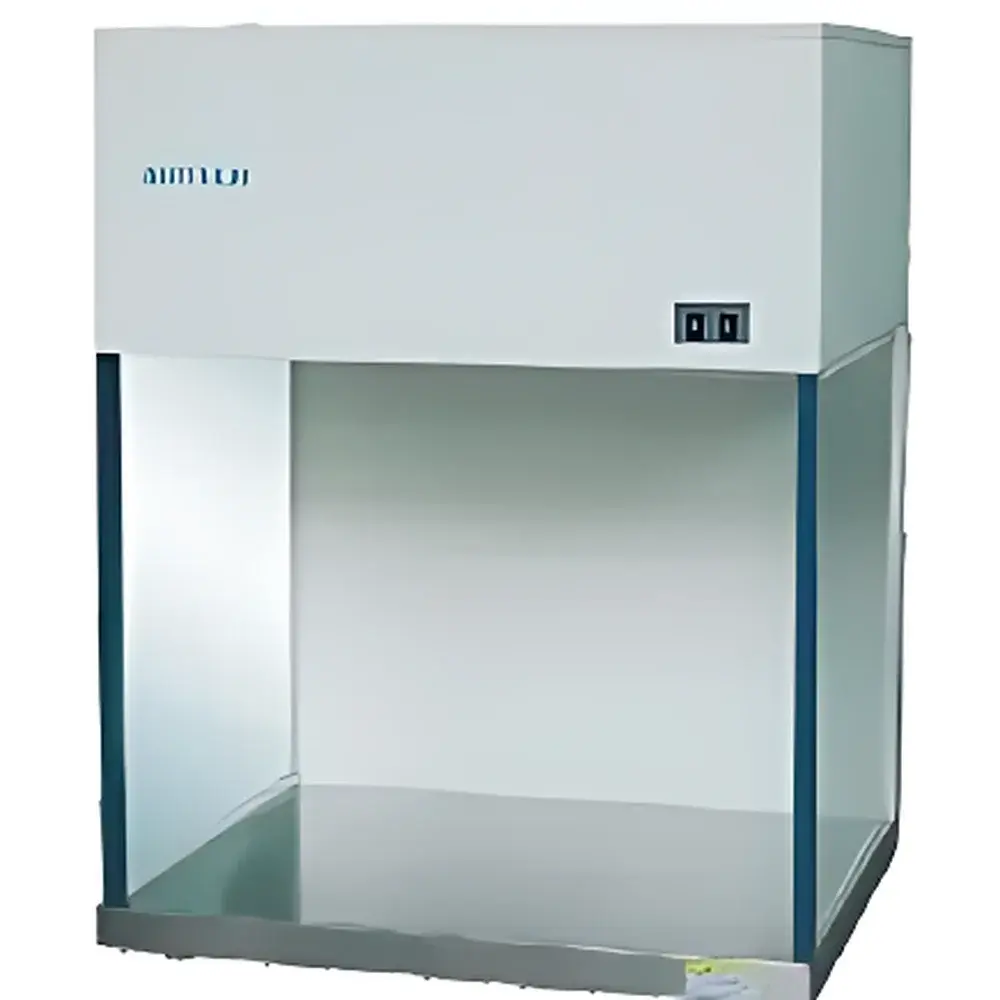
AnTai VD-650-U Vertical Laminar Flow Clean Bench
| Origin | Jiangsu, China |
|---|---|
| Manufacturer Type | Authorized Distributor |
| Origin Category | Domestic (PRC) |
| Model | VD-650-U / VD-650 |
| Price Range | USD 700 – 1,400 |
| Instrument Category | Vertical Laminar Flow Clean Bench |
| Cleanliness Class | ISO 5 (equivalent to Class 100 per Fed. Std. 209E) |
| Noise Level | ≤62 dB(A) |
| User Capacity | Single-user, front-access only |
| Airflow Pattern | Vertical downward laminar flow |
| Average Air Velocity | ≥0.3 m/s (continuously adjustable) |
| Illuminance | ≥300 lx |
| Power Supply | 220 VAC, 50 Hz, single-phase |
| Input Power | 250 W |
| Net Weight | 60 kg |
| Work Area Dimensions | 615 × 495 × 500 mm (W×D×H) |
| External Dimensions | 650 × 535 × 835 mm (W×D×H) |
| HEPA Filter Specification | 610 × 450 × 50 mm, single unit |
| Lighting | 14 W fluorescent lamp × 1 |
| UV Lamp | 8 W germicidal lamp × 1 |
| Microbial Contamination | ≤0.5 CFU/plate·hour |
Overview
The AnTai VD-650-U Vertical Laminar Flow Clean Bench is an ISO 5–certified (Class 100 per Fed. Std. 209E) personnel-protective and product-protective workstation engineered for routine aseptic procedures in research laboratories, quality control environments, and small-scale bioprocessing settings. It operates on the principle of vertical unidirectional airflow: ambient air is drawn through a pre-filter, then forced downward through a certified high-efficiency particulate air (HEPA) filter (≥99.99% @ 0.3 µm), delivering uniform, low-turbulence laminar flow across the entire work surface. This design minimizes cross-contamination risk and ensures consistent particle-free conditions critical for cell culture handling, media preparation, microbiological assay setup, and sterile instrument staging. Unlike horizontal flow hoods—which exhaust filtered air toward the operator—the VD-650-U directs airflow vertically into the work surface and exhausts it through a rear plenum, enhancing operator safety and reducing ambient air entrainment.
Key Features
- Compact desktop footprint (650 × 535 × 835 mm external dimensions) optimized for space-constrained labs and benchtop integration without requiring floor mounting or dedicated utility connections.
- Adjustable-speed centrifugal blower system with voltage-controlled fan regulation—enabling precise, real-time adjustment of face velocity between 0.3–0.5 m/s to accommodate varying procedural requirements while maintaining ISO 5 compliance.
- Stainless steel 304 work surface (615 × 495 × 500 mm) with seamless welds and radiused corners for easy decontamination and resistance to corrosion from common disinfectants and solvents.
- Full-height transparent side panels fabricated from tempered, non-reflective acrylic—providing unobstructed visual monitoring while minimizing glare and static accumulation.
- Dual independent lighting system: a 14 W daylight-balanced fluorescent lamp for general task illumination (≥300 lx at work surface), and an 8 W UVC germicidal lamp (254 nm) with safety interlock switch to prevent accidental exposure during operation.
- Integrated electrical safety architecture including thermal overload protection, grounded chassis, short-circuit circuit breaker, and automatic UV shutoff when sash is opened—fully compliant with IEC 61000-6-3 (EMC) and IEC 61010-1 (safety for laboratory equipment).
Sample Compatibility & Compliance
The VD-650-U supports open-container manipulations of non-hazardous biological samples, pharmaceutical intermediates, and electronic components requiring particulate-free handling. It is not suitable for volatile organic compounds, aerosol-generating procedures, or biohazardous agents requiring containment (e.g., BSL-2+ pathogens); such applications require certified biosafety cabinets (BSCs) per NSF/ANSI 49. The unit meets ISO 14644-1:2015 (Cleanrooms and associated controlled environments) for airborne particle concentration verification and conforms to Chinese national standard YY 0569–2011 (Class II A2 BSC equivalency framework for clean bench performance testing). Routine validation—including airflow uniformity mapping, filter integrity testing (DOP/PAO scan), and microbial challenge assessment—is recommended every six months per GLP and ISO/IEC 17025 guidelines.
Software & Data Management
As a Class I passive environmental control device, the VD-650-U operates without embedded microprocessors or digital interfaces. All operational parameters—including fan speed, lighting status, and UV activation—are managed via front-panel mechanical switches with tactile feedback. While no onboard data logging or network connectivity is provided, the unit is fully compatible with external environmental monitoring systems (EMS) via analog 4–20 mA airflow sensor outputs (optional retrofit). Audit trails for maintenance, filter replacement, and certification can be maintained manually or integrated into laboratory information management systems (LIMS) using standardized SOP templates aligned with FDA 21 CFR Part 11 requirements for record retention and reviewer accountability.
Applications
- Aseptic transfer of mammalian and microbial cultures in academic and industrial life science labs.
- Preparation and dispensing of sterile growth media, buffers, and reagents under GMP Annex 1–aligned conditions.
- Assembly and inspection of precision optical and microelectromechanical systems (MEMS) components where sub-5 µm particulate control is essential.
- Calibration and handling of reference standards in analytical chemistry laboratories prior to HPLC, GC, or ICP-MS analysis.
- Training environments for undergraduate and technical education programs emphasizing fundamental aseptic technique and cleanroom behavior protocols.
FAQ
Is the VD-650-U certified to international cleanroom standards?
Yes—it is validated to meet ISO 5 (Class 100) performance criteria per ISO 14644-1 and Fed. Std. 209E, with documented HEPA filter efficiency ≥99.99% at 0.3 µm.
Can this unit be used for handling hazardous materials?
No. It provides product protection only—not personnel or environmental protection. Hazardous or infectious agents require NSF/ANSI 49–compliant biosafety cabinets.
What is the recommended HEPA filter replacement interval?
Under typical usage (8 hrs/day, 5 days/week), replace the HEPA filter every 18–24 months—or sooner if differential pressure exceeds 250 Pa or airflow drops below 0.25 m/s.
Does the unit include validation documentation?
Factory-installed units ship with a Certificate of Conformance, filter test report (including initial DOP scan data), and calibration certificate for airflow and illuminance measurements.
Is UV lamp irradiance intensity verified during commissioning?
Yes—each unit undergoes UVC output verification (measured at 254 nm, ≥40 µW/cm² at 1 m distance) prior to shipment, with traceable NIST-calibrated radiometer data included in the QA dossier.
Related Products



