
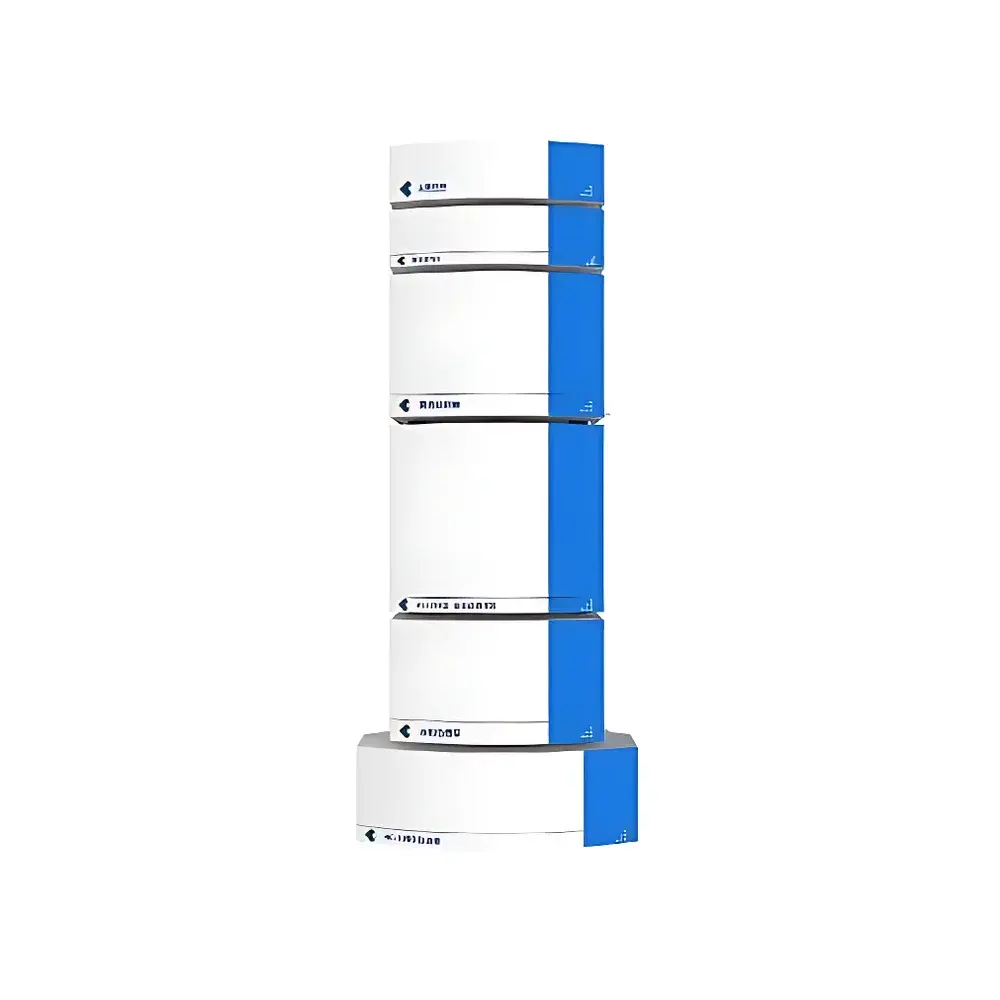
Anters-1200R High-Performance Liquid Chromatograph
| Brand | KEZHE SHANGHAI |
|---|---|
| Origin | Shanghai, China |
| Manufacturer Type | OEM Manufacturer |
| Instrument Type | Conventional HPLC System |
| Model | Anters-1200R |
| Flow Rate Range | 0.001–5 mL/min |
| Maximum Pressure | 40 MPa |
| Autosampler Capacity | Standard 144 × 2 mL vials |
| Injection Volume Range | 0.1–100 µL |
| Column Oven Temperature Range | −20 °C to 100 °C |
| Refractive Index (RI) Detection Range | 1.00–1.75 RIU |
| Data Acquisition Rate | 100 Hz |
Overview
The Anters-1200R High-Performance Liquid Chromatograph is a fully integrated, modular HPLC system engineered for precision analysis of non-UV-absorbing compounds—particularly relevant in natural product chemistry, traditional Chinese medicine (TCM) research, and antibiotic characterization. Unlike UV/VIS-based detection systems, the Anters-1200R employs a high-stability differential refractometer (RID) as its primary detector, enabling universal, label-free quantification of carbohydrates, glycosides, lipids, polymers, and other optically transparent analytes that lack chromophores. Its core architecture follows classical liquid chromatography principles: solvent delivery via dual-piston reciprocating pumps, precise gradient formation, temperature-controlled column compartment, automated sample introduction, and real-time RI signal acquisition. The system complies with fundamental chromatographic performance criteria defined in ISO 17025-accredited laboratories and supports method development aligned with ICH Q2(R2) guidelines for analytical validation.
Key Features
- Binary gradient pump system delivering flow rates from 0.001 to 5.000 mL/min with <0.3% RSD flow precision and <0.06% absolute accuracy across the full range;
- Maximum operating pressure of 40 MPa (5800 psi), compatible with sub-2 µm particle-packed columns for high-resolution separations;
- Autosampler with 144-position 2 mL vial tray (expandable to 96-well plates or 10 mL vials), featuring needle wash station, vial presence sensing, and <0.1% carryover;
- Column oven with programmable range from −20 °C to +100 °C, ±0.15 °C thermal stability, and support for up to three 30 cm columns (six-column option available);
- Differential refractometer with 1.00–1.75 RIU measurement range, 8 µL flow cell volume, baseline noise ≤5×10⁻⁷ RIU, and drift ≤5×10⁻⁶ RIU/30 min;
- Integrated vacuum degasser ensuring consistent mobile phase composition and minimizing bubble-induced baseline disturbances;
- Optical subsystem with self-calibrating monochromator (wavelength accuracy ±0.2 nm) and built-in lamp life monitoring;
- Modular workstation software supporting full instrument control, method scheduling, and real-time overlay of chromatograms, gradient profiles, and hardware status.
Sample Compatibility & Compliance
The Anters-1200R accommodates diverse sample matrices including crude herbal extracts, fermented broth supernatants, purified polysaccharide fractions, and synthetic small-molecule libraries. Its RID-based detection eliminates dependence on UV chromophores, making it suitable for QC/QA of TCM formulations per Chinese Pharmacopoeia (ChP) monographs requiring RI detection. The system meets mechanical and electrical safety requirements per IEC 61010-1. Software functionality includes user-level access control, electronic signatures, audit trail logging, and data integrity safeguards aligned with FDA 21 CFR Part 11 expectations for regulated environments. While not pre-certified for GMP production lines, its architecture supports GLP-compliant workflows when deployed with documented SOPs and periodic performance verification (e.g., system suitability testing per USP ).
Software & Data Management
The Anters Chromatography Workstation is a Windows-based, modular application designed for cross-platform interoperability. It provides native support for ASTM E1319 and ASTM E1980 data exchange formats. Key modules include Method Editor (with linear, stepwise, and point–drag gradient programming), Sequence Scheduler (for unattended overnight runs), Peak Integration Engine (with customizable baseline algorithms and retention time locking), and Report Generator (exporting PDF, CSV, and CDF files). Audit trail records all parameter changes, user logins, method modifications, and data exports with timestamps and operator IDs. Data storage follows hierarchical folder structures compliant with ALCOA+ principles (Attributable, Legible, Contemporaneous, Original, Accurate, Complete, Consistent, Enduring, Available). Optional integration with LIMS via ODBC or RESTful API enables enterprise-scale data governance.
Applications
- Quantitative profiling of monosaccharide and oligosaccharide compositions in botanical extracts;
- Stability-indicating assays for heat- or pH-labile natural products lacking UV absorbance;
- Release testing of polysaccharide-based vaccines and adjuvants;
- Method transfer from legacy RID-HPLC platforms to modernized, automated systems;
- Preparative fraction collection guidance using real-time RI signal triggering;
- Compatibility studies between excipients and active pharmaceutical ingredients (APIs) in formulation development;
- Support for hyphenated techniques: direct coupling to ELSD, fluorescence, or mass spectrometry detectors via standard 1/16″ stainless steel tubing and pressure-rated fittings.
FAQ
Is the Anters-1200R compliant with 21 CFR Part 11?
Yes—the workstation implements role-based authentication, electronic signatures, immutable audit trails, and data encryption at rest and in transit, satisfying core technical requirements for Part 11 compliance in non-production settings.
Can the system operate with reversed-phase, HILIC, and SEC columns?
Yes—all standard 1/4″–28 threaded column hardware interfaces are supported; column switching valves (optional) enable multi-dimensional separations.
What maintenance intervals are recommended for the RID flow cell?
Routine cleaning with isopropanol followed by water flush is advised after every 200 injections; annual calibration against certified RI standards is recommended.
Does the autosampler support low-volume microplate formats?
Yes—configurable trays accept 350 µL × 2 blocks of 96-well plates, with programmable needle depth and aspiration speed optimization.
Is remote monitoring possible?
Yes—via secure HTTPS-enabled web interface; real-time pressure, flow, temperature, and detector output streams are accessible through authenticated browser sessions.
Related Products







