
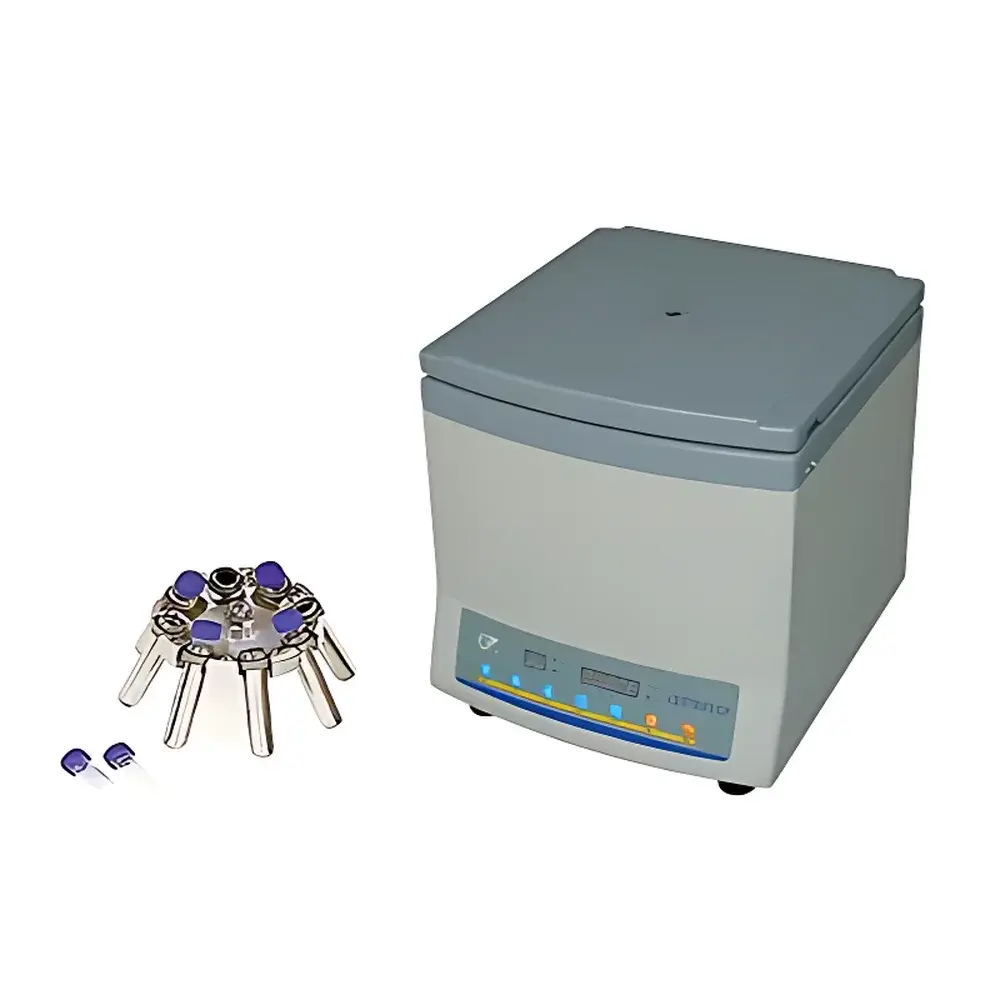
AnTing Feige TDL-40B Low-Speed High-Capacity Benchtop Centrifuge
| Brand | AnTing Feige |
|---|---|
| Origin | Shanghai, China |
| Model | TDL-40B |
| Type | Benchtop Low-Speed Centrifuge |
| Max Speed | 5000 rpm |
| Max RCF | 4328 ×g |
| Max Capacity | 4 × 100 mL (horizontal rotor) |
| Dimensions | 405 × 460 × 395 mm |
| Rotor Configurations | Horizontal swing-out rotor with multiple bucket and adapter options (100 mL × 4, 50 mL × 8, 15 mL × 16/24, 2/5/10 mL × 16/24, 96-well microplate × 2) |
| Control System | Microprocessor-based digital display with electronic lid lock |
| Noise Level | ≤65 dB(A) |
| Temperature Rise | <5 °C during standard operation |
| Compliance | Designed per IEC 61010-2-020 (Safety Requirements for Centrifuges) |
Overview
The AnTing Feige TDL-40B is a microprocessor-controlled benchtop low-speed centrifuge engineered for high-capacity routine separation tasks in life science, clinical diagnostics, pharmaceutical quality control, and environmental laboratories. It operates on the principle of sedimentation under centrifugal force—accelerating phase separation of heterogeneous mixtures based on particle density, size, and shape. With a maximum rotational speed of 5000 rpm and a peak relative centrifugal force (RCF) of 4328 ×g, the TDL-40B delivers consistent, reproducible separations without inducing excessive thermal load or mechanical stress on temperature-sensitive samples such as plasma, whole blood, cell suspensions, or crude extracts. Its compact footprint (405 × 460 × 395 mm) and robust cast-aluminum housing support stable operation in shared lab environments, while the integrated electronic lid interlock ensures compliance with basic mechanical safety requirements defined in IEC 61010-2-020.
Key Features
- Microprocessor-based digital control system with real-time rpm and RCF display, time setting (1–99 min or continuous), and automatic rotor identification via preset programs
- Horizontal swing-out rotor architecture enabling rapid sample loading/unloading and minimizing cross-contamination risk between tubes
- Triple-layer safety design: motorized lid lock, imbalance detection with auto-shutdown, and reinforced stainless-steel centrifuge chamber
- Low-noise operation (<65 dB[A]) achieved through precision-balanced rotor assembly and vibration-damping base construction
- Minimal thermal accumulation: chamber temperature rise limited to <5 °C after 30 minutes at maximum speed, preserving sample integrity for non-refrigerated protocols
- Modular rotor compatibility supporting standardized configurations—including 100 mL × 4 buckets, 15 mL × 24 conical tube carriers, and dual 96-well plate holders—enabling workflow flexibility across hematology, microbiology, and assay development
Sample Compatibility & Compliance
The TDL-40B accommodates common laboratory consumables including polypropylene conical tubes (15 mL, 50 mL), glass or plastic centrifuge bottles (100 mL), vacuum blood collection tubes (2–10 mL), and standard SBS-format microplates. Its operational envelope aligns with widely referenced methods in ISO 15189 (medical laboratories), CLSI H26-A3 (blood specimen processing), and USP (dissolution testing preparation). While not a refrigerated unit, its thermally stable performance supports protocols where ambient-temperature centrifugation is explicitly required—for instance, platelet-rich plasma (PRP) isolation or polymer precipitation steps in nucleic acid extraction workflows. The device meets CE marking requirements for electrical safety and electromagnetic compatibility (EMC), and its mechanical architecture conforms to the structural integrity provisions of IEC 61010-2-020 for laboratory centrifuges.
Software & Data Management
The TDL-40B employs embedded firmware—not PC-dependent software—to manage run parameters, cycle history, and error logging. All settings are retained in non-volatile memory following power interruption. Though it lacks network connectivity or audit-trail functionality required under FDA 21 CFR Part 11, its digital interface provides traceable operational records suitable for GLP-aligned documentation when paired with laboratory notebook entries. Each run logs speed, time, and RCF; users may manually annotate batch identifiers or protocol references using external LIMS integration. For labs requiring electronic data capture, third-party serial-to-USB adapters enable ASCII-formatted output compatible with spreadsheet-based tracking systems.
Applications
- Clinical laboratories: Separation of serum, plasma, and buffy coat from whole blood specimens using standardized 10–15 minute spins at 3000–4000 rpm
- Biotechnology QA/QC: Clarification of bacterial lysates, yeast harvest, and protein precipitation prior to HPLC or SDS-PAGE analysis
- Food safety testing: Sedimentation of suspended solids in dairy, juice, or wastewater samples for turbidity assessment or pathogen concentration
- Environmental monitoring: Isolation of particulate matter from soil leachates or aquatic samples for heavy metal analysis
- Educational settings: Teaching fundamental centrifugation principles—including Stoke’s law validation, density gradient setup, and rotor dynamics—due to its intuitive interface and mechanical transparency
FAQ
Is the TDL-40B suitable for use with infectious or biohazardous samples?
Yes—when operated with sealed rotors and appropriate biosafety containment (e.g., sealed buckets or secondary containment sleeves), it complies with BSL-2 handling guidelines for low-risk agents. Always follow institutional biosafety protocols.
Can this centrifuge accommodate 50 mL conical tubes in the 100 mL bucket configuration?
Yes—the horizontal rotor accepts standard 50 mL polypropylene conical tubes within the 100 mL bucket; however, ensure symmetrical loading and adherence to maximum weight limits per bucket (≤100 g).
Does the unit include rotor calibration documentation?
No factory-provided NIST-traceable calibration certificate is included; users should perform periodic verification using certified tachometers and reference standards per internal SOPs or ISO/IEC 17025 requirements.
What maintenance intervals are recommended for long-term reliability?
Inspect rotor threads and bucket latches every 6 months; clean chamber interior weekly with 70% ethanol; lubricate swing-out pivot points annually using silicone-free grease approved for medical devices.
Is there an optional refrigeration module available?
No—this is a non-refrigerated model. For temperature-sensitive applications requiring sub-ambient conditions, consider dedicated refrigerated centrifuges compliant with ISO 13485 or IEC 61010-2-020 Annex BB.



