
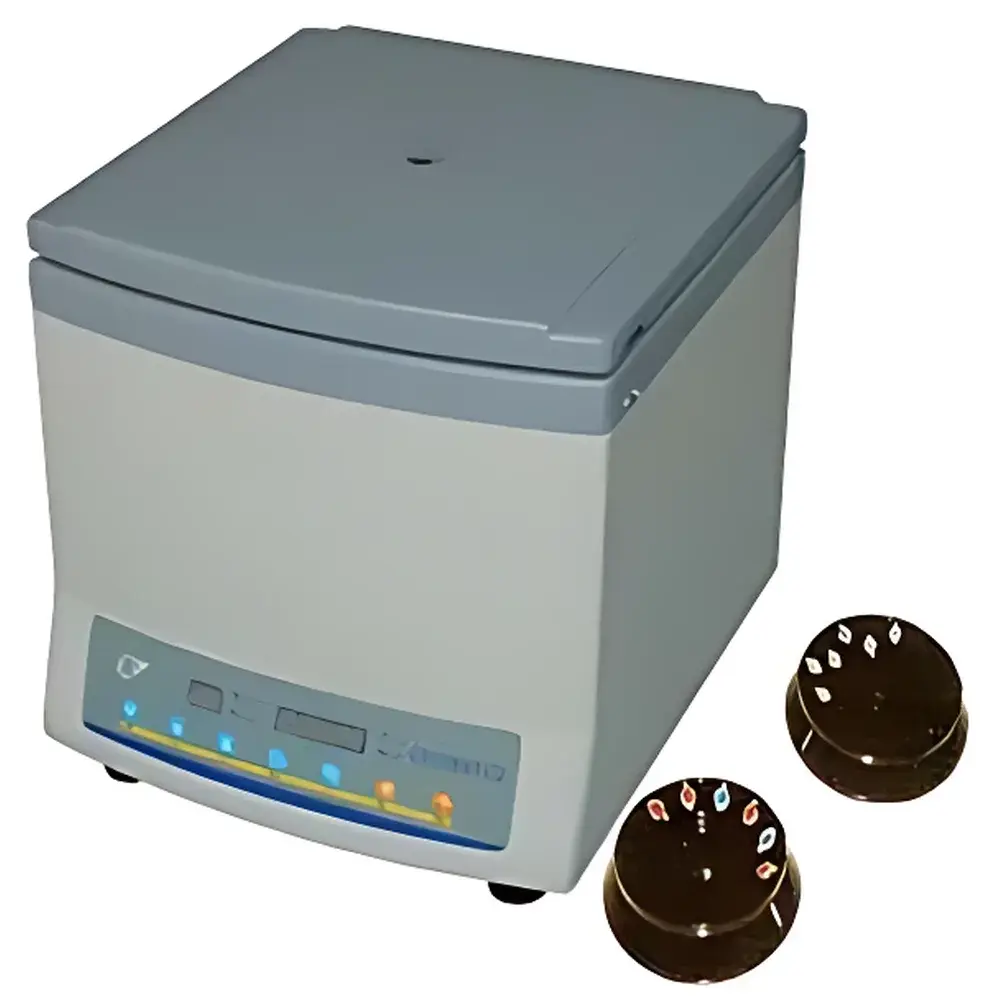
AnTing Feige TGL-16GB High-Speed Benchtop Centrifuge
| Brand | AnTing Feige |
|---|---|
| Origin | Shanghai, China |
| Model | TGL-16GB |
| Max Speed | 12000 rpm |
| Max RCF | ≥12000 ×g |
| Capacity | 24 × 2 mL or 48 × 0.5 mL |
| Timer Range | 0–60 min |
| Noise Level | ≤70 dB(A) |
| Power Supply | 220 V, 50 Hz, 370 W |
| Dimensions (L×W×H) | 350 × 390 × 350 mm |
| Weight | 20 kg |
| Rotor Type | Fixed-angle rotor |
| Application Class | Biomolecular separation |
| Safety | Electronic door lock |
| Drive System | Frequency-controlled motor |
Overview
The AnTing Feige TGL-16GB High-Speed Benchtop Centrifuge is an engineered solution for routine biomolecular separation tasks in academic laboratories, clinical diagnostics, and quality control environments. Designed on the proven platform of the TGL-16G series, the TGL-16GB integrates a higher-power brushless motor and frequency-converter-based speed regulation to deliver stable rotational performance across its operational range. It operates on the principle of sedimentation under centrifugal force—accelerating particle separation based on differences in density, size, and shape within liquid suspensions. With a maximum rotational speed of 12,000 rpm and a corresponding relative centrifugal force (RCF) of ≥12,000 ×g, the instrument supports rapid pelleting of cellular organelles, nucleic acids, proteins, and virus particles. Its compact benchtop footprint (350 × 390 × 350 mm) enables deployment in space-constrained labs without compromising mechanical rigidity or thermal stability.
Key Features
- Frequency-controlled drive system ensures precise speed regulation, minimal speed drift (< ±50 rpm at max load), and extended motor service life.
- Electronic safety interlock door lock prevents operation when the lid is not fully closed—compliant with IEC 61010-1 requirements for laboratory equipment safety.
- Low-noise design (≤70 dB[A] at full speed) achieved through balanced rotor dynamics, vibration-damping chassis, and optimized airflow management.
- Thermally stable operation: temperature rise remains below 12 °C after 30 minutes of continuous operation at 12,000 rpm, reducing sample denaturation risk.
- Digital timer with 1-minute resolution (0–60 min) and automatic rotor deceleration ramp (soft-stop) to preserve pellet integrity.
- Fixed-angle rotor configuration optimized for microcentrifuge tubes—compatible with standard 0.5 mL and 2.0 mL polypropylene tubes meeting ISO 8573-1 purity class 4 for low particulate generation.
Sample Compatibility & Compliance
The TGL-16GB accommodates two standardized tube configurations: 24 × 2.0 mL or 48 × 0.5 mL, supporting common workflows in DNA extraction, PCR setup, serum separation, and bacterial cell harvesting. Rotors are manufactured from high-strength aluminum alloy (6061-T6), anodized per MIL-A-8625 Type II, and certified for ≥10,000 operational cycles at rated speed. The device meets electromagnetic compatibility (EMC) requirements per EN 61326-1 and electrical safety standards per EN 61010-1:2010. While not intrinsically certified for GMP/GLP environments, its repeatable speed/RCF output, traceable timer function, and mechanical interlocks support documentation under internal SOPs aligned with ISO/IEC 17025 and CLIA guidelines.
Software & Data Management
The TGL-16GB operates via an integrated microcontroller-based interface with LED display and tactile membrane keypad—designed for reliability in non-networked lab settings. No proprietary software or PC connectivity is provided; all parameters (speed, time, acceleration/deceleration profile) are set manually and retained in volatile memory only during active use. For audit-trail compliance in regulated workflows, users may integrate external logging devices (e.g., USB data loggers recording panel-displayed values at 10-second intervals) or document run parameters manually in bound lab notebooks per FDA 21 CFR Part 11 Annex A recommendations for non-electronic records.
Applications
- Routine isolation of genomic DNA and plasmid preparations from bacterial lysates.
- Clarification of cell culture supernatants prior to ELISA or Western blot analysis.
- Concentration of viral vectors and exosomes in preclinical research settings.
- Serum/plasma separation from whole blood using anticoagulant-treated tubes (EDTA, heparin).
- Pelleting of mitochondria and nuclei in subcellular fractionation protocols (e.g., differential centrifugation series).
- Removal of insoluble aggregates from protein purification intermediates prior to SEC or IEX chromatography.
FAQ
What rotor types are compatible with the TGL-16GB?
Only the factory-supplied fixed-angle rotor (part number: TGL-16GB-FA-24/48) is validated for use. Swapping rotors from other models voids safety certification and invalidates RCF calibration.
Is the TGL-16GB suitable for biosafety level 2 (BSL-2) applications?
Yes—when used with sealed tube caps and operated inside a certified biosafety cabinet during loading/unloading, it meets containment requirements for moderate-risk agents per CDC/NIH Biosafety in Microbiological and Biomedical Laboratories (BMBL), 6th Edition.
Does the unit include rotor imbalance detection?
No—imbalance protection relies solely on mechanical cut-off triggered by excessive vibration amplitude. Users must ensure symmetrical tube loading and verify balance before each run.
Can the timer be bypassed for continuous operation?
No—the timer is non-bypassable and mandatory for activation; this design prevents unattended operation and aligns with institutional equipment safety policies.
What maintenance schedule is recommended?
Rotor inspection every 500 runs or biannually (whichever occurs first); lubrication-free motor requires no scheduled greasing; air intake filters should be vacuum-cleaned monthly.



