
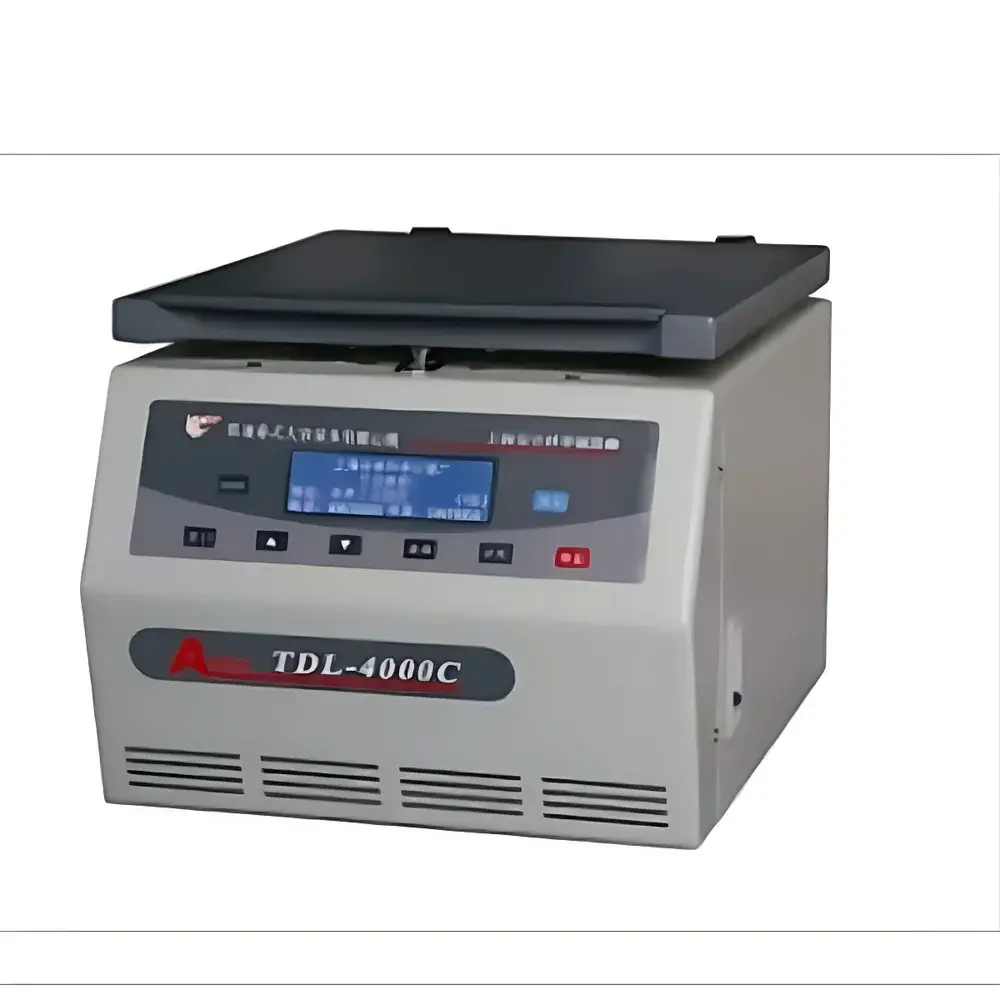
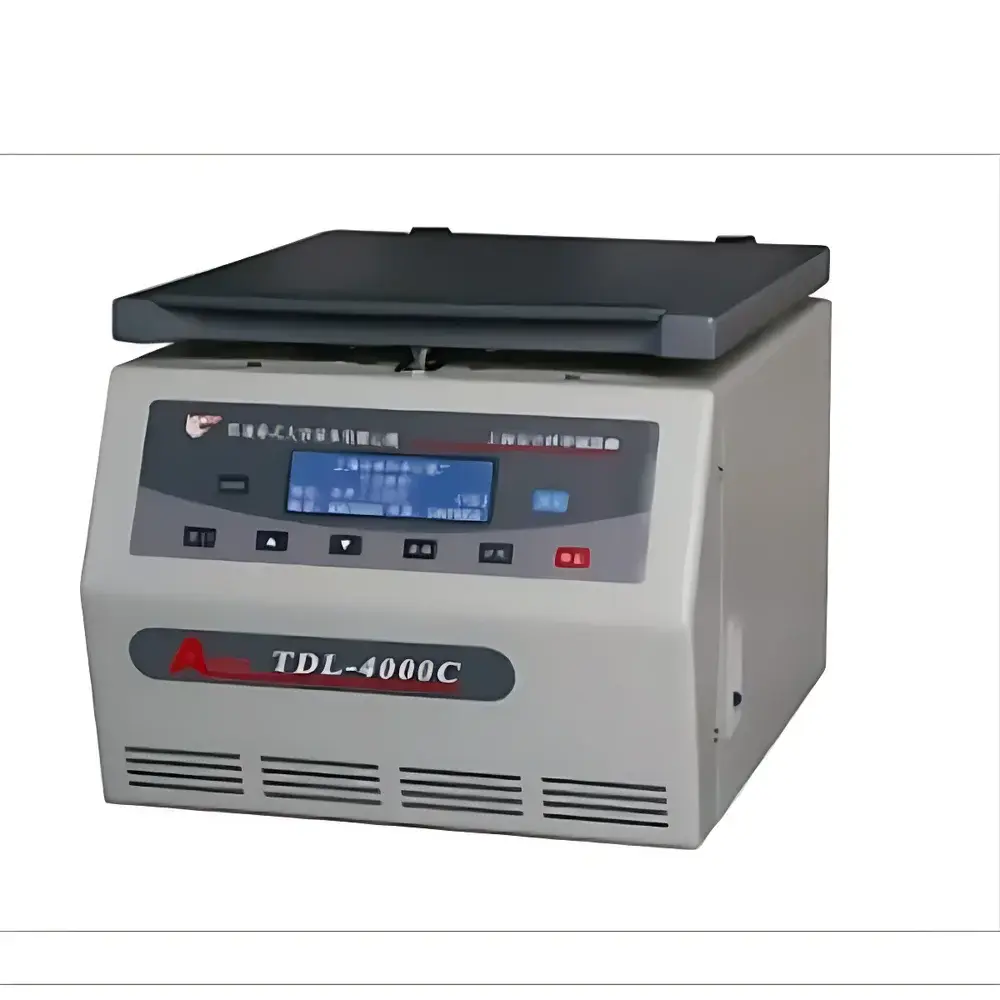
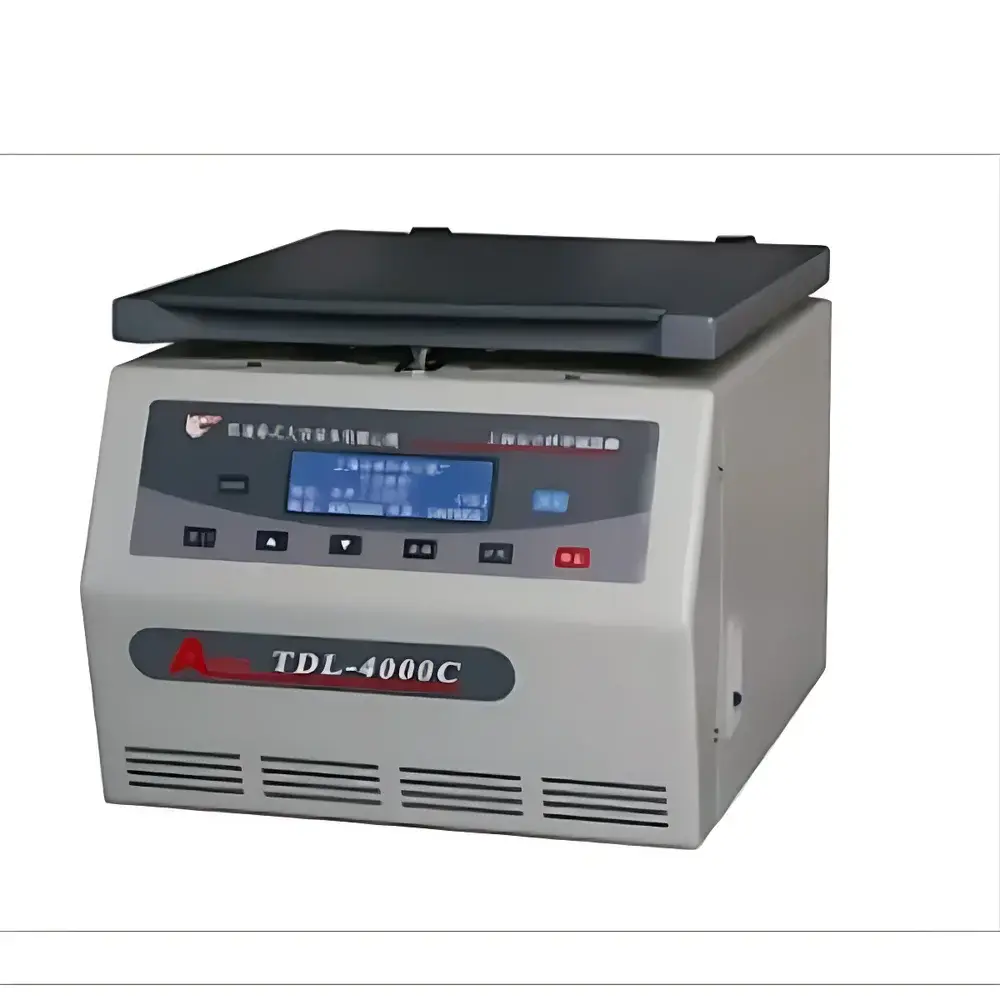
AnTing TDL-4000C Benchtop Low-Speed High-Capacity Centrifuge
| Brand | AnTing |
|---|---|
| Origin | Shanghai, China |
| Model | TDL-4000C |
| Type | Benchtop Centrifuge |
| Speed Range | 0–4000 rpm |
| Max RCF | 3300 × g |
| Max Capacity | 50 mL × 4 (horizontal rotor) |
| Timer Range | 0–99 min |
| Power Supply | 220 V, 50 Hz, 400 W |
| Dimensions (L×W×H) | 660 mm × 460 mm × 415 mm |
| Weight | 80 kg |
| Rotor Configuration | Horizontal swing-out rotor with safety hood |
| Drive System | Frequency-controlled AC motor |
| Construction | Reinforced polymer housing with precision-machined aluminum rotor chamber |
Overview
The AnTing TDL-4000C is a benchtop low-speed high-capacity centrifuge engineered for routine separation tasks in clinical, pharmaceutical, and academic laboratories where reproducible sedimentation of suspended particles—such as whole blood cells, yeast pellets, tissue homogenates, and precipitated proteins—is required at moderate g-forces. Operating on the principle of sedimentation centrifugation, the instrument applies radial acceleration to heterogeneous mixtures, enabling phase separation based on particle density, size, and shape. Its design prioritizes operational stability, mechanical robustness, and user safety—features critical for extended daily use in quality control labs, biobanking facilities, and teaching laboratories. Unlike high-speed or ultracentrifuges, the TDL-4000C operates within a controlled speed envelope (up to 4000 rpm), minimizing heat generation and mechanical stress while delivering consistent 3300 × g performance across its full load capacity.
Key Features
- Frequency-controlled AC motor ensures precise speed regulation, minimal speed drift (< ±10 rpm), and smooth acceleration/deceleration profiles—critical for preserving sample integrity during sensitive biological separations.
- Horizontal swing-out rotor configuration supports large-volume tubes (up to 50 mL × 4) and accommodates multiple tube formats including 250 mL × 4, 100 mL × 4, 75 mL × 3, 50 mL × 4, 25 mL × 8, 15 mL × 36, and 7 mL × 36—enabling flexible workflow integration without rotor interchange.
- Integrated safety hood with interlocked lid prevents operation when open and automatically halts rotation upon lid opening—compliant with IEC 61010-1:2010 safety standards for laboratory equipment.
- Reinforced polymer chassis and vibration-damped base reduce operational noise (< 65 dB(A)) and eliminate micro-vibrations that could compromise layer resolution in density-gradient applications.
- Digital timer (0–99 minutes) with auto-stop function and audible end-of-run alert supports unattended operation while maintaining strict adherence to standardized protocols.
- Compact footprint (660 × 460 × 415 mm) and 80 kg mass provide inherent stability without requiring anchoring—ideal for shared lab spaces with limited floor area.
Sample Compatibility & Compliance
The TDL-4000C is validated for use with standard polypropylene, polycarbonate, and glass centrifuge tubes rated for ≤3300 × g. It supports common clinical and research workflows including plasma/serum separation from whole blood (per CLSI H18-A3 guidelines), cell pellet recovery from suspension cultures, clarification of bacterial lysates, and precipitation harvesting in protein purification schemes. While not certified for ISO 13485 or FDA 21 CFR Part 11 out-of-the-box, its repeatable speed/RCF output, mechanical traceability, and documented calibration procedures support GLP-compliant recordkeeping when integrated into validated SOPs. All rotors undergo static and dynamic balancing per ISO 21501-4, and the unit carries CE marking under the EU Machinery Directive 2006/42/EC.
Software & Data Management
The TDL-4000C operates via an embedded microcontroller with push-button interface—no external software or PC connection required. All operational parameters (set speed, time, and real-time status) are displayed on a dual-line LED screen. Though lacking network connectivity or electronic audit trail functionality, its deterministic behavior enables manual logbook entries aligned with ALCOA+ principles (Attributable, Legible, Contemporaneous, Original, Accurate, Complete, Consistent, Enduring, Available). For regulated environments, users may integrate run logs into LIMS via barcode-scanned batch IDs or timestamped paper records compliant with Annex 11 and USP analytical instrument qualification frameworks.
Applications
- Clinical diagnostics: Separation of serum/plasma from anticoagulated blood specimens prior to immunoassay or chemistry analysis.
- Cell biology: Harvesting adherent and suspension mammalian cells, yeast, or bacteria at low shear stress to maintain viability and membrane integrity.
- Food & beverage QC: Clarification of juice extracts, dairy emulsions, and fermentation broths for turbidity assessment or particulate analysis.
- Environmental testing: Concentration of suspended solids or microorganisms from water samples per EPA Method 1600 series.
- Academic instruction: Demonstrating sedimentation kinetics, Stoke’s law validation, and rotor dynamics in undergraduate physics and biochemistry laboratories.
FAQ
What is the maximum relative centrifugal force (RCF) achievable with the TDL-4000C?
The instrument delivers a maximum RCF of 3300 × g at 4000 rpm with the standard horizontal rotor and 50 mL tubes.
Can the TDL-4000C accommodate 250 mL bottles?
Yes—the horizontal rotor accepts up to four 250 mL bottles using optional adapter sleeves; maximum RCF remains 3300 × g at full load.
Is the centrifuge suitable for continuous operation?
It is rated for intermittent duty cycles (≤6 hours/day); continuous operation requires active cooling and periodic rotor inspection per manufacturer maintenance schedule.
Does the unit include rotor imbalance detection?
No—imbalance protection is provided solely by mechanical damping and the safety hood interlock; users must manually verify tube mass symmetry before each run.
What electrical certification does the TDL-4000C hold?
It complies with IEC 61010-1:2010 and carries CE marking under 2006/42/EC; no UL or CSA listing is provided.



