
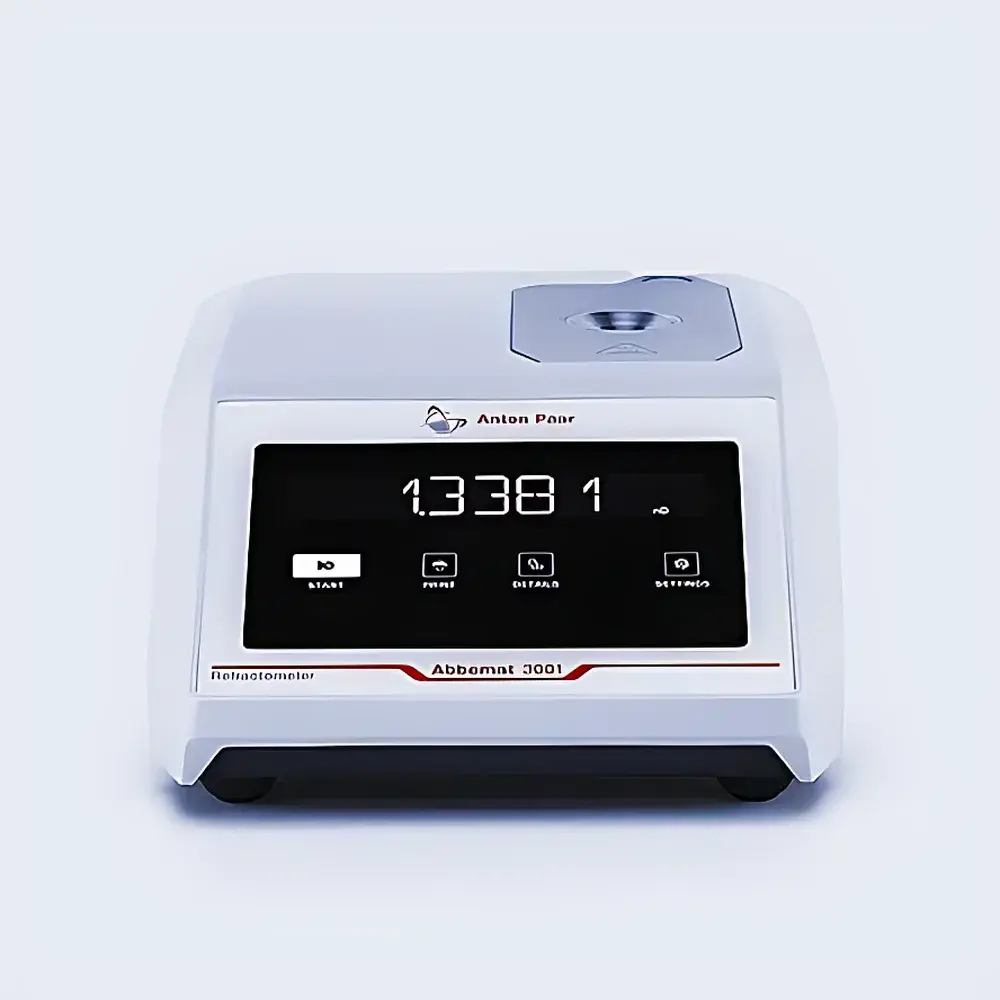
Anton Paar Abbemat 3001/3101/3201 Benchtop Automatic Refractometer
| Brand | Anton Paar |
|---|---|
| Origin | Austria |
| Manufacturer | Anton Paar GmbH |
| Product Type | Benchtop Refractometer |
| Temperature Control | Peltier-based, ±0.03 °C accuracy (verified by T-Check system) |
| Display | Digital LCD |
| Refractive Index Range | 1.33 to 1.55 nD |
| Accuracy | ±0.0001 nD |
| Sample Volume | As low as 70 µL |
| Prism Material | Sapphire (Mohs hardness 9) |
| Measurement Cycle Time | As low as 10 seconds |
| Additional Scales | Brix, % w/w, % v/v, g/100g, etc. |
| Predefined Methods | 1 primary + 8 swappable application-specific methods |
| Compliance | Fully traceable temperature calibration |
Overview
The Anton Paar Abbemat 3001/3101/3201 series represents a rigorously engineered line of benchtop automatic refractometers designed for routine quality control and research-grade refractive index (nD) measurement in regulated and non-regulated laboratory environments. Operating on the principle of total internal reflection at the sample–prism interface, these instruments determine refractive index with high optical resolution and minimal operator dependency. Each unit integrates a sapphire prism—engineered for long-term dimensional stability and resistance to mechanical abrasion—and a precision Peltier temperature control system that maintains prism surface temperature within ±0.03 °C, a critical requirement for metrologically sound nD determination per ISO 2859, ASTM D1218, and USP . The Abbemat practical series is purpose-built for laboratories requiring rapid, repeatable, and auditable measurements across liquid, semi-viscous, turbid, or solid-melt samples—without reliance on operator expertise or method development.
Key Features
- Patented T-Check system: Validates and documents prism surface temperature accuracy prior to each measurement cycle, ensuring full traceability to NIST-traceable standards.
- Sapphire prism (Mohs hardness 9): Eliminates degradation from repeated cleaning with lab tools; maintains optical flatness and refractive fidelity over >10 years of continuous use.
- Automated single-touch operation: Initiates measurement, temperature equilibration, data acquisition, and result output without manual intervention.
- Multi-scale reporting: Simultaneous real-time calculation of refractive index (nD), Brix (% sugar), mass concentration (% w/w), volume concentration (% v/v), density-equivalent units, and user-defined custom scales.
- Low-volume sampling: Compatible with sample volumes as small as 70 µL—critical for high-value, limited-availability, or hazardous materials.
- Integrated thermal management: Dual-zone Peltier elements provide independent heating and cooling, enabling rapid stabilization across 10–40 °C operating range (±0.01 °C setpoint resolution).
Sample Compatibility & Compliance
The Abbemat 3001/3101/3201 accommodates a broad spectrum of sample types—including aqueous solutions, organic solvents, syrups, emulsions, suspensions, polymer melts, and crystalline solids melted in situ—without requiring dilution or filtration. Its optical design compensates for light scattering in turbid media via adaptive signal processing, maintaining accuracy even at optical densities up to OD 2.0. All models comply with ISO/IEC 17025 requirements for measurement uncertainty estimation and support audit-ready documentation through optional label printers and export-capable USB/RS-232 interfaces. Temperature calibration records, measurement logs, and method parameters are timestamped and stored with electronic signatures enabled under FDA 21 CFR Part 11-compliant software configurations (when paired with Anton Paar’s mPDS 2.0 or higher).
Software & Data Management
While the base Abbemat practical series operates via an embedded firmware interface with no PC dependency, optional connectivity enables integration into centralized LIMS or ELN platforms. Data export formats include CSV, TXT, and XML—structured to align with ASTM E1382 metadata conventions. Audit trails record operator ID, timestamp, method version, temperature history, and raw photodiode signal profiles for every measurement. Firmware updates are delivered via signed USB firmware packages, preserving cryptographic integrity and version control in GxP environments. Method libraries—including pre-validated protocols for pharmaceutical excipients, food-grade syrups, and industrial glycols—are managed locally and can be duplicated across instrument fleets without requalification.
Applications
- Pharmaceutical QC: Verification of solvent purity, active ingredient concentration in liquid formulations, and excipient identity testing per USP monographs.
- Food & Beverage: Rapid Brix determination in fruit juices, dairy products, and confectionery syrups; compliance with AOAC 932.12 and ICUMSA methods.
- Chemical Manufacturing: In-process monitoring of reaction progress (e.g., esterification, polymerization), solvent recovery efficiency, and blend homogeneity.
- Academic Research: Calibration of density–refractivity correlations, thermodynamic modeling of binary mixtures, and interfacial property studies.
- Cosmetics & Personal Care: Quality assurance of surfactant solutions, essential oil dilutions, and emulsion phase stability assessment.
FAQ
Is the Abbemat 3001/3101/3201 compliant with 21 CFR Part 11?
Yes—when configured with optional software modules (mPDS 2.0+), electronic signature capability, and audit trail logging, the system meets predicate rule requirements for closed-system validation.
What is the minimum required sample volume for reliable measurement?
70 µL is sufficient for full-accuracy measurement across all models, provided the sample fully covers the sapphire prism surface area (≥12 mm²).
How often does the instrument require recalibration?
No routine recalibration is needed; the T-Check system validates temperature performance before every measurement. Annual verification using certified refractive index standards (e.g., Cargille nD = 1.4800 ±0.0001) is recommended for ISO 17025 accreditation.
Can the Abbemat measure opaque or highly viscous samples?
Yes—the optical path and signal processing algorithm are optimized for turbid liquids (e.g., milk, paint thinners) and viscosities up to 10,000 mPa·s; no centrifugation or dilution is required.
Is the sapphire prism replaceable in the field?
No—sapphire is permanently bonded to the optical housing during factory assembly to preserve alignment integrity; replacement requires return-to-factory service.




