
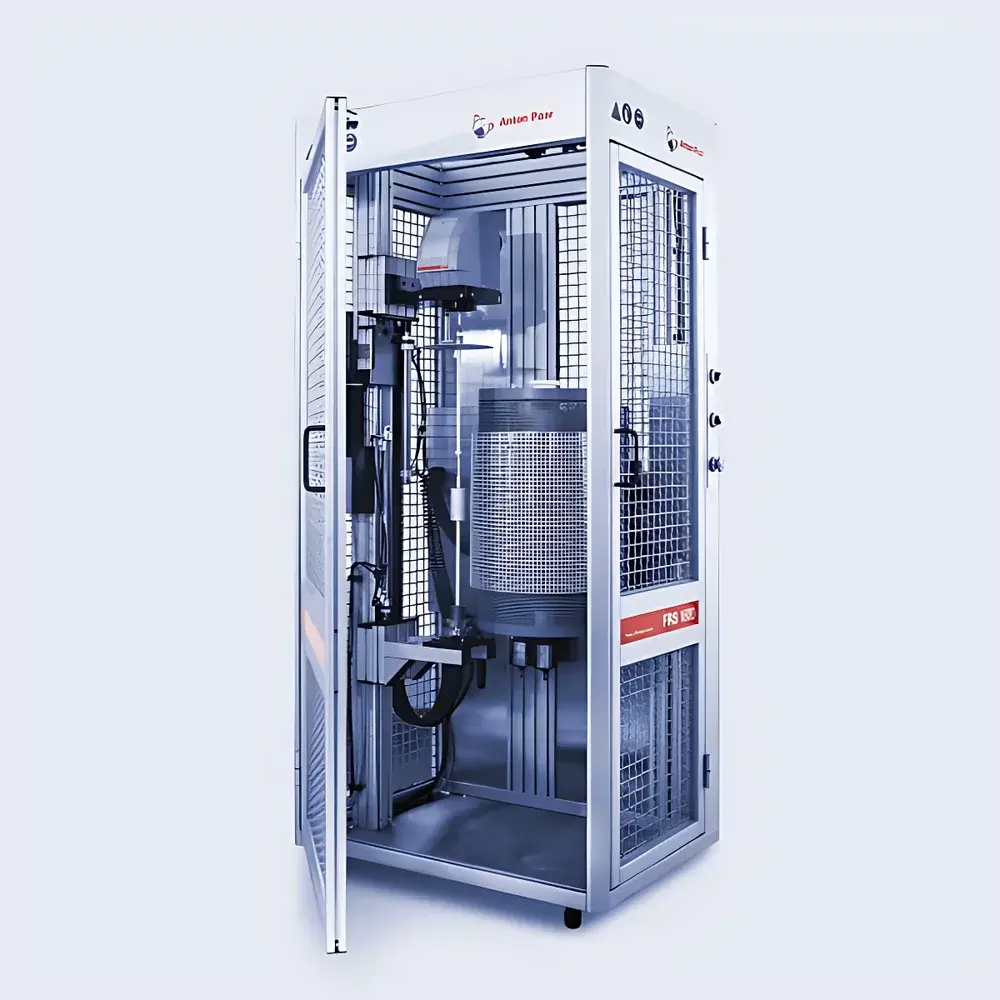
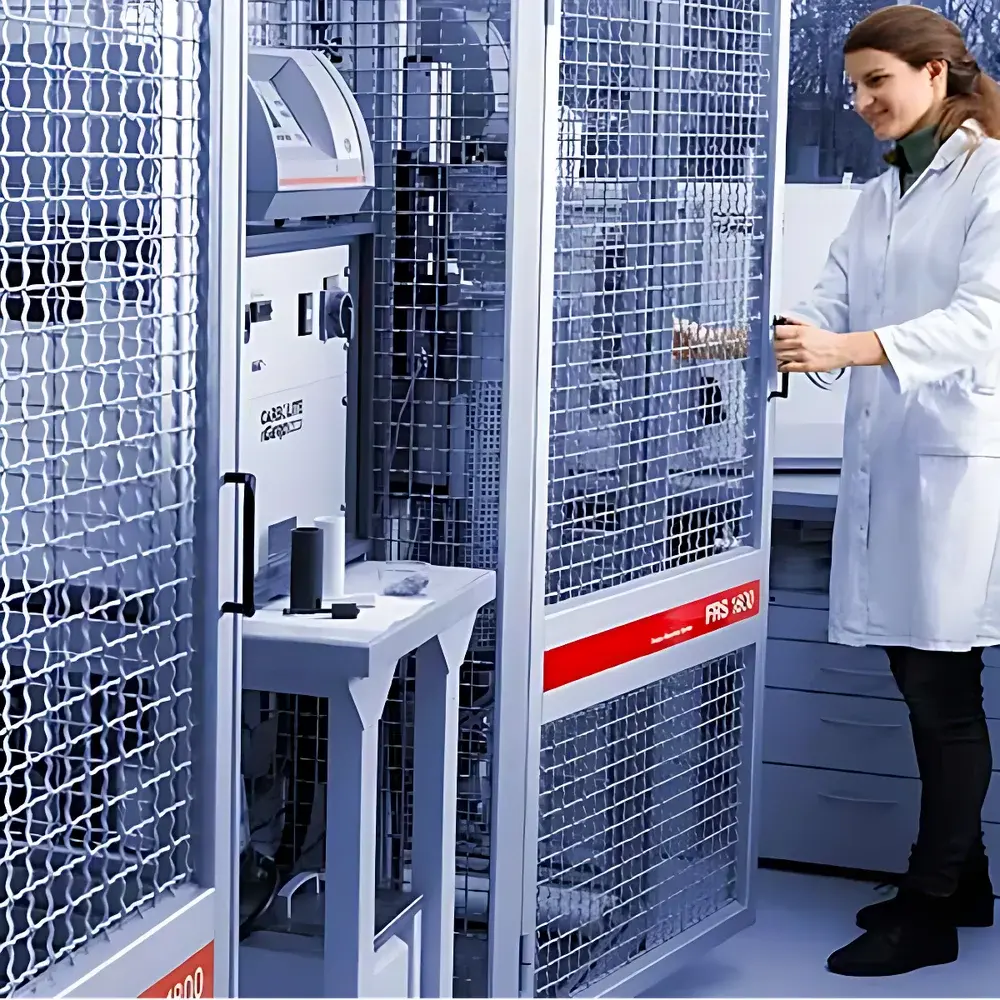
Anton Paar FRS 1800 High-Temperature Rotational Rheometer
| Brand | Anton Paar |
|---|---|
| Origin | Austria |
| Manufacturer Type | Original Equipment Manufacturer (OEM) |
| Origin Category | Imported |
| Model | FRS 1800 |
| Instrument Type | Rotational Rheometer |
| Sample Type | Solids, Melts, Slags, Glasses, Ceramics |
| Motor Bearing | Air Bearing |
| Temperature Range | 20 °C to 1730 °C (up to 1800 °C with optional furnace configuration) |
| Frequency Range | 10⁻⁷ to 628 rad/s |
| Minimum Angular Velocity | 10⁻⁹ rad/s |
| Maximum Angular Velocity | 314 rad/s (300 rpm) |
| Maximum Torque | 230 mNm |
| Torque Resolution | 0.1 nNm |
| Normal Force Range | 0.005–50 N |
| Normal Force Resolution | 0.5 mN |
| Viscosity Range | 10⁻³ to 10⁷ Pa·s |
| Angular Displacement Setpoint | 0.1 µrad to ∞ |
| Angular Displacement Resolution | 10 nrad |
| Measurement Head Max Speed | 3000 rpm |
| Furnace Cooling | Dual-mode (gas + water) |
| Atmosphere Options | Air, N₂, Ar, He |
| Compliance | ASTM C965, ISO 7884-2 |
| Measuring System Materials | Al₂O₃, Graphite, Pt, Custom Alloys |
| Rotor Diameter | 11–27.6 mm |
| Sample Cup Height (max) | 100 mm |
| Dimensions (W × H × D) | 680 × 1950 × 920 mm |
| Weight | 150 kg |
Overview
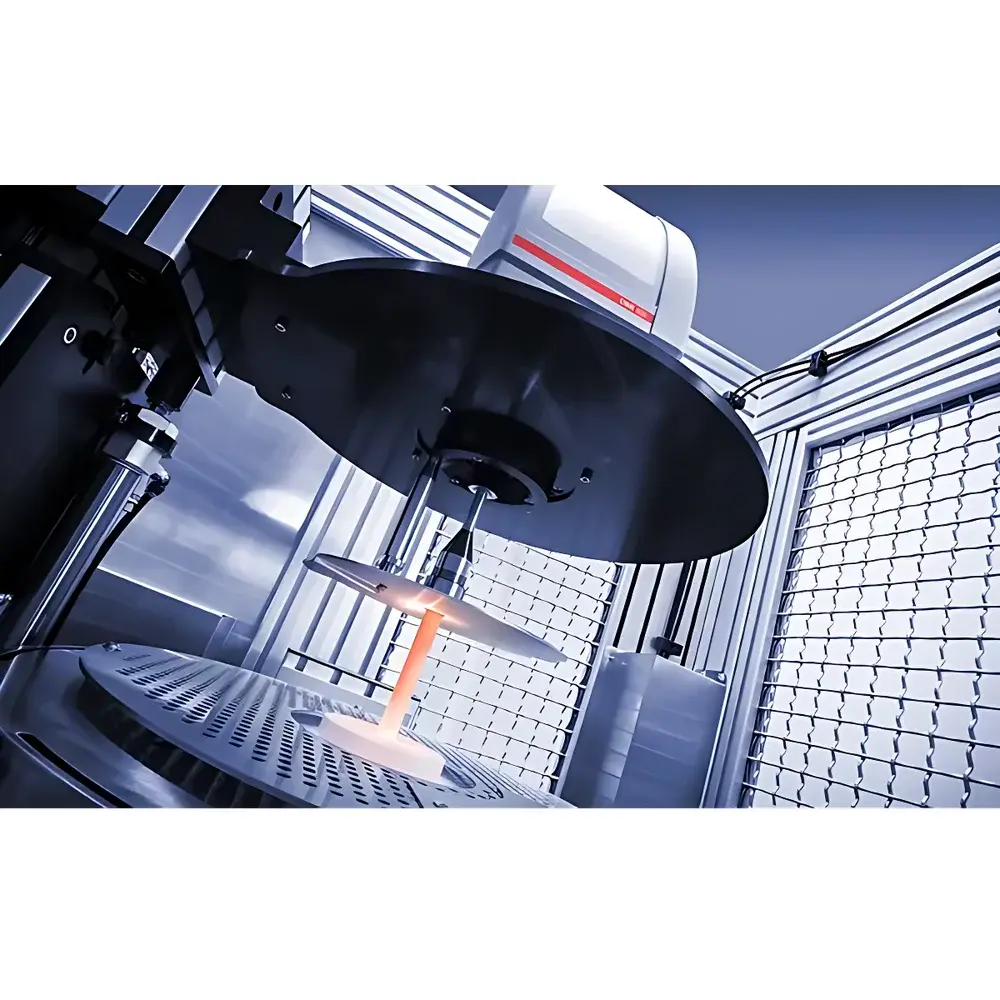
The Anton Paar FRS 1800 is a high-temperature rotational rheometer engineered for precise viscoelastic and viscosity characterization of inorganic melts—including glasses, slags, refractory ceramics, and metallurgical alloys—under controlled thermal and atmospheric conditions. Operating on the principle of controlled-strain and controlled-stress rotational rheology, the FRS 1800 employs a high-resolution air-bearing EC motor coupled with an integrated optical encoder to deliver frictionless, drift-free torque transmission across an unprecedented dynamic range. Its measurement architecture conforms to Couette flow geometry, enabling accurate determination of shear viscosity, storage/loss moduli (G′/G″), yield stress, and normal force evolution during phase transitions (e.g., solid-to-liquid transition, glass transition, crystallization onset). Designed for operation from ambient temperature up to 1730 °C (with extended capability to 1800 °C via optional furnace tuning), the system integrates a laboratory-grade high-temperature furnace with dual-stage gas/water cooling, ensuring ±0.1 °C temperature stability and reproducible thermal ramping profiles.
Key Features
- Air-bearing synchronous EC motor with 0.1 nNm torque resolution and 10⁻⁹ rad/s minimum angular velocity, eliminating mechanical hysteresis and enabling reliable low-viscosity (<10⁻³ Pa·s) melt measurements.
- Integrated normal force sensor (0.005–50 N, 0.5 mN resolution) for real-time detection of melting points, solidification onset, and interfacial contact events during heating/cooling cycles.
- Automated sample immersion system combining pneumatic pre-positioning and stepper-motor fine alignment—ensuring repeatable, operator-safe insertion of measuring systems into solid samples prior to melting.
- Dual-cooling furnace (compressed gas + recirculating water) for rapid thermal equilibration and minimized thermal gradients across the sample volume.
- CE-certified safety enclosure with interlocked access door, integrated inert-gas purge ports (N₂, Ar, He), and real-time overtemperature/overpressure monitoring per IEC 61000-6-4 and EN 61000-6-2 standards.
- Full EC mode support: simultaneous control of shear rate (CSR) and shear stress (CSS), enabling both steady-state and transient rheological protocols including creep-recovery, stress relaxation, and amplitude sweeps.
Sample Compatibility & Compliance
The FRS 1800 accommodates heterogeneous, high-reactivity, and thermally unstable samples—including oxide-based glasses, blast furnace slags, nuclear waste vitrification matrices, and molten metal oxides—within chemically inert measuring systems fabricated from high-purity Al₂O₃, graphite, platinum, or customer-specified refractory alloys. Sample geometry is configurable using rotors ranging from 11 mm to 27.6 mm in diameter and crucibles up to 100 mm in height. The system complies with internationally recognized standard methods for high-temperature viscosity measurement: ASTM C965 (Standard Test Method for Determination of Viscosity of Glass Above the Softening Point) and ISO 7884-2 (Glass — Viscosity and Fixed Points — Part 2: Determination of Viscosity by Rotational Viscometry). All thermal and rheological data are traceable to NIST-calibrated reference materials and recorded with full audit trail integrity under GLP/GMP-aligned workflows.
Software & Data Management
RheoCompass™ software serves as the unified control, acquisition, and analysis platform for the FRS 1800. It supports fully automated temperature-rheology coupling: synchronized thermal ramps, auto-triggered immersion, adaptive oscillatory frequency sweeps, and real-time normal force threshold detection for phase-change identification. Data export formats include ASCII, CSV, and HDF5, compatible with third-party statistical and modeling tools (e.g., MATLAB, Python SciPy, Thermo-Calc). The software meets FDA 21 CFR Part 11 requirements for electronic records and signatures, featuring role-based user access, electronic audit trails, and secure data encryption. Optional DMA™ module enables dynamic mechanical analysis extensions for viscoelastic mapping of semi-crystalline or composite melts.
Applications
- Viscosity-temperature profiling of container glass and optical glass melts for furnace optimization and forming process design.
- Crystallization kinetics and nucleation behavior analysis in slag systems for metallurgical process control and waste immobilization validation.
- Yield stress and thixotropic recovery quantification in ceramic slip formulations and battery electrode slurries at elevated processing temperatures.
- Interfacial rheology of molten metal/oxide interfaces relevant to casting and refining operations.
- Validation of constitutive models (e.g., Vogel–Fulcher–Tammann, Arrhenius, MYEGA) for predictive simulation of industrial melt processing.
FAQ
What temperature accuracy is achieved during high-temperature viscosity measurements?
The FRS 1800 achieves ±0.1 °C temperature accuracy across its operating range (20–1730 °C) using calibrated S- or B-type thermocouples embedded directly in the furnace zone adjacent to the sample cup.
Can the system operate under reducing atmospheres?
Yes—the furnace chamber supports continuous inert gas purging (N₂, Ar, He) and is rated for operation under mildly reducing atmospheres; custom configurations for H₂/N₂ mixtures are available upon request.
Is torque calibration traceable to national metrology institutes?
All torque sensors undergo factory calibration against NIST-traceable dead-weight standards, with certificate documentation provided per ISO/IEC 17025 requirements.
How is sample contamination prevented during repeated high-temperature runs?
The system utilizes disposable or regenerable refractory measuring systems; graphite components are vacuum-baked between runs, and furnace zones feature removable insulation liners for residue management.
Does the FRS 1800 support time-temperature superposition (TTS) analysis?
Yes—RheoCompass™ includes built-in TTS modules compliant with ISO 6721-10, enabling master curve construction for linear viscoelastic behavior prediction across extended frequency domains.



