
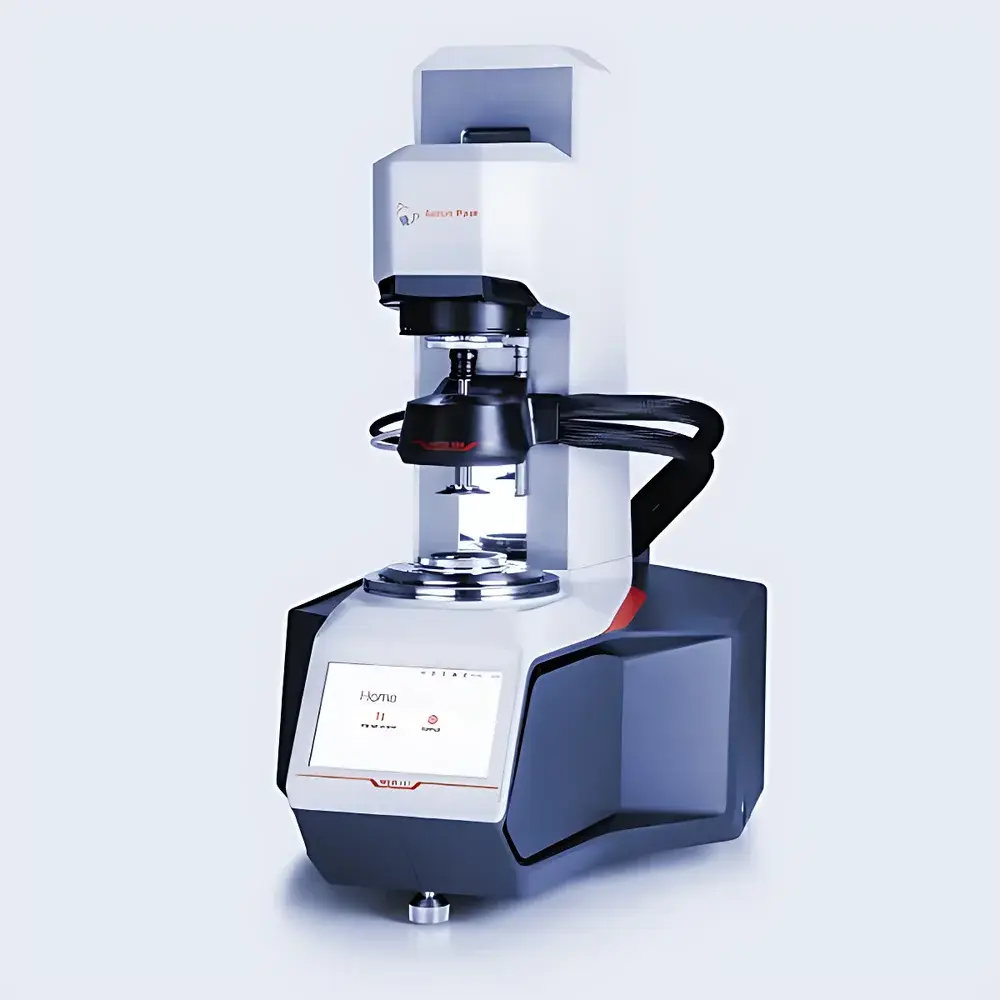
Anton Paar MCR 703 MultiDrive Advanced Rotational Rheometer
| Brand | Anton Paar |
|---|---|
| Origin | Austria |
| Manufacturer Type | Original Equipment Manufacturer (OEM) |
| Product Origin | Imported |
| Model | MCR 703 |
| Instrument Type | Rotational Rheometer |
| Sample Viscosity Range | High-Viscosity Fluids |
| Sample State | Liquid |
| Bearing System | Precision Porous Carbon Air Bearings |
| Minimum Angular Velocity | 0 rad/s |
| Frequency Range | 2 × 10⁻⁸ Hz to 200 Hz (equivalent to 10⁻⁷ – 628 rad/s) |
| Maximum Angular Velocity | 628 rad/s (6000 rpm in counter-rotation mode) |
| Maximum Torque | 230 mNm |
| Torque Resolution | 0.05 nNm |
Overview
The Anton Paar MCR 703 MultiDrive is a high-end, dual-drive rotational rheometer engineered for fundamental and applied research in complex fluid and soft solid characterization. Based on Couette flow geometry and torque-controlled or strain-controlled rheological principles, it delivers exceptional accuracy and flexibility across steady shear, oscillatory, transient, and extensional deformation regimes. Unlike conventional single-motor rheometers, the MCR 703 integrates two electronically commutated (EC) synchronous motors—each supported by precision porous carbon air bearings—enabling simultaneous actuation and sensing. This architecture supports three distinct operational modes: Controlled Motor Torque (CMT), Separated Motor and Transducer (SMT), and Counter-Rotation Mode. In CMT mode, the upper motor functions as both drive and sensor under real-time position control (TruStrain™), ideal for precise stress-controlled experiments including creep, recovery, and yield stress determination. In SMT mode, one motor serves exclusively as a high-fidelity torque transducer while the other provides controlled motion—critical for measuring low-amplitude dynamic responses with minimal inertia coupling. The counter-rotation configuration enables fixed-plane deformation within the sample volume, facilitating in situ structural observation via optical or confocal microscopy.
Key Features
- Dual EC motor system with independent air-bearing support for ultra-low friction and thermal stability
- Three configurable measurement architectures: CMT, SMT, and Counter-Rotation Mode
- TruStrain™ real-time position control enabling true strain fidelity in transient and oscillatory tests
- Integrated 360° capacitive normal force sensor with resolution down to 0.001 N and full bearing integration
- High-resolution optical encoder for angular displacement (<1 nrad resolution) and velocity feedback
- Toolmaster™ automatic recognition of all connected measuring systems, temperature units, and accessories
- QuickConnect™ one-hand coupling mechanism for rapid, repeatable measurement system attachment
- Active motor thermal management to ensure long-term torque stability and minimize thermal drift
- Modular electronics enclosure compatible with glovebox integration and inert-atmosphere operation (N₂, Ar)
Sample Compatibility & Compliance
The MCR 703 accommodates liquid, paste, gel, and semi-solid samples across a broad viscosity range—from dilute polymer solutions to highly filled suspensions and molten thermoplastics. Its design complies with international standards governing rheological testing, including ISO 6721 (Plastics — Determination of dynamic mechanical properties), ASTM D4065 (Standard Practice for Plastics: Dynamic Mechanical Properties), and USP (Uniformity of Dosage Units) for pharmaceutical suspensions. When configured for DMA, it meets ASTM D7028 (Standard Test Method for Glass Transition Temperature of Polymer Matrix Composites) and ISO 6721-1 (General principles). All data acquisition and instrument control adhere to FDA 21 CFR Part 11 requirements through optional audit trail, electronic signature, and user access control modules. The system supports GLP/GMP-compliant workflows with full traceability of calibration history, measurement parameters, and environmental conditions.
Software & Data Management
RheoCompass™ software provides an integrated platform for method development, real-time visualization, advanced data analysis, and report generation. It includes pre-validated test templates aligned with ASTM, ISO, and DIN protocols, enabling immediate compliance-ready reporting. Raw torque, normal force, angle, and temperature data are recorded at up to 10 kHz sampling rate with time-stamped metadata. The software supports batch processing of frequency sweeps, amplitude sweeps, and time sweeps—including master curve construction via time–temperature superposition (TTS). Export formats include ASCII, CSV, HDF5, and RheoML—an XML-based open standard for rheological data interchange. For regulated environments, optional modules provide electronic signatures, role-based permissions, and immutable audit logs compliant with 21 CFR Part 11 Annex 11 and EU GMP Annex 11.
Applications
- Linear and nonlinear viscoelasticity of polymers, biopolymers, and colloidal dispersions
- Yield stress and thixotropic behavior quantification in coatings, inks, and food products
- In situ structure–property relationships during shear using coupled microscopy setups
- Extensional rheology via UXF (Universal Extensional Fixture) with Hencky strains >8
- Multi-mode DMA: axial tension, torsion, three-point bending, and compression on films, fibers, and bulk specimens
- Anisotropic material characterization via combined axial–torsional loading to determine Poisson’s ratio
- High-temperature rheology under inert atmosphere for reactive melts and battery slurries
- Powder flow analysis using dedicated powder rheometry accessories
- Tribological evaluation with integrated friction and wear modules
FAQ
What distinguishes the MCR 703 MultiDrive from conventional rheometers?
It features two independently controlled EC motors with air-bearing support, enabling CMT, SMT, and counter-rotation modes—offering unmatched flexibility in deformation control and measurement fidelity.
Can the MCR 703 perform extensional rheology?
Yes—when equipped with the UXF universal extensional fixture, it measures uniaxial extension at Hencky strains exceeding 8, supporting quantitative analysis of strain hardening in elastomers and polymer melts.
Is the system suitable for use inside a nitrogen-purged glovebox?
Yes—the modular electronics enclosure allows physical separation of the main unit and control box, enabling installation in confined or inert-atmosphere environments without performance compromise.
How does Toolmaster™ improve experimental reproducibility?
It automatically detects and configures connected measuring systems, temperature units, and accessories—recording calibration data, geometry parameters, and firmware versions directly into the measurement file.
Does the MCR 703 support regulatory compliance for pharmaceutical QC?
With optional 21 CFR Part 11 and Annex 11 modules, it delivers full audit trails, electronic signatures, and secure user authentication required for GMP-compliant quality control laboratories.



