
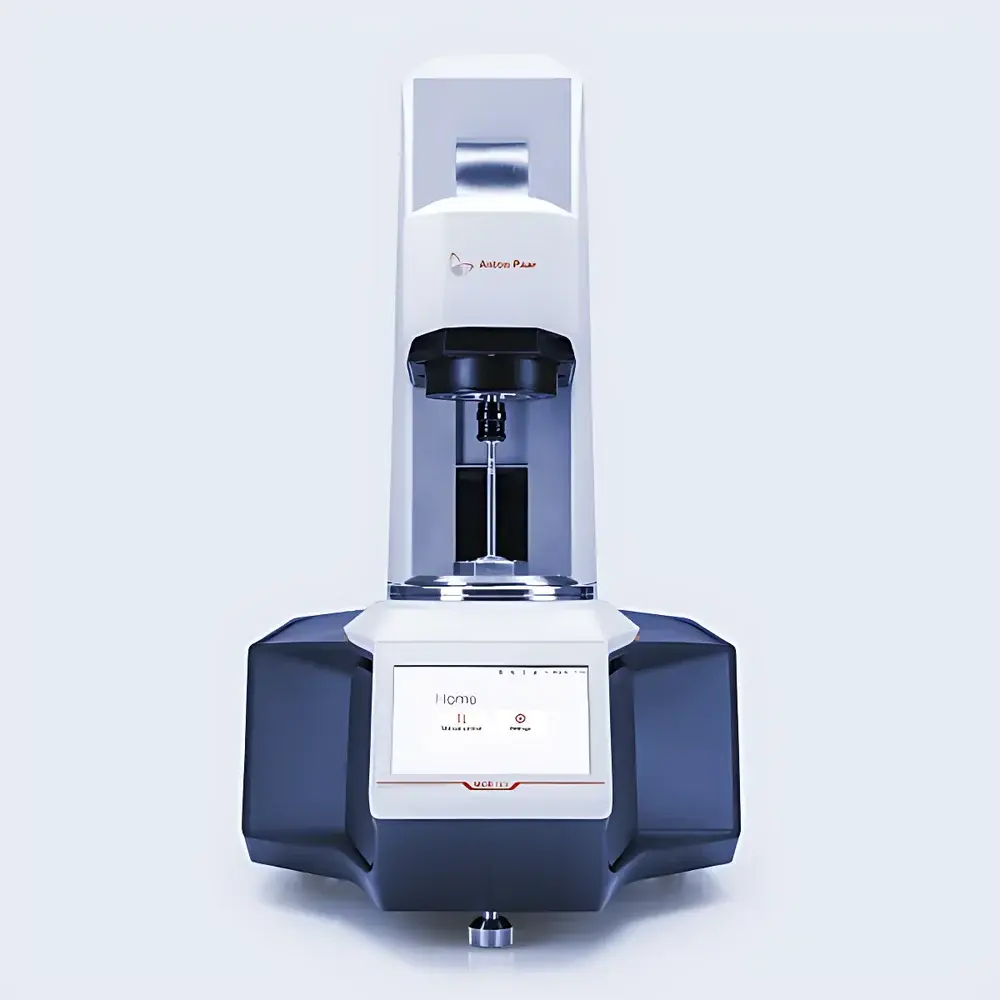
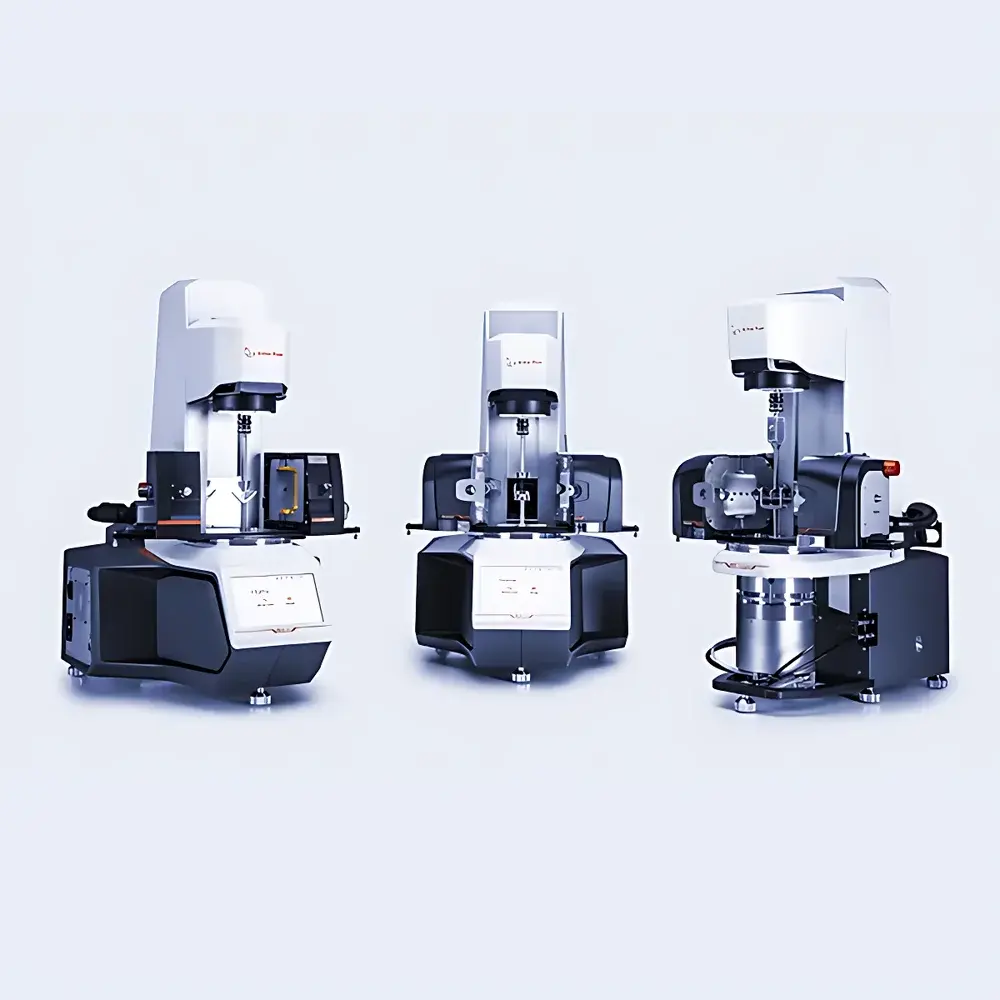
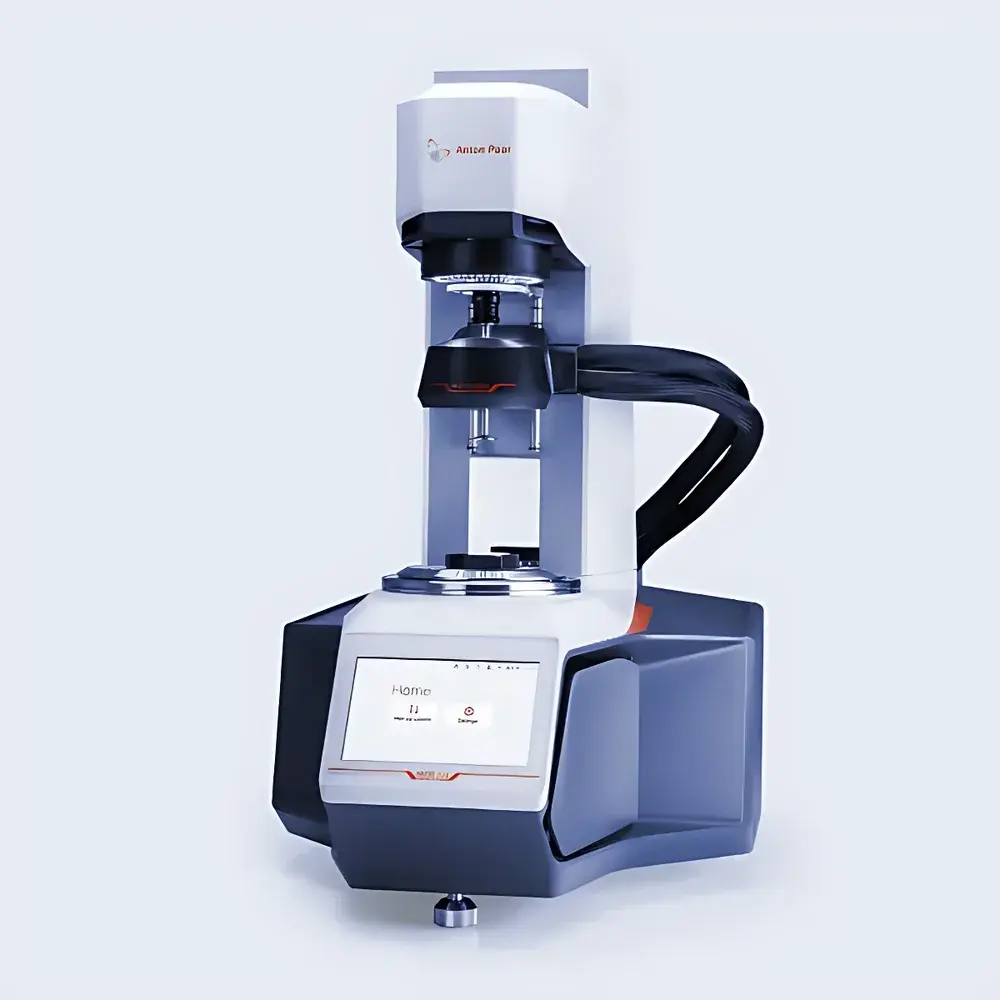
Anton Paar MCR Modular Intelligent Advanced Rheometer
| Brand | Anton Paar |
|---|---|
| Origin | Austria |
| Manufacturer Type | Manufacturer |
| Origin Category | Imported |
| Model | MCR |
| Instrument Type | Rotational Rheometer |
| Sample Viscosity Range | High-Viscosity |
| Sample State | Liquid |
| Motor Bearing | Air Bearing |
| Temperature Range | −160 °C to 1000 °C |
| Minimum Rotational Speed | 0 rpm |
| Frequency Range | 2×10⁻⁸–200 rad/s |
| Maximum Rotational Speed | 3000 rpm |
| Maximum Torque | 300 mNm |
| Torque Resolution | 0.05 nNm |
Overview
The Anton Paar MCR Modular Intelligent Advanced Rheometer represents a paradigm shift in rotational rheometry, engineered for precision, adaptability, and long-term scientific validity. Based on a fully modular platform architecture, the MCR series—comprising the MCR 303, MCR 503, and MCR 503 Power—implements Couette flow principles with high-fidelity torque and angular displacement transduction to quantify viscoelastic behavior across dynamic oscillatory, steady shear, and transient modes. Its core measurement capability spans complex modulus (G*, η*), yield stress, thixotropy, linear and nonlinear viscoelasticity (LAOS), and time–temperature superposition (TTS) analysis. Designed for laboratories requiring traceable, reproducible rheological data under GLP/GMP-aligned workflows, the MCR platform integrates seamlessly into regulated environments where ASTM D4402, ISO 6721-10, and USP compliance are essential.
Key Features
- Modular hardware architecture enabling field-upgradable configurations—from basic QC rheometry to full material characterization platforms including DMA, extensional, and tribological modules
- Air-bearing-supported motor system with ultra-low friction and zero mechanical hysteresis, ensuring exceptional torque fidelity down to 0.05 nNm resolution
- Electronically commutated (EC) permanent-magnet synchronous motor delivering precise control over angular velocity (0–3000 rpm) and oscillatory frequency (2×10⁻⁸–200 rad/s)
- Integrated 360° capacitive normal force sensor with full bearing integration—enabling simultaneous, non-contact normal force measurement from 0.001 N to 70 N (model-dependent)
- Optical encoder-based angular displacement detection with sub-nanoradian resolution (<1 nrad for MCR 503 Power), critical for accurate strain-controlled LAOS and creep recovery
- Ultra-fast instrument boot (<6 s) and real-time touchscreen-guided sample preparation via the 7-inch capacitive touch interface
- Patented TruStrain™ technology (US Pat. 9176918) for true strain control in both rotational and oscillatory modes—eliminating geometric assumptions in complex fluid deformation
Sample Compatibility & Compliance
The MCR series accommodates liquid, paste, molten polymer, and semi-solid samples across an extended temperature range of −160 °C to 1000 °C—enabled by Peltier, liquid nitrogen, and furnace-based thermal units including the H-PTD 200/Air air-cooled Peltier system. All models support standardized geometries (cone-plate, parallel-plate, concentric cylinder) and optional accessories for powders (Powder Cell), melts (Searle-type), and extensional flows (Filament Stretching Rheometer module). The system complies with international standards for rheological instrumentation validation, including ISO/IEC 17025 traceability requirements for torque and temperature calibration. Data acquisition meets FDA 21 CFR Part 11 criteria when used with RheoCompass software’s audit trail, electronic signature, and role-based access controls—making it suitable for pharmaceutical process development and QC release testing.
Software & Data Management
RheoCompass 2.0 is the unified, role-adaptive software environment for the MCR platform—designed for both routine operators and advanced researchers. It features over 250 preconfigured method templates aligned with ASTM, ISO, and USP protocols, each with guided touchscreen workflows and context-sensitive help. The software supports customizable report generation (PDF, CSV, XML), batch processing, multivariate statistical analysis, and automated pass/fail evaluation against user-defined specification limits. Raw data—including torque, strain, stress, temperature, and normal force—is stored in vendor-neutral HDF5 format with embedded metadata (instrument ID, calibration history, environmental logs). For enterprise integration, RheoCompass provides OPC UA and REST API interfaces compatible with LIMS and MES systems. All data handling adheres to ALCOA+ principles (Attributable, Legible, Contemporaneous, Original, Accurate, Complete, Consistent, Enduring, Available) throughout the data lifecycle.
Applications
- Pharmaceutical formulation: Gelation kinetics of thermosensitive hydrogels, suspension stability assessment, and injectable viscosity profiling per USP
- Polymers & composites: Melt rheology for extrusion and injection molding simulation; crosslinking monitoring via time-sweep G′ evolution
- Food science: Yield stress mapping of dairy spreads, thixotropic recovery of sauces, and fat crystal network dynamics under cooling ramps
- Advanced materials: Viscoelastic characterization of battery slurries, ceramic pastes, and nanocomposite dispersions under high-shear startup conditions
- Academic research: Fundamental studies of soft glassy rheology, jamming transitions, and nonlinear response in colloidal gels using LAOS protocols
FAQ
What distinguishes the MCR 503 Power from the MCR 503?
The MCR 503 Power features an enhanced torque motor (300 mNm max), improved torque resolution (0.05 nNm), and expanded normal force range (up to 70 N), optimized for high-stiffness materials and demanding DMA applications.
Can the MCR perform extensional rheology?
Yes—when equipped with the optional Filament Stretching Rheometer (FSR) module or the Linear Drive 20 actuator, the MCR 503/703 supports uniaxial extensional measurements per ISO 11443 and ASTM D7175.
Is RheoCompass compliant with 21 CFR Part 11?
Yes—when configured with user authentication, electronic signatures, and audit trail logging enabled, RheoCompass satisfies all technical and procedural requirements for regulated environments.
What temperature control options are available below −40 °C?
Cryogenic operation is supported via liquid nitrogen cooling with the P-CCD or P-ETD temperature units, achieving stable setpoints down to −160 °C with ±0.05 °C accuracy.
How does TruStrain™ improve measurement accuracy?
TruStrain™ eliminates reliance on geometric assumptions by directly measuring actual sample deformation via integrated optical encoders—critical for non-Newtonian fluids exhibiting edge fracture or wall slip.
Related Products



