
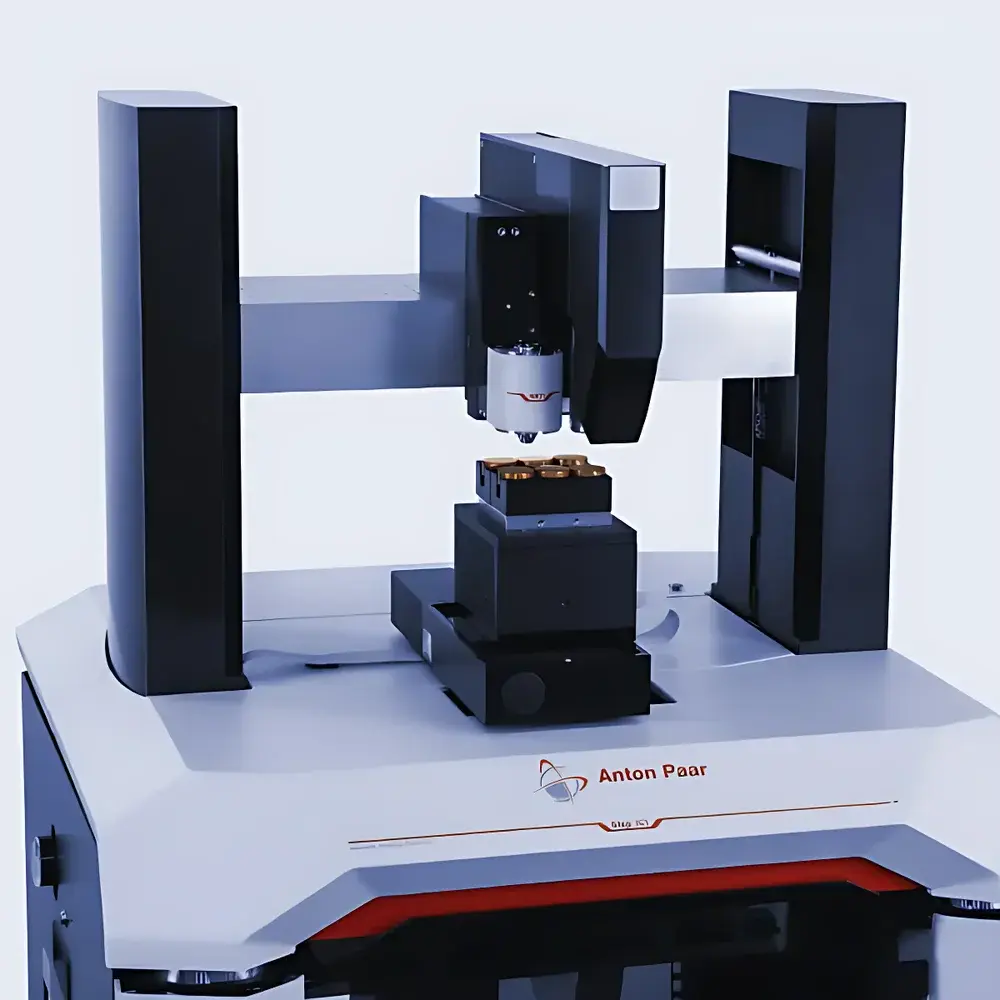
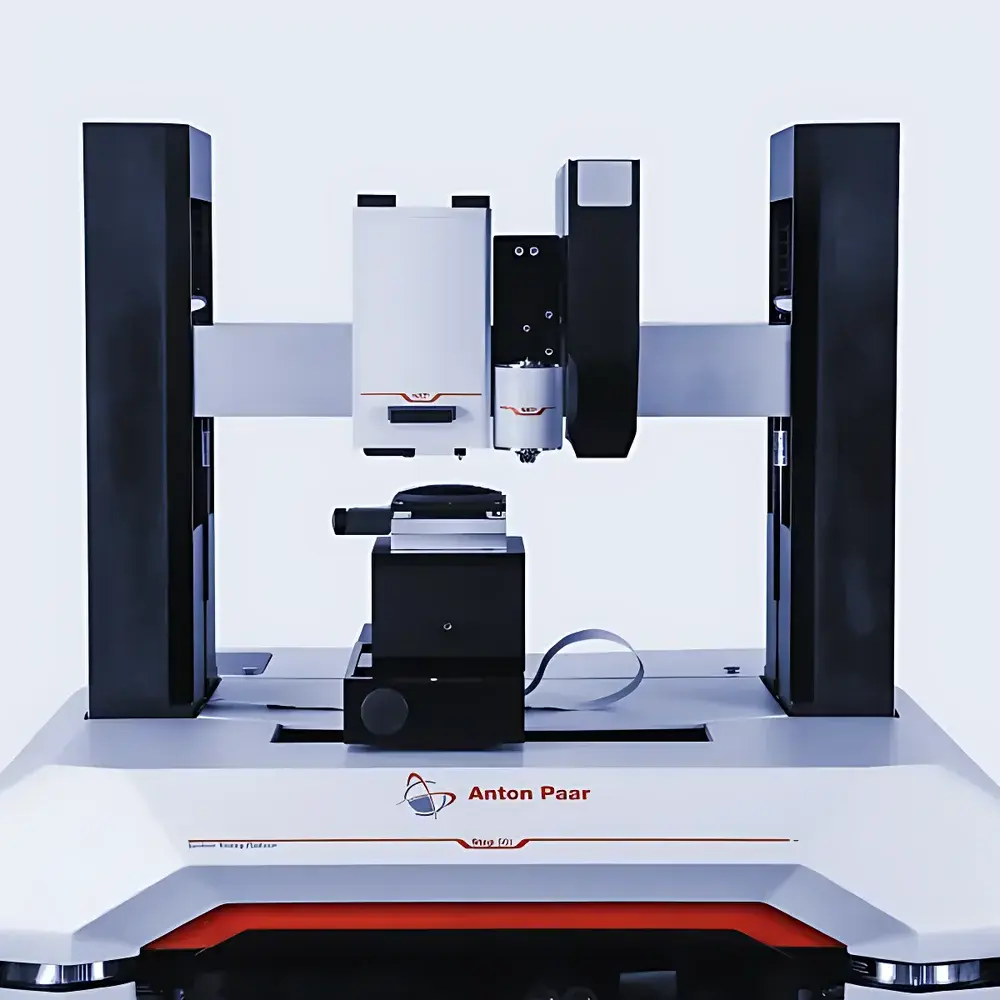
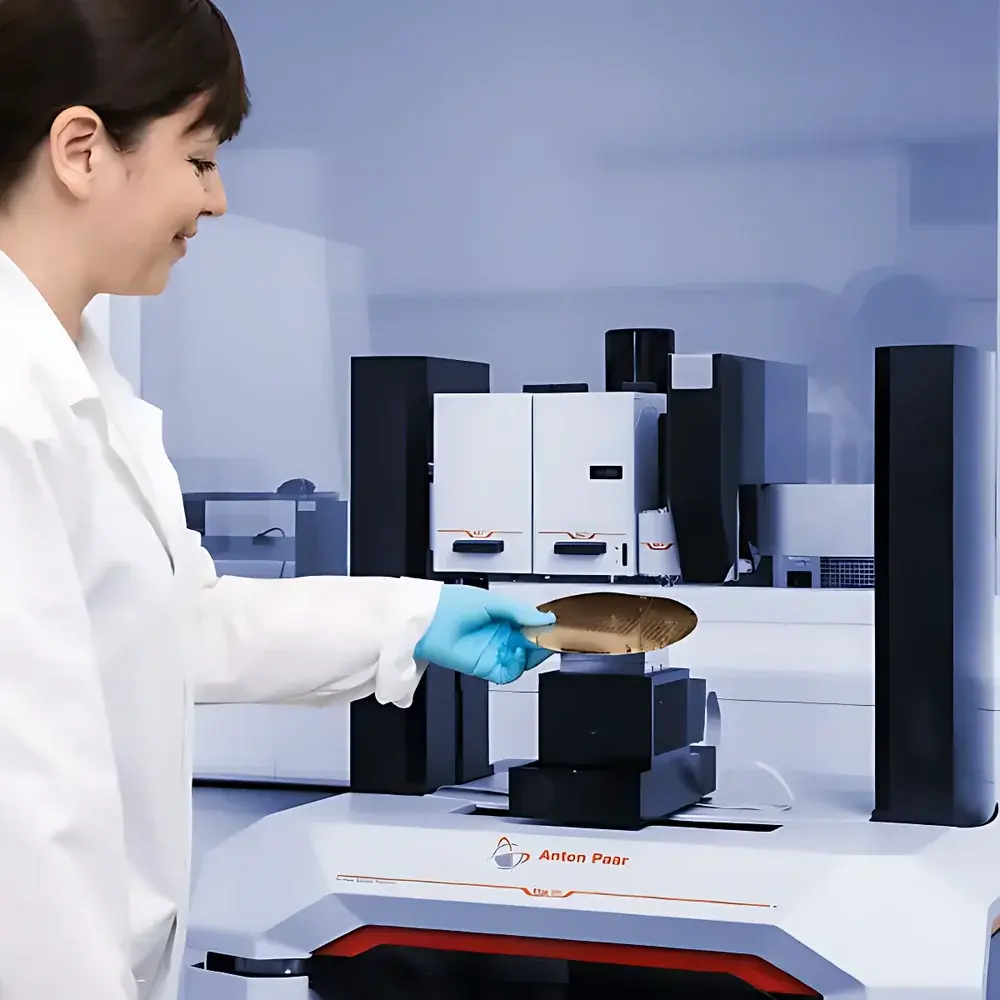
Anton Paar NHT³ Nanoindentation Tester
| Brand | Anton Paar |
|---|---|
| Origin | Switzerland |
| Manufacturer Type | Original Equipment Manufacturer (OEM) |
| Product Origin | Imported |
| Model | NHT³ |
| Instrument Type | Nanoindentation Tester |
| Maximum Indentation Depth | 200 µm |
| Effective Load Range | 0.1 mN to 500 mN |
| Load Resolution | 20 nN |
| Load Noise (RMS) | ≤0.5 µN |
| Depth Resolution | 0.01 nm |
| Depth Noise (RMS) | ≤0.15 nm |
| Loading Rate | up to 10,000 mN/min |
| Data Acquisition Rate | 192 kHz |
| Environmental Options | Liquid Testing Compatible |
Overview
The Anton Paar NHT³ Nanoindentation Tester is a high-precision, surface-referenced instrument engineered for quantitative mechanical characterization at the nanoscale and microscale. It operates on the principle of controlled quasi-static and dynamic displacement-controlled indentation, where a calibrated diamond tip (Berkovich, cube-corner, or custom geometry) is driven into the sample surface under precisely regulated load while simultaneously measuring penetration depth with sub-nanometer resolution. Unlike conventional nanoindenters relying solely on actuator displacement, the NHT³ integrates a patented surface reference ring that actively tracks real-time surface position during testing—eliminating thermal drift artifacts and enabling immediate measurement after sample loading. This architecture ensures traceable, reproducible quantification of hardness (H), reduced elastic modulus (Er), creep compliance, strain-rate sensitivity, and viscoelastic parameters (E′, E″, tan δ) without pre-conditioning wait times. Designed for ISO 14577-compliant indentation testing and aligned with ASTM E2546 guidelines for nanomechanical property mapping, the NHT³ serves as a foundational tool in advanced materials R&D, thin-film metrology, and quality control laboratories requiring GLP/GMP traceability.
Key Features
- Surface-Referenced Measurement Architecture: Integrated reference ring continuously monitors sample surface position during indentation, decoupling true displacement from thermal expansion effects—enabling zero-wait-time operation post-loading and eliminating hours-long thermal equilibration delays.
- High-Fidelity Force-Displacement Sensing: Dual-sensor system delivers 20 nN load resolution and 0.01 nm depth resolution, with RMS noise levels of ≤0.5 µN (load) and ≤0.15 nm (depth), ensuring statistical confidence in low-force regimes (e.g., soft polymers, biomaterials, ultrathin coatings).
- High-Throughput “Fast Matrix” Mode: Automated grid-based indentation sequences execute up to 600 indents per hour with full force–displacement curve acquisition, synchronized optical positioning, and real-time data validation—optimized for statistical property mapping and batch QC screening.
- Multi-Method Platform Flexibility: Modular STEP platform supports interchangeable test heads—including nanoindentation, micro-scratch, and dynamic mechanical analysis (DMA) modules—allowing seamless transition between hardness, adhesion, wear resistance, and viscoelastic profiling on a single instrument frame.
- In-Situ Optical Navigation: Integrated high-magnification optical microscope (up to 1000×) with motorized XY stage enables precise targeting of microstructural features (grains, phases, defects), critical for correlative structure–property analysis.
- Rapid Tip Exchange System: Patented quick-lock mechanism allows full indenter replacement—including calibration verification—in under 2 minutes, minimizing downtime and supporting multi-tip experimental protocols (e.g., cross-comparison studies, tip wear monitoring).
Sample Compatibility & Compliance
The NHT³ accommodates rigid and compliant substrates ranging from brittle ceramics and metallic alloys to hydrogels, pharmaceutical tablets, and biological tissues. Its liquid cell option enables in-situ indentation under controlled aqueous or solvent environments—essential for studying hydration-dependent mechanics, corrosion interfaces, or electrochemical material behavior. The system meets ISO 14577-1:2022 requirements for instrument calibration, uncertainty estimation, and test procedure documentation. All raw data—including force, displacement, time stamps, environmental conditions, and operator metadata—are stored in vendor-neutral HDF5 format with embedded audit trails, satisfying FDA 21 CFR Part 11 electronic record integrity requirements when deployed in regulated environments. Traceable calibration certificates (including NIST-traceable reference standards) are provided for both load and displacement channels.
Software & Data Management
Control and analysis are executed via Anton Paar’s proprietary Advanced Mechanical Testing Software (AMTS), a Windows-based application compliant with ICH GCP and GLP data governance frameworks. AMTS supports method scripting (Python API integration), automated report generation (PDF/Excel), customizable pass/fail criteria for QC workflows, and hierarchical project management for multi-user labs. Dynamic mechanical analysis (DMA) routines include sine-wave indentation for depth-resolved storage/loss modulus profiling, phase angle mapping, and harmonic contact stiffness extraction. All measurements embed full parameter logs (e.g., loading rate, hold time, thermal drift compensation status), enabling retrospective root-cause analysis of outliers. Raw datasets are exportable without proprietary codec restrictions, facilitating third-party statistical modeling (e.g., Weibull analysis, machine learning feature extraction) and inter-laboratory comparison studies.
Applications
- Quantitative hardness and modulus mapping of PVD/CVD coatings, thermal barrier layers, and MEMS structural films
- Creep and stress-relaxation analysis of polymer blends, elastomers, and biodegradable scaffolds
- Adhesion strength assessment via micro-scratch testing on multilayer photovoltaic stacks and battery electrode architectures
- In-situ mechanical evolution tracking during electrochemical cycling (with liquid cell + potentiostat integration)
- Depth-dependent viscoelastic profiling of tissue-engineered constructs and ocular implants
- Statistical grain-level property variation analysis in additively manufactured superalloys and titanium alloys
FAQ
Does the NHT³ require thermal stabilization before starting measurements?
No—the surface reference ring compensates for thermal drift in real time, allowing immediate testing after sample mounting.
Can the same indenter be used for both nanoindentation and scratch testing?
No—scratch testing requires dedicated Rockwell C or sphero-conical tips; the NHT³ supports rapid head swapping but not shared indenters across modalities.
Is the software compatible with LIMS integration?
Yes—AMTS provides ODBC-compliant database export and RESTful API endpoints for direct LIMS synchronization.
What calibration standards are supplied with the instrument?
NIST-traceable fused silica and stainless steel reference samples for load and depth calibration, plus certified Berkovich tip geometry certificate.
How is data integrity ensured during long-duration creep tests?
Continuous timestamped logging at 192 kHz, with checksum-verified HDF5 file writing and optional RAID-backed storage configuration.



