
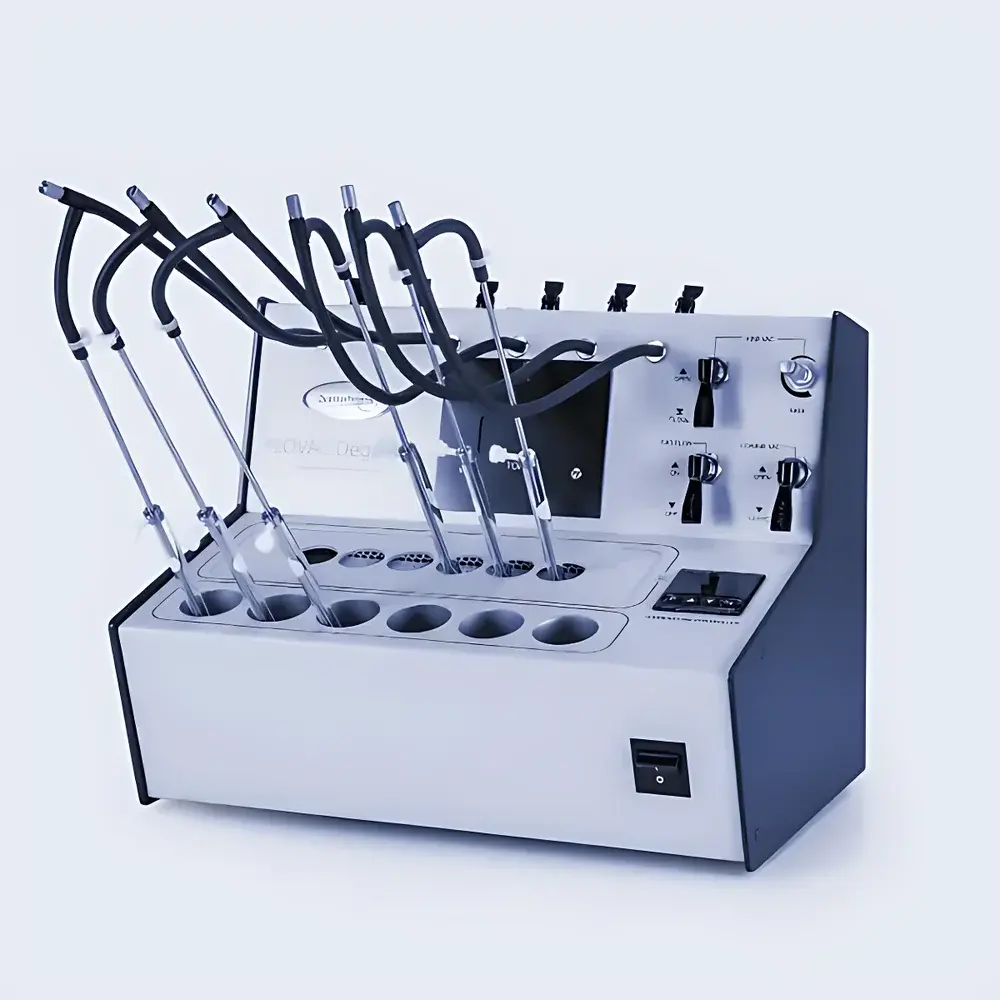
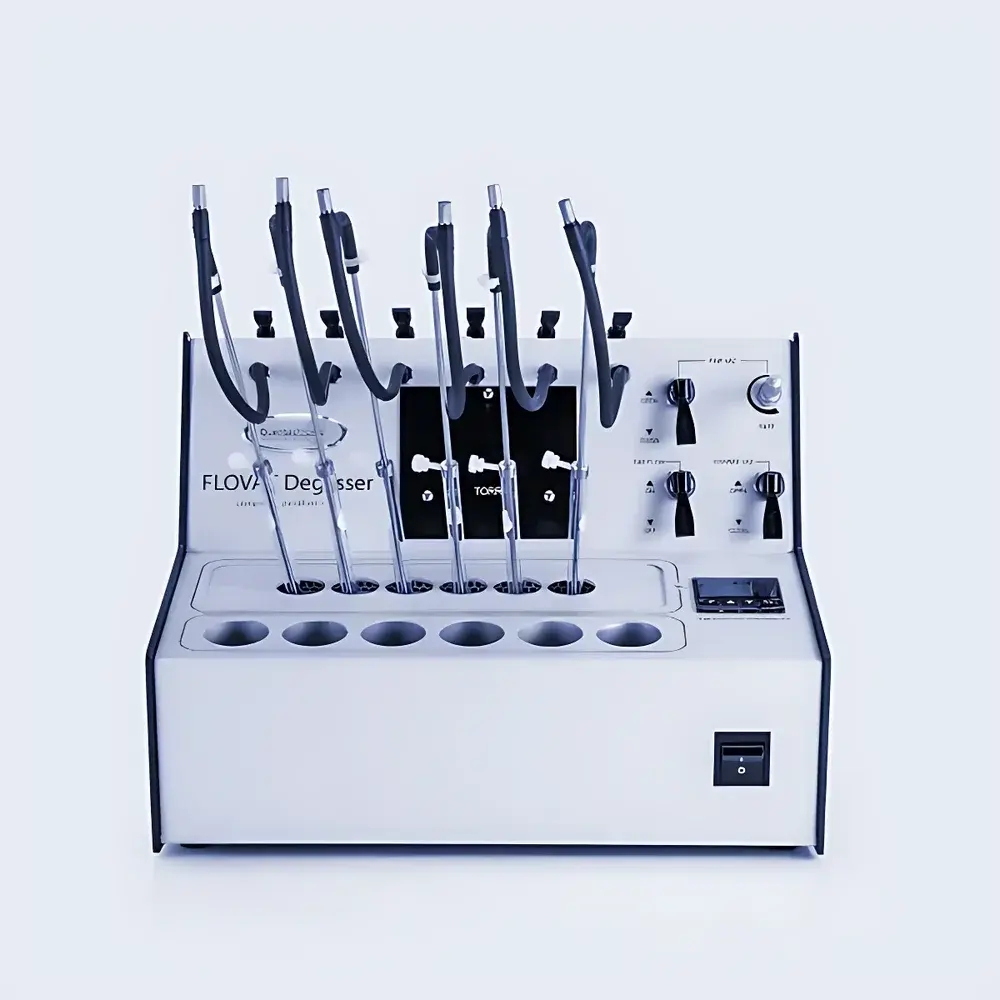
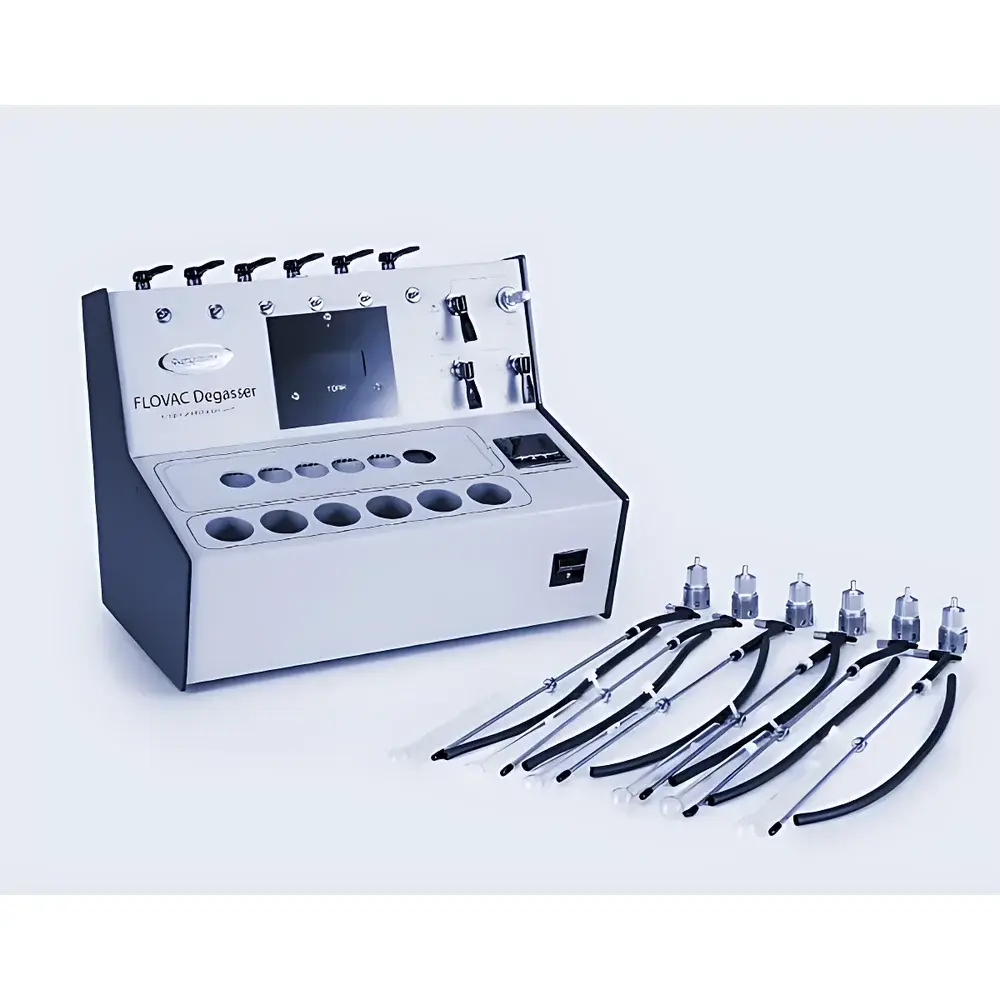
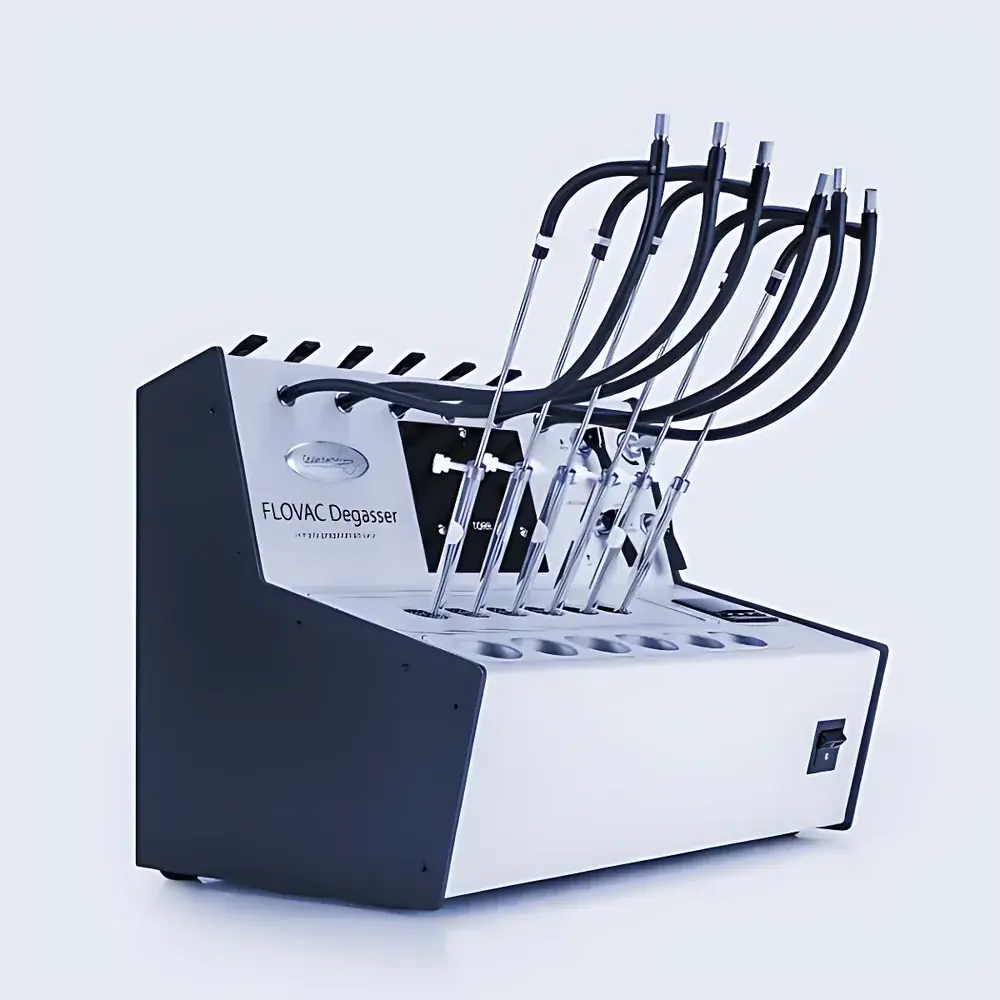
Anton Paar Quantachrome FloVac 6-Port Automated Degassing Station
| Brand | Anton Paar Quantachrome |
|---|---|
| Origin | USA |
| Manufacturer Type | Authorized Distributor |
| Origin Category | Imported |
| Model | FloVac |
| Pricing | Available Upon Request |
| Degassing Modes | Vacuum & Flow-through |
| Number of Ports | 6 |
| Temperature Zones | 2 (Ambient & Heated) |
| Cooling Chamber Capacity | 6 samples |
| Gas Options | User-selectable (N₂, He, etc.) |
| Flow Rate Control | Independent per port, up to 100 mL/min |
| Valve Type | Coarse + Fine adjustment |
| Sample Tube Diameters Supported | 6 mm, 9 mm, 12 mm |
| Temperature Control | Digital, ±1 °C setpoint accuracy |
| Temperature Sensor Accuracy | ±5 °C (thermocouple) |
| Dimensions (H×W×D, excl. rear fittings) | 28 cm × 36 cm × 25 cm |
| Weight | 5 kg |
| Power Input | 100–240 V AC, 50/60 Hz |
| CE Compliant | Yes |
Overview
The Anton Paar Quantachrome FloVac 6-Port Automated Degassing Station is a precision-engineered sample preparation instrument designed for high-throughput, reproducible degassing of solid and powdered samples prior to surface area, porosity, or adsorption analysis (e.g., BET, Langmuir, BJH). It integrates dual-mode degassing—vacuum and controlled flow-through—within a single compact platform, eliminating the need for separate vacuum manifolds or gas purge stations. The FloVac operates on the principle of thermal desorption under reduced pressure or inert gas sweep, enabling efficient removal of physisorbed moisture, solvents, and atmospheric contaminants from porous materials such as catalysts, MOFs, activated carbons, zeolites, and battery electrode powders. Its architecture supports GLP-compliant workflows in analytical laboratories performing ISO 9277, ASTM D3663, and USP –compliant surface characterization.
Key Features
- Dual-Mode Degassing: Seamless switching between vacuum degassing (down to <10 mbar typical base pressure) and inert gas flow-through mode—each port independently configurable for method flexibility.
- 6-Port Parallel Processing: Simultaneous conditioning of six samples using standardized glass or stainless-steel sample tubes (6 mm, 9 mm, or 12 mm OD), significantly reducing total analysis cycle time.
- Dedicated Cooling Chamber: Integrated ambient-temperature holding zone accommodates six pre-degassed samples, enabling staggered processing without thermal cross-contamination or operator intervention.
- Precision Gas Flow Control: Dual-stage (coarse + fine) mass-flow-regulated valves per port allow stable, low-turbulence gas delivery from 0.1 to 100 mL/min—critical for minimizing powder fluidization and maintaining sample integrity.
- Digital Temperature Management: Two independent thermal zones: one heated zone (up to 400 °C, depending on tube compatibility) with four-digit digital setpoint display and ±1 °C stability; one passive ambient cooling zone with no active heating.
- CE-Compliant Safety Architecture: Built-in overtemperature protection, electrical isolation, and fail-safe valve sequencing ensure compliance with IEC 61010-1 for laboratory equipment safety.
Sample Compatibility & Compliance
The FloVac accommodates standard U-shaped or straight sample tubes used in gas sorption analyzers—including those conforming to ASTM D3663 Annex A1 and ISO 9277 Annex B specifications. Its modular port design accepts quartz, borosilicate glass, and high-temp stainless-steel sample holders. All gas pathways are chemically inert (electropolished stainless steel and PTFE-sealed fittings), supporting use with N₂, Ar, He, and other non-corrosive purge gases. The system meets CE marking requirements for electromagnetic compatibility (EMC Directive 2014/30/EU) and low-voltage safety (LVD Directive 2014/35/EU). While not intrinsically rated for hazardous environments, its design aligns with general laboratory best practices for GMP/GLP traceability when paired with instrument logbook documentation.
Software & Data Management
The FloVac operates as a standalone hardware platform with local digital interface only—no embedded software or PC connectivity. All operational parameters (temperature setpoint, flow rate per port, degassing duration) are manually configured and recorded externally by the user. This architecture ensures deterministic behavior, eliminates firmware update dependencies, and simplifies audit readiness in regulated environments where electronic records must be generated via validated LIMS or ELN systems. Temperature readings are displayed in real time with 0.1 °C resolution; setpoint deviations and valve positions are visually indicated via LED status indicators adjacent to each port. For full 21 CFR Part 11 compliance, users integrate FloVac operation logs into their existing electronic record systems alongside associated gas sorption analyzer data.
Applications
- Pre-conditioning of catalysts and supported metal oxides prior to chemisorption (H₂, CO pulse titration)
- Removal of residual solvents from MOF and COF synthesis batches before permanent gas uptake measurement
- Moisture evacuation from lithium-ion battery cathode/anode powders in R&D and QC labs
- Standardized degassing of pharmaceutical excipients per USP guidelines for specific surface area determination
- Stabilization of carbon black and silica fume samples prior to mercury intrusion porosimetry
- Batch-wise preparation of geological core samples for low-pressure CO₂ adsorption isotherms
FAQ
Can the FloVac be used with corrosive gases such as NH₃ or HCl?
No. The internal gas pathways are compatible only with inert or non-reactive gases (e.g., N₂, Ar, He). Corrosive or condensable gases may damage seals and valves and void warranty coverage.
Is temperature calibration traceable to NIST standards?
The unit includes a calibrated thermocouple input; however, end-user calibration against a NIST-traceable reference thermometer is recommended annually per ISO/IEC 17025 requirements.
Does the FloVac support programmable ramp-and-hold temperature profiles?
No. It provides static temperature setpoints only. For multi-step thermal protocols, external programmable ovens or integrated gas sorption analyzers with built-in degas modules are recommended.
What maintenance is required for long-term reliability?
Routine inspection of O-rings, periodic cleaning of flow restrictors with isopropanol, and verification of vacuum integrity using a calibrated leak detector every 6 months are advised.
Can the cooling chamber be actively refrigerated?
No. The cooling chamber maintains ambient temperature passively. For sub-ambient stabilization, integration with an external chilled circulating bath or environmental chamber is necessary.



