
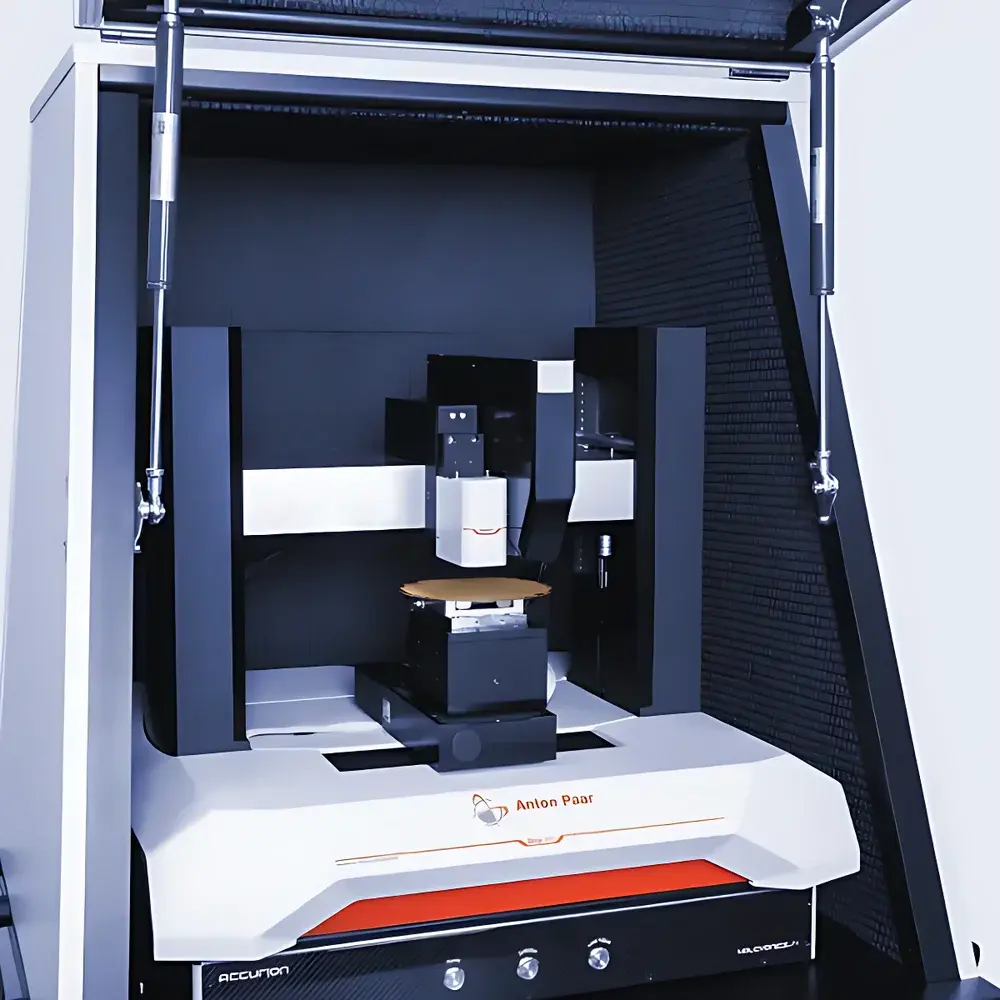
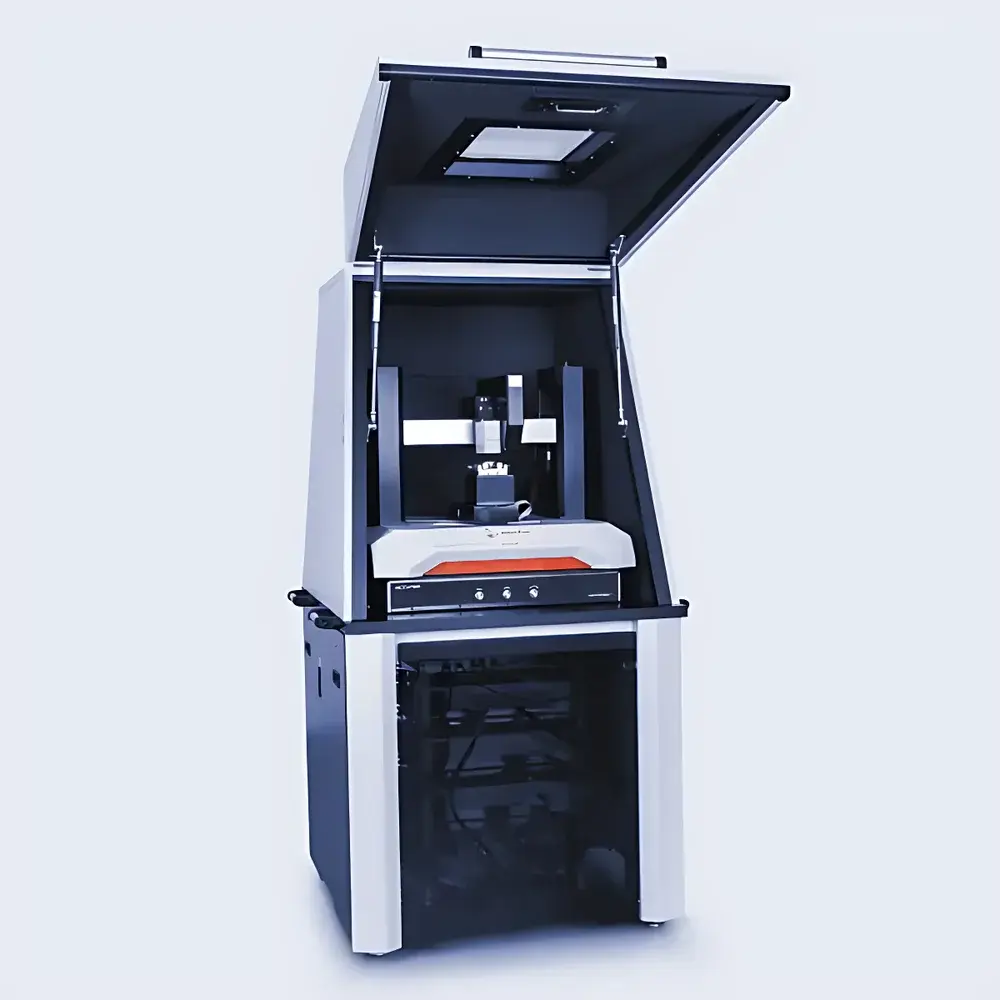
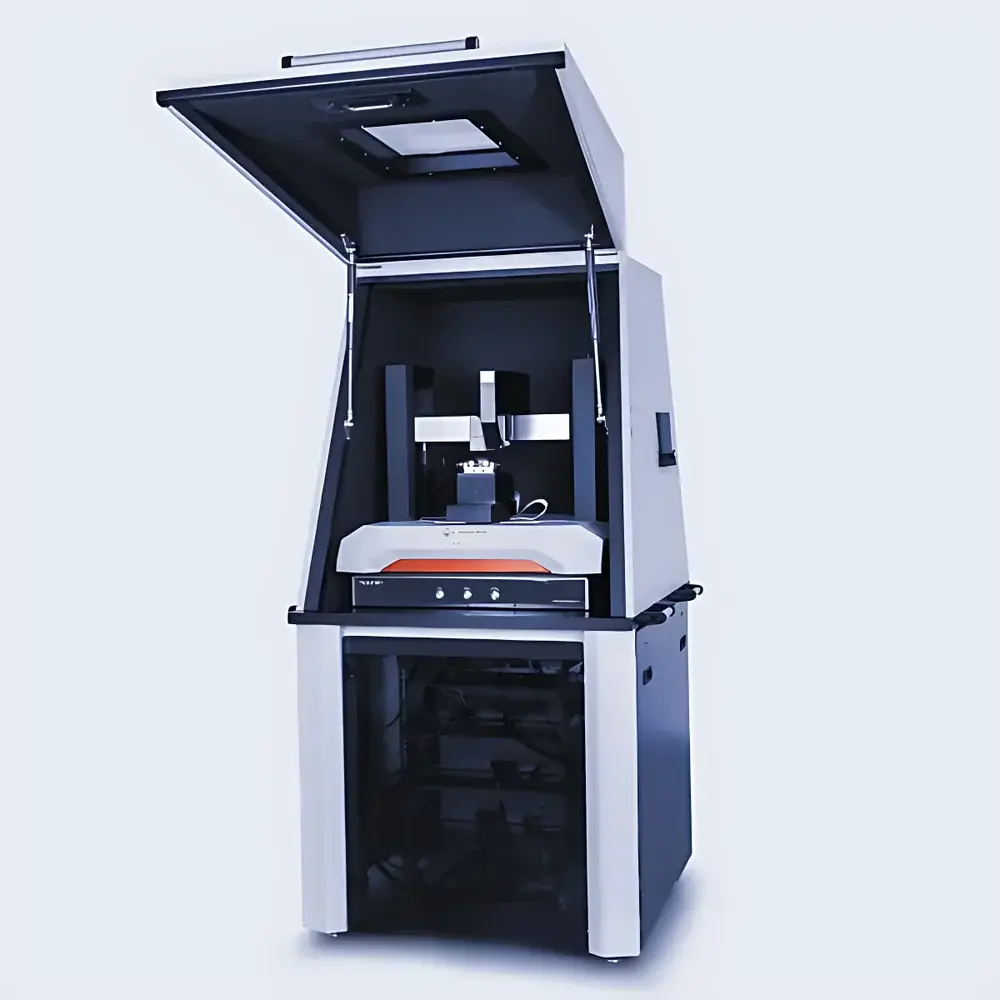
Anton Paar UNHT³ Ultra-Nanoindentation Tester
| Brand | Anton Paar |
|---|---|
| Origin | Switzerland |
| Manufacturer | Anton Paar GmbH |
| Type | Nanoindentation and Scratch Tester |
| Model | UNHT³ |
| Indentation Depth Range | 0–100 µm |
| Load Range | 10 µN – 100 mN |
| Load Resolution | 3 nN |
| Displacement Resolution | 0.003 nm |
| Thermal Drift | <3 nm/min |
| Frame Stiffness | >10⁸ N/m |
| Compliance with Standards | ISO 14577, ASTM E2546 |
Overview
The Anton Paar UNHT³ Ultra-Nanoindentation Tester is an instrumented indentation system engineered for metrological-grade mechanical property characterization at the nanoscale. It operates on the principle of controlled quasi-static and dynamic force-displacement actuation, where a calibrated diamond indenter (typically Berkovich, cube-corner, or spherical) is brought into contact with a sample surface under precisely regulated load conditions. The system captures high-fidelity load–displacement (P–h) curves with sub-nanometer displacement resolution and nanonewton-level force sensitivity—enabling quantitative extraction of hardness, reduced elastic modulus, creep compliance, viscoelastic moduli, and interfacial adhesion behavior. Its core innovation lies in the Active Surface Reference (ASR) technology, which decouples thermal expansion effects from true sample deformation by employing a physically separate reference surface mounted on an ultra-low-expansion Macor® platform. This architecture eliminates frame compliance artifacts and suppresses uncorrected thermal drift to <10 fm/s—making the UNHT³ uniquely suited for extended-duration measurements (e.g., multi-hour creep or relaxation tests) on soft polymers, hydrogels, thin films, biological tissues, and hard ceramics alike.
Key Features
- True force sensing via integrated piezoresistive micro-force sensor—no calibration drift, direct measurement down to 10 µN
- Active Surface Reference (ASR) system (EP 1828744 / US 7,685,868)—real-time compensation of thermal drift and mechanical frame deformation
- Ultra-stable mechanical architecture with frame stiffness >10⁸ N/m, ensuring minimal compliance error even at 100 mN maximum load
- Sub-angstrom displacement resolution (0.003 nm) and nanonewton load resolution (3 nN), validated per ISO 14577 Annex B metrological requirements
- Dual-range actuation: seamless transition from ultra-low-load probing (10 µN) to high-load indentation (100 mN) without hardware reconfiguration
- “Fast Grid” indentation mode: up to 600 indents/hour with automated positioning, fully compliant with ISO 14577 Part 1–3 for Instrumented Indentation Testing (IIT)
- “Template Mode”: user-defined data processing workflows exported as reusable templates for batch analysis and GLP-compliant reporting
- Multi-sample stage accommodating ≥6 specimens—enabling unattended overnight testing sequences with positional repeatability <50 nm
Sample Compatibility & Compliance
The UNHT³ supports heterogeneous sample classes—including amorphous polymers, cross-linked hydrogels, atomic-layer-deposited (ALD) coatings, metallic glasses, and ex vivo soft tissue sections—without requiring substrate correction algorithms. Environmental control options include vacuum chambers (<10⁻⁵ mbar), liquid cells (for in-situ hydration studies), and temperature stages (−30 °C to +200 °C) with humidity regulation (10–95% RH). All hardware and firmware comply with ISO/IEC 17025 traceability frameworks; software modules support 21 CFR Part 11 audit trails, electronic signatures, and ALCOA+ data integrity principles. Test protocols align with ISO 14577 (all parts), ASTM E2546, and EN 1071-3 for ceramic coatings—ensuring regulatory acceptance in medical device, aerospace, and semiconductor QA/QC environments.
Software & Data Management
Control and analysis are executed via the proprietary iNano software suite, designed for ISO 17025-conformant laboratories. It provides full traceability: every test includes embedded metadata (indenter geometry, environmental logs, calibration certificates, operator ID), raw P–h curve export (ASCII/CSV), and native support for third-party scripting (Python API). Advanced analysis modules include continuous multi-cycle (CMC) loading, constant strain-rate indentation, user-defined ramp-hold sequences, and dynamic mechanical analysis (DMA) with sine-wave excitation (0.1–100 Hz). Stiffness mapping, modulus gradient profiling, and time-dependent viscoelastic modeling (Maxwell, Prony series) are performed using built-in fitting engines validated against NIST SRM 2241 reference materials.
Applications
- Mechanical mapping of graded thin-film stacks in MEMS and photovoltaic devices
- Creep and stress-relaxation quantification in biomedical hydrogels and tissue-engineered scaffolds
- Interfacial adhesion assessment of DLC and TiN coatings on orthopedic implants
- Depth-sensing modulus profiling across oxide layers on Si wafers (gate dielectrics, passivation films)
- Hardness homogeneity evaluation in additively manufactured metal alloys (Inconel 718, Ti-6Al-4V)
- Viscoelastic parameter extraction for polymer electrolytes in solid-state battery R&D
FAQ
Does the UNHT³ require periodic recalibration of its force sensor?
No—the piezoresistive force sensor is factory-calibrated against NIST-traceable deadweight standards and exhibits negligible long-term drift. A yearly verification using certified reference samples (e.g., fused silica, sapphire) is recommended per ISO/IEC 17025.
Can the system perform scratch testing in addition to nanoindentation?
Yes—the UNHT³ platform supports optional scratch modules with lateral force measurement up to ±100 mN and real-time acoustic emission monitoring for critical load detection.
Is the ASR system compatible with liquid immersion testing?
Yes—ASR functionality remains fully operational in liquid cells; the reference surface is isolated from fluid thermal gradients via hermetic sealing and low-thermal-conductivity mounting.
What data formats are supported for export and LIMS integration?
Raw P–h curves, processed results (hardness/modulus maps), and metadata are exportable as CSV, XML, HDF5, and PDF reports. RESTful API enables direct integration with LabVantage, Thermo Fisher SampleManager, and custom LIMS platforms.



