
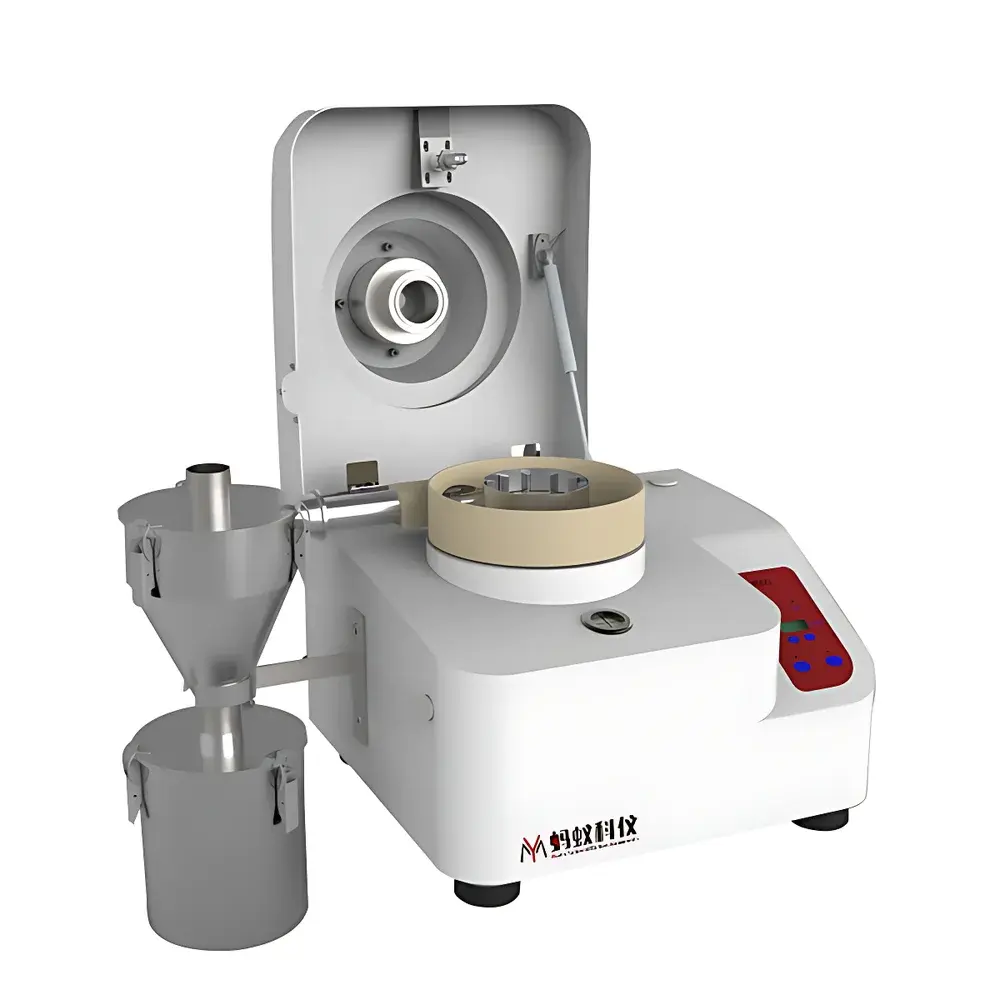
Ants Scientific Instruments AM500 High-Speed Rotational Grinder
| Brand | Ants Scientific Instruments |
|---|---|
| Origin | Beijing, China |
| Manufacturer Type | Authorized Distributor |
| Country of Origin | China |
| Model | AM500 |
| Instrument Type | Rotational Grinder |
| Sample Type | Soft, Medium-Hard, Brittle, Elastic, and Fibrous Materials |
| Feed Size | ≤10 mm |
| Final Particle Size | 40 µm (typical, adjustable via sieve ring) |
| Sieve Ring Aperture Range | Trapezoidal holes: 0.08–1.5 mm |
| Round holes | 2.0–6.0 mm |
| Grinding Chamber Capacity | Up to 4500 mL (with cyclone separator) |
| Standard Collection Pan Volume | 300 mL (1 L pan optional) |
| Rotational Speed | 6000–20000 rpm |
| Tip Speed | 31–103 m/s (100 mm rotor diameter) |
| Rotor Tooth Count | 6, 12, or 24 teeth |
| Rotor & Sieve Ring Material | Stainless steel or titanium |
| Collection Pan Material Options | Stainless steel, nylon, or PTFE |
| Compliance | Designed for GLP-compliant sample preparation workflows |
Overview
The Ants Scientific Instruments AM500 High-Speed Rotational Grinder is an engineered solution for rapid, reproducible, and contamination-controlled size reduction of diverse laboratory samples. Operating on the principle of centrifugal acceleration and dual-stage mechanical attrition—primary impact at the rotor periphery followed by secondary shearing and extrusion between rotating blades and a stationary sieve ring—the AM500 achieves consistent sub-40 µm particle output in seconds. Its design prioritizes thermal management: minimal residence time (<1 s) within the grinding chamber prevents heat accumulation, making it suitable for thermolabile biological tissues, polymers, and pharmaceutical excipients. When paired with cryogenic accessories (e.g., liquid nitrogen cooling jackets), the system supports low-temperature grinding protocols aligned with ASTM E2937-22 and USP guidelines for preserving molecular integrity during sample homogenization.
Key Features
- Variable-speed digital control (6000–20000 rpm) with real-time overload indication—enables precise optimization of energy input for each material class.
- Modular rotor-sieve assembly: Interchangeable rotors (6/12/24 teeth) and sieve rings (trapezoidal or round apertures from 0.08 mm to 6.0 mm) allow method development across soft, fibrous, elastic, and moderately hard matrices.
- Integrated dust-tight sealing architecture: Auto-engaging magnetic lock ensures positive chamber closure; anti-splash feed funnel minimizes cross-contamination and operator exposure.
- Tool-free disassembly: Plug-and-play rotor and sieve ring mounting enables rapid cleaning and changeover—critical for multi-sample workflows under ISO/IEC 17025-accredited labs.
- Full-sample recovery design: Removable collection pans (1 L volume, available in stainless steel, nylon, or PTFE) permit quantitative transfer without loss—essential for trace-level elemental or organic analysis.
- Expandable configuration: Optional automated feeder and cyclone separator support batch processing up to 4500 mL, meeting throughput requirements for environmental soil composites or agricultural feedstock screening.
Sample Compatibility & Compliance
The AM500 accommodates heterogeneous organic and inorganic materials including plant tissues, animal organs, polymer pellets, pharmaceutical tablets, soil aggregates, and composite resins. Its validated performance with soft-to-medium hardness samples (Mohs 1–4) aligns with ISO 17892-3 for geotechnical specimen preparation and ASTM D2234/D2234M for coal and coke sampling. All wetted components comply with FDA 21 CFR §177.1550 (food-contact plastics) and EU Regulation (EC) No 1935/2004. The instrument’s mechanical design supports GMP-aligned documentation: parameter logs (speed, duration, rotor ID) can be exported via RS-232 or USB for audit trails compliant with 21 CFR Part 11 when integrated with validated LIMS environments.
Software & Data Management
While the AM500 operates via intuitive front-panel controls (LED-displayed rpm, runtime, and overload status), its digital interface supports external data capture through TTL-triggered pulse outputs and analog voltage signals (0–10 V). Optional firmware upgrade enables timestamped operation logging—including rotor serial number, sieve ring aperture code, and total grinding cycles—for preventive maintenance scheduling and ISO 9001 process traceability. No proprietary software is required; raw output files are CSV-compatible for integration into ELN platforms such as LabArchives or Benchling.
Applications
- Agricultural science: Homogenization of grain, forage, and root tissues prior to NIR spectroscopy or mycotoxin extraction.
- Pharmaceutical R&D: Pre-analysis milling of coated tablets and lyophilized biologics to ensure representative subsampling per USP .
- Environmental testing: Preparation of sediment, sludge, and filter media for heavy metal digestion (EPA Method 3050B) or microplastic isolation (ISO 24007).
- Food safety: Rapid comminution of meat, dairy, and spice matrices for pathogen enrichment or allergen ELISA testing.
- Materials science: Size reduction of polymer blends and recycled composites prior to rheological or DSC characterization.
FAQ
What safety certifications does the AM500 hold?
The unit conforms to IEC 61000-6-2 (EMC immunity) and IEC 61000-6-4 (EMC emissions); mechanical safety complies with EN 61000-1-2 (low-voltage directive) and includes redundant interlock circuitry that halts rotation upon chamber opening.
Can the AM500 be used for cryogenic grinding?
Yes—when equipped with optional LN₂-compatible feed funnels and PTFE-lined collection pans, the AM500 supports continuous liquid nitrogen-assisted grinding per ASTM F2676-21 for biomolecular preservation.
Is method transfer possible between different rotor/sieve configurations?
Method equivalence validation is supported via built-in repeatability mode (three consecutive runs at identical parameters); users may generate SOPs referencing rotor tooth count, sieve geometry, and tip speed (m/s) rather than rpm alone.
How is calibration verified?
Speed accuracy is factory-verified using NIST-traceable tachometry; annual verification can be performed using external optical tachometers—no internal recalibration is required.
Does the system meet cleanroom compatibility requirements?
With stainless steel and PTFE wetted parts, and zero-oil vacuum-sealed bearings, the AM500 meets ISO Class 5 (Class 100) particulate emission limits when operated inside laminar flow hoods or isolators.



