
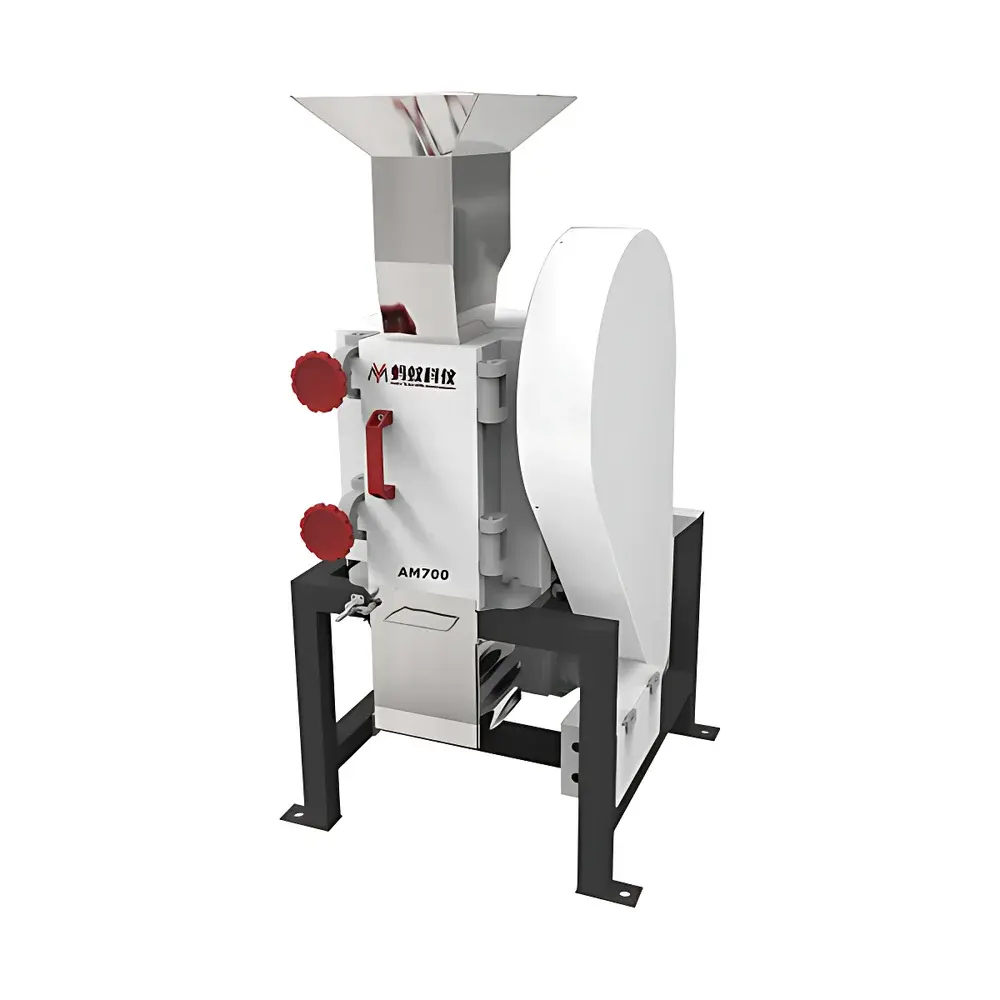
Ants Scientific Instruments AM700 Jaw Crusher
| Brand | Ants Scientific Instruments |
|---|---|
| Origin | Beijing, China |
| Manufacturer Type | Authorized Distributor |
| Country of Origin | China |
| Model | AM700 |
| Instrument Type | Jaw Crusher |
| Sample Applicability | Hard & Brittle Materials |
| Feed Size | ≤120 × 90 mm |
| Discharge Size (D90) | <2 mm |
| Final Output Particle Size | 0.01–0.5 mm |
| Batch Throughput | 300 kg/h |
| Jaw Width | 146 mm |
| Eccentric Shaft Speed | 253 rpm (customizable) |
| Adjustable Gap Range | 0–40 mm |
| Gap Indication | Calibrated Scale |
| Zero-Point Calibration | Yes |
| Dust Extraction Port | Yes |
| Safety Interlock | Yes |
| Hopper Design | Splash-Resistant |
| Chamber Access | Front-Opening Door |
| Collection Bin Options | 10 L or 30 L |
| Timing Modes | Continuous or Programmable (1 s – 7 h 59 min 59 s) |
| Jaw Material Options | Manganese Steel, Stainless Steel, Tungsten Carbide, Heavy-Metal-Free Alloy |
Overview
The Ants Scientific Instruments AM700 Jaw Crusher is an industrial-grade primary crushing system engineered for high-throughput size reduction of hard, brittle, and medium-hard bulk materials in laboratory and pilot-scale environments. Operating on the principle of compressive crushing—where material is fed between two opposing jaws, one fixed and the other oscillating via an eccentric shaft—the AM700 delivers consistent, reproducible particle size reduction through controlled mechanical stress. Its robust cast-iron frame, precision-machined jaw assembly, and dynamically balanced drive mechanism ensure stable operation under continuous load. Designed to meet the preparatory grinding requirements of analytical workflows—including XRF sample preparation, geochemical assay, cement clinker homogenization, and mineralogical characterization—the AM700 bridges the gap between benchtop crushers and industrial jaw units without compromising on safety, traceability, or regulatory readiness.
Key Features
- High-capacity throughput of up to 300 kg/h, enabling efficient batch or semi-continuous processing of large-volume samples
- Maximum feed opening of 120 × 90 mm—among the largest in its class—accommodating oversized geological cores, construction aggregates, and ceramic blocks without pre-cutting
- Precision-adjustable jaw gap (0–40 mm), calibrated via engraved stainless-steel scale with zero-point compensation to offset jaw wear over time
- Splash-resistant hopper with integrated dust extraction port compliant with ISO 13849-1 Category 3 safety architecture and compatible with standard lab vacuum systems (e.g., HEPA-filtered central vacuum networks)
- Front-access grinding chamber with interlocked door mechanism—meets EN 60204-1 emergency stop and access control requirements
- Modular jaw inserts available in four certified material grades: ASTM A128 Grade C manganese steel (for abrasion resistance), AISI 304 stainless steel (for corrosion-sensitive matrices), tungsten carbide-tipped (for ultra-hard silicates), and heavy-metal-free alloy (USP / compliant for pharmaceutical excipient testing)
- Programmable timing controller with dual-mode operation: continuous duty or precise interval-based crushing (1 second to 7 hours, 59 minutes, 59 seconds), supporting GLP-compliant protocol documentation
Sample Compatibility & Compliance
The AM700 is validated for use with geologically representative matrices (e.g., granite, basalt, limestone), industrial minerals (quartz, feldspar, kaolin), construction materials (concrete, asphalt, refractory bricks), energy feedstocks (bituminous coal, lignite, biomass pellets), and ceramic precursors (alumina, zirconia, borosilicate glass). It complies with ISO 17025:2017 clause 6.4.2 regarding equipment suitability for intended use and supports audit-ready documentation for GMP-regulated laboratories (FDA 21 CFR Part 211, Annex 15). All jaw materials are certified per ISO 10474 and supplied with CoA referencing elemental composition and hardness (HBW/HRC). The unit is CE-marked per Machinery Directive 2006/42/EC and carries IP54-rated electrical enclosure protection.
Software & Data Management
While the AM700 operates as a standalone electromechanical system, its programmable timer module logs operational metadata—including start/stop timestamps, total runtime, and cycle count—to internal non-volatile memory. Optional RS-485 Modbus RTU interface enables integration into centralized LIMS or MES platforms for automated data capture. All calibration events—including zero-point adjustments and gap recalibrations—are recorded with operator ID, date/time stamp, and reason code, satisfying FDA 21 CFR Part 11 electronic record and signature requirements when paired with validated software middleware.
Applications
- Preparation of homogenized subsamples for X-ray fluorescence (XRF) and inductively coupled plasma (ICP-OES/MS) analysis in geochemistry and environmental testing labs
- Routine size reduction of cement clinker and raw meal prior to Blaine fineness testing (ASTM C204) and strength development studies
- Fragmentation of ceramic green bodies and sintered components for microstructural analysis (SEM-EDS, XRD)
- Primary comminution of coal samples for proximate and ultimate analysis (ASTM D3172–D3176)
- Crushing of recycled construction and demolition waste (C&D) for leaching test feedstock (TCLP, SPLP, EN 12457)
- Feedstock conditioning for subsequent milling stages (e.g., planetary ball mill, vibratory disc mill) in materials science R&D
FAQ
What safety certifications does the AM700 hold?
The unit conforms to EU Machinery Directive 2006/42/EC, carries CE marking, and meets EN 60204-1 for electrical safety and EN ISO 13857 for safe guarding distances. Optional ATEX Zone 22 certification is available upon request for combustible dust environments.
Can the AM700 be integrated into an automated sample prep line?
Yes—via optional Modbus RTU (RS-485), it supports handshake protocols with upstream feeders and downstream conveyors, enabling unattended multi-stage comminution sequences under SCADA supervision.
How is jaw wear compensated during long-term operation?
The zero-point calibration function allows users to re-reference the closed-gap position after wear, preserving dimensional accuracy across thousands of crushing cycles without requiring replacement parts.
Is validation documentation available for regulated industries?
Yes—Factory Acceptance Test (FAT) reports, IQ/OQ templates aligned with ASTM E2500, and material traceability dossiers are provided with each shipment.



