
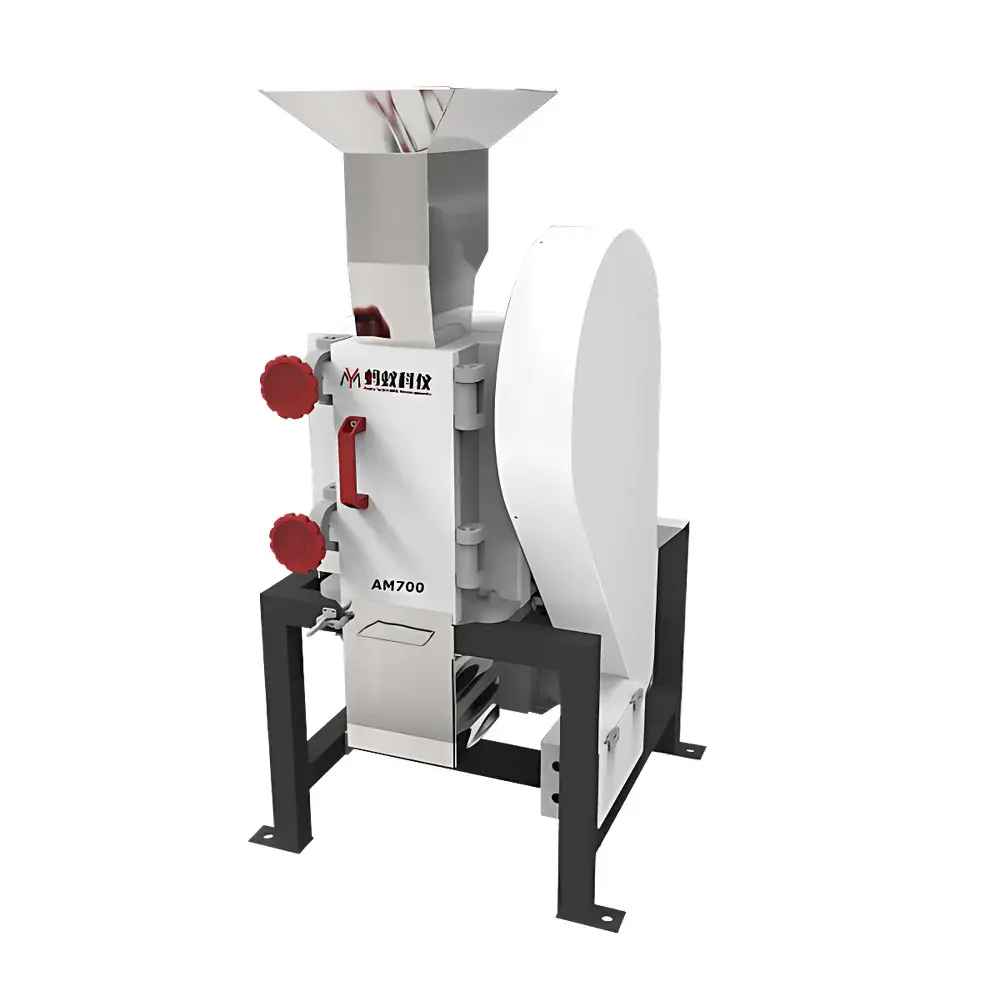
Ants Scientific Instruments AM700 Jaw Crusher for Soil and Hard Materials
| Brand | Ants Scientific Instruments |
|---|---|
| Origin | Beijing, China |
| Manufacturer Type | Authorized Distributor |
| Country of Origin | China |
| Model | AM700 |
| Instrument Type | Jaw Crusher |
| Sample Applicability | Medium-hard to hard, brittle materials |
| Maximum Feed Size | 120 × 90 mm |
| Output Particle Size (D90) | < 2 mm |
| Minimum Output Particle Size | ≥ 0.5 mm |
| Batch Processing Capacity | 10 L – 30 L |
Overview
The Ants Scientific Instruments AM700 Jaw Crusher is an engineered laboratory-scale primary crushing device designed for rapid size reduction of bulk solid samples prior to downstream analysis. It operates on the principle of compressive mechanical force generated by two opposing jaw plates—one stationary and one dynamically driven via an eccentric shaft—producing elliptical motion that subjects feed material to repeated compression, shearing, and attrition. This mechanism enables efficient pre-crushing of geotechnical, environmental, and mineralogical specimens—including soil aggregates, rock fragments, concrete cores, and ceramic shards—without thermal degradation or phase alteration. The AM700 is not intended for final micronization but serves as a robust first-stage comminution tool compliant with ASTM D2234 (Standard Practice for Collection of a Gross Sample of Coal), ISO 14688-1 (Geotechnical Investigation and Testing — Identification and Classification of Soil), and USP (Particle Size Analysis) preparatory workflows.
Key Features
- Adjustable discharge gap with digital readout and zero-point calibration—ensuring consistent output gradation and inter-laboratory reproducibility across sequential batches.
- Front-access hinged grinding chamber door—enabling full visual inspection, tool-free internal cleaning, and rapid maintenance without disassembly.
- Anti-splash feed hopper with integrated vacuum port (standard 50 mm diameter)—compatible with laboratory-grade dust extraction systems to meet OSHA 29 CFR 1910.94 and EU Directive 2004/37/EC (carcinogens and mutagens) exposure control requirements.
- Heavy-duty cast-iron frame and manganese steel jaw plates—optimized for abrasion resistance when processing silica-rich soils, gravel, and sintered oxides.
- Variable-speed drive system (mechanically regulated)—supporting controlled throughput modulation to prevent overloading and minimize fines generation in moisture-sensitive or cohesive samples.
Sample Compatibility & Compliance
The AM700 accepts feed particles up to 120 mm × 90 mm in maximum dimension and delivers a D90 particle size distribution below 2 mm, with minimum achievable fragment size ≥ 0.5 mm. It is validated for use with non-hygroscopic, non-fibrous, and non-explosive materials classified as medium-hard (Mohs 4–6) to hard (Mohs 7–8), including clay-rich subsoils, lateritic nodules, slag, limestone, and fired clay bricks. The unit complies with IEC 61000-6-2 (immunity) and IEC 61000-6-4 (emissions) for electromagnetic compatibility. All electrical components meet IP54 ingress protection rating. Documentation includes CE Declaration of Conformity, RoHS 2011/65/EU compliance certificate, and factory calibration report traceable to NIM (National Institute of Metrology, China).
Software & Data Management
The AM700 operates as a stand-alone mechanical instrument with no embedded firmware or digital connectivity. Its digital gap display and calibrated scale provide direct operator feedback during setup; all operational parameters are manually recorded per GLP-compliant sample logbooks. For laboratories implementing electronic lab notebooks (ELN) or LIMS integration, the device supports manual entry of batch ID, feed mass, gap setting, run duration, and observed output consistency. While it lacks native 21 CFR Part 11 audit trail functionality, its mechanical design ensures full traceability through physical calibration logs and routine preventive maintenance records aligned with ISO/IEC 17025:2017 Clause 6.4.2 (Equipment Management).
Applications
- Preparation of soil samples for XRF, ICP-OES, and leaching tests (e.g., TCLP, SPLP) requiring homogenized sub-2 mm fractions.
- Reduction of construction waste aggregates prior to sieve analysis (ASTM C136) or specific gravity determination (ASTM C127).
- Primary crushing of geological core segments prior to quartering and pulverization in planetary ball mills.
- Size conditioning of recycled battery cathode materials (LiCoO₂, NMC) before acid digestion and elemental recovery assays.
- Routine fragmentation of ceramic insulators and refractory bricks for porosity and thermal conductivity benchmarking.
FAQ
What is the recommended maintenance interval for jaw plate replacement?
Jaw plates should be inspected after every 200 operating hours or following processing of 5 tons of abrasive material—whichever occurs first. Replacement is indicated by >15% loss of original tooth profile depth or visible micro-cracking.
Can the AM700 process wet or frozen soil samples?
No. The unit is rated for dry, free-flowing solids only. Moisture content exceeding 8% w/w may cause clogging at the discharge aperture and accelerate wear due to paste formation.
Is third-party calibration certification available?
Yes. Ants Scientific Instruments offers optional NIST-traceable calibration services performed by ISO/IEC 17025-accredited metrology partners upon request, including gap verification, speed tolerance assessment, and load-cycle repeatability testing.
Does the crusher include safety interlocks?
Yes. A dual-channel mechanical safety switch disables motor operation when the front access door is unlatched, conforming to EN ISO 13857 (safety distances) and EN 60204-1 (electrical equipment of machines).
Related Products



