
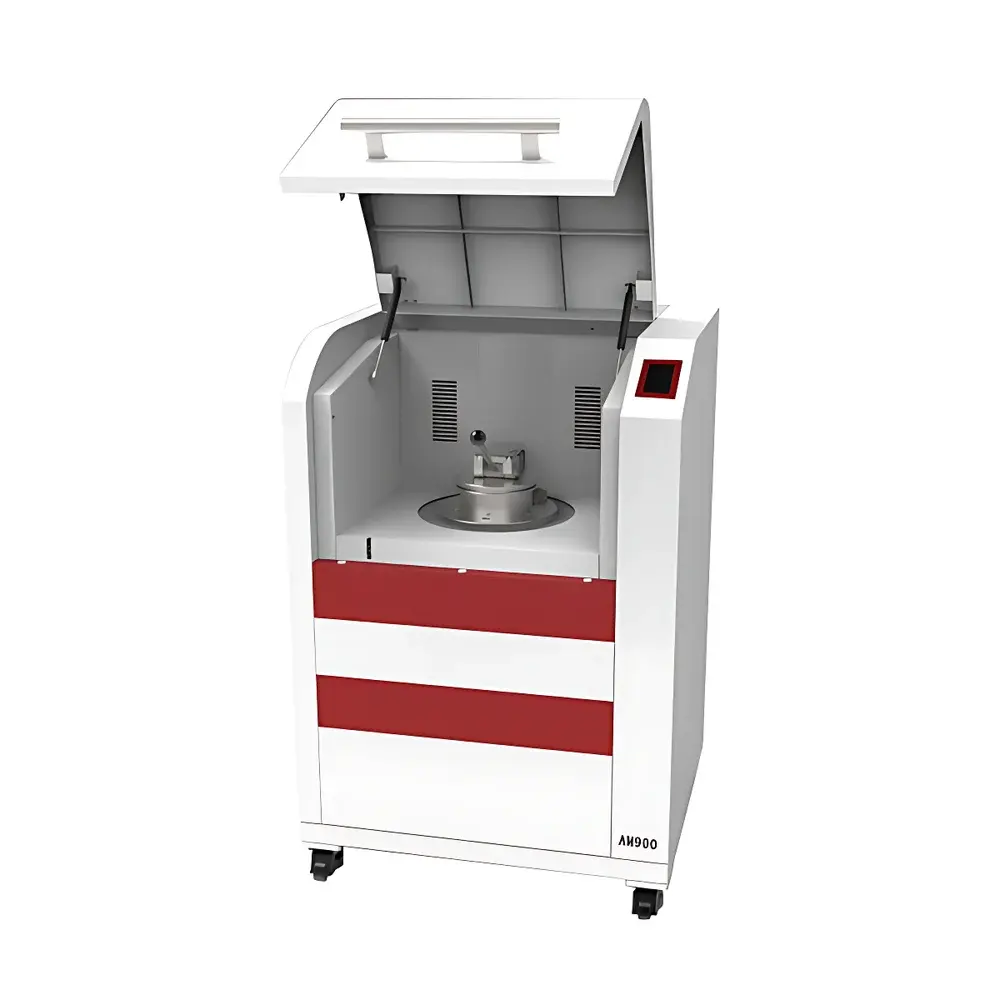
Ants Scientific Instruments AM900 Disc Vibratory Grinder
| Brand | Ants Scientific Instruments |
|---|---|
| Origin | Beijing, China |
| Model | AM900 |
| Instrument Type | Vibratory Disc Grinder |
| Sample Type | Hard, Brittle, or Fibrous Materials |
| Feed Size | ≤15 mm |
| Output Particle Size (D90) | <20 µm |
| Batch Volume | 15–250 mL |
| Grinding Speed | 700–1500 rpm (continuously adjustable) |
| Grinding Time Range | 1 s – 99 h 59 min 59 s |
| Jar Capacities | 50 mL, 100 mL, 250 mL |
| Jar Materials | Hardened Steel, Tungsten Carbide, Agate, Zirconia, Heavy-Metal-Free Stainless Steel |
| Grinding Modes | Dry & Wet |
| Programmable Methods | 10 stored protocols |
| Display | LCD Touchscreen |
| Drive Mechanism | Horizontal Orbital Vibration |
| Noise Reduction | Acoustically Sealed Chamber |
| Quick-Clamp System | Yes |
| Auto-Jar Recognition | Yes (for WC & Agate jars, with speed limits enforced) |
Overview
The Ants Scientific Instruments AM900 Disc Vibratory Grinder is an engineered solution for high-efficiency, reproducible fine comminution of hard, brittle, and fibrous materials. It operates on the principle of horizontal orbital vibration—where a motor-driven disc imparts controlled, high-frequency circular motion to the grinding chamber. This motion induces intense compressive, impact, and shear forces between grinding media and sample particles, enabling rapid size reduction without thermal degradation or cross-contamination. Designed specifically for analytical sample preparation workflows—including X-ray fluorescence (XRF), inductively coupled plasma (ICP), and wavelength-dispersive spectroscopy (WDS)—the AM900 delivers D90 particle sizes consistently below 20 µm within seconds to minutes, meeting stringent requirements for homogeneity and representativeness in trace elemental analysis.
Key Features
- Horizontal orbital vibration drive ensures stable, low-noise operation even at maximum speed (1500 rpm), minimizing mechanical resonance and operator fatigue.
- Intelligent jar recognition system automatically detects tungsten carbide (speed-limited to 1200 rpm) and agate (700 rpm) jars, enforcing material-specific safety thresholds to prevent jar fracture or premature wear.
- Ergonomic carry handle and tool-free quick-clamp mechanism enable rapid, repeatable installation and removal of grinding jars—critical for high-throughput labs processing multiple sample types per shift.
- Sealed acoustic chamber reduces operational noise to <65 dB(A), complying with ISO 7779 and OSHA workplace exposure guidelines for continuous use in shared laboratory environments.
- 10 programmable method slots store time, speed, and pause parameters—supporting GLP-compliant audit trails when paired with optional timestamped log export via USB.
- Multi-material jar compatibility (hardened steel, zirconia, agate, tungsten carbide, heavy-metal-free stainless steel) ensures suitability across regulated applications—from RoHS-compliant electronics testing to USP / elemental impurity screening.
- Continuous speed adjustment (700–1500 rpm) and precise time resolution (1-second increments up to 99 h 59 min 59 s) allow method optimization for diverse matrices including coal, slag, ceramics, soil, plant tissue, and pharmaceutical excipients.
Sample Compatibility & Compliance
The AM900 accommodates feed particles up to 15 mm in diameter and processes batch volumes from 15 mL to 250 mL—making it suitable for both micro-scale R&D and routine QC batches. Its ability to achieve D90 <20 µm under dry or wet conditions aligns with ASTM C1107 (grout fineness), ISO 13320 (laser diffraction validation), and EPA Method 6010D (ICP-OES sample prep). The heavy-metal-free stainless-steel jar option satisfies FDA 21 CFR Part 11 requirements for electronic records integrity in pharmaceutical manufacturing environments. All grinding protocols are compatible with Good Laboratory Practice (GLP) documentation standards, and the sealed chamber design prevents airborne particulate release—meeting OSHA 1910.94 and EU Directive 2004/37/EC (carcinogens and mutagens) containment expectations.
Software & Data Management
The AM900 features an integrated LCD touchscreen interface with intuitive icon-based navigation and real-time status feedback (elapsed time, remaining time, current rpm, jar type detected). While the base unit does not include network connectivity, all 10 user-defined methods can be exported and archived via USB flash drive in CSV format—including timestamps, parameter sets, and operator ID fields (when manually entered). Optional firmware upgrades support future integration with LIMS platforms through RS-232 serial output (ASCII protocol), enabling automated method dispatch and result logging. Audit trail functionality complies with Annex 11 (EU GMP) and 21 CFR Part 11 Subpart B for electronic signatures and record retention.
Applications
- Ceramics & Glass: Homogenization of sintered oxides, frits, and optical glass prior to XRF calibration curve development.
- Construction Materials: Preparation of cement clinker, fly ash, and concrete aggregates for alkali-silica reactivity (ASR) testing per ASTM C1260.
- Environmental Analysis: Pulverization of soil cores, sediment composites, and plant biomass for total metal digestion (EPA 3050B, 3051A).
- Minerals & Metallurgy: Rapid milling of coal, coke, quartzite, and blast furnace slag to sub-20 µm fractions for quantitative phase analysis (XRD) and geochemical mapping.
- Electronics Recycling: Size reduction of PCB fragments and solder alloys under inert atmosphere (with optional glovebox integration) for Pb, Cd, Hg, Cr(VI), and Br quantification per IEC 62321-5.
FAQ
What grinding mechanisms does the AM900 employ?
It utilizes horizontal orbital vibration—not eccentric rotation or planetary motion—to generate compressive, impact, and frictional forces between grinding media and sample.
Can the AM900 perform cryogenic grinding?
No—it is not designed for liquid nitrogen cooling; however, its low-heat-generation drive architecture minimizes thermal load during extended dry grinding cycles.
Is wet grinding supported, and what solvents are compatible?
Yes; ethanol, isopropanol, acetone, and aqueous buffers are routinely used. Jar material selection must account for chemical resistance—e.g., zirconia for acidic media, agate for HF-containing slurries.
How is method reproducibility ensured across operators?
Via the quick-clamp system’s repeatable positioning, auto-jar recognition, and stored protocol execution—eliminating manual speed/time entry errors.
Does the AM900 meet ISO/IEC 17025 calibration requirements?
While the instrument itself is not a measuring device requiring formal calibration, its speed and timer subsystems are factory-verified against NIST-traceable standards, and performance qualification (PQ) protocols are provided for lab-specific validation.



